
“And power was given (the beast) over all kindred’s, and tongues, and nations. And all that dwell upon the earth shall worship him, whose names are not written in the book of life of the Life” (Rev. 13:7-8).
Church and State after Constantine
The three sons of Constantine, Constantine II, Constantius and Constants, divided up the empire on his death in 337, though the matter was not finally settled until all rivals were eliminated several months later. Constantius received the Fast, and the two brothers in the West soon fought with each other. The empire was finally united under Constantius, and since he was pro-Arian, there was a period of further dispute about the trinitarian question.
The sons outdid their father in attacking paganism. A law was put into effect in 341 which suppressed pagan cults. Another decree in 356 closed the temples and prohibited sacrifice to pagan gods on pain of death. In 357, Constantius removed from the Senate house in Rome the altar of victory on which incense had been offered by senators from antiquity.
In the beginning, the leaders of the church welcomed the advances of Constantine toward the church, but during the rule of his sons the bishops grew jealous of the power the emperors held over them. They began trying to reassert their own authority in religious matters, and their efforts led eventually to a compromise. In the end, the bishop of Rome and the patriarch of Constantinople would be able to claim more power than the emperors.
A “Christian” society
There were great changes in both Christianity and the Roman Empire during the rule of Constantine and his successors. Christianity, a persecuted minority faith before the reign of Constantine, had become the religion of the empire by the end of the fourth century. The bishop of Rome in the fifth century claimed universal authority, and his claims were accepted in the West. By the time of Pope Gregory I (590-604), the collapse of the Western Empire left the Roman bishop the real ruler in Italy.
The Catholic society that replaced pagan Rome was the creation of Constantine. It called itself Christian, but it had little to do with true Christian principles. Constantine merged his old religion, the worship of the unconquerable Sun, with his new faith; he continued to identify the sun with the Christian God — and with Christ. Christian writers and artists contemporary with Constantine often used the sun imagery in portraying Christ. There are mosaics from the period picturing Christ as the sun-god. In 321, when the emperor made the first day of the week a holiday, he called it ‘the venerable day of the Sun’ — or Sunday (Eerdmans’ Handbook to the History of Christianity, p. 131).
The worship of relies and images
From this time, the church took over many pagan ideas and practices. From sun-worship came the celebration of Christ’s birth on the 25th of December, the birthday of the sun. Saturnalia, the Roman winter festival, became the celebration of the Christmas season. Before this time, candles and incense, as well as images, had been avoided by the church because they symbolized paganism. Now they were incorporated into the Christian service. Some of the later Eastern emperors did forbid the veneration of images, and there was a long period of controversy. Those who opposed the use of images in Christian worship were called iconoclasts — the term was used in a derogatory sense — and their views were finally dismissed. The veneration of the images of saints –clearly a substitution for the worship of the old pagan gods — prevailed in Christendom, both east and west.
In ancient Rome, the image of the emperor was revered. Even after the emperors became nominally Christian, the imperial icon continued to be seen in prominent places. Constantine and his successors erected huge statues of themselves, and in time the “Christian” emperors also set up statues honoring their religious heroes. Justinian erected an imposing statue of Christ over the main gate of the imperial palace at Constantinople. By the end of the sixth century, icons of Jesus and Mary were often replacing the imperial images.
The new idolatry
The veneration of the Virgin Mary was also borrowed from the old pagan cults. In Ephesus, the worship of Mary replaced the cult of Artemis or Diana. In Rome, the cult of Mary was substituted for the worship of Isis. That Egyptian goddess had become popular in Rome as the “universal mother.” The images of Isis holding her son Horns are remarkably similar to some of the early depictions of the Madonna and child.
The cult of saints and martyrs grew rapidly in the fourth century as the old pagan forms of worship were blended with what now passed for Christianity. The veneration of relics became the new superstition and it brought nominal Christians to Palestine in droves. Helena, the mother of Constantine, was a leader of this cult, and her search for the “true cross” is well known.
“The Christian historian Theodoret boasts that in many places saints and martyrs took the place of pagan gods, and their shrines the place of pagan temples” (Eerdmans’ Handbook to the History of Christianity, p. 132).
With the belief that martyrs were now in heaven, it was natural that they would come to be looked upon as intermediaries. The teaching that there is one High Priest disappeared along with so many other gospel truths.
The traffic in relics was so abused that some of the church leaders themselves expressed concern. Many of the saints and martyrs were mythical, leading to a council declaration in 401 that a saint or martyr must be proved genuine before a chapel could be consecrated to him. This all led eventually to the canonization process whereby Rome would make the final decision as to whether a “saint” might be venerated.
Vigilantius, a priest from Aquitaine, wrote, “We almost see the rites of the pagans introduced into the churches under the pretext of religion; ranks of candles are lit in full daylight; and everywhere people kiss and adore some bit of dust in a little pot, wrapped in a precious fabric” (Ibid, p. 133).
Division of the Empire
Constantine had moved his capital to Constantinople in the East, and from that time on the empire tended to separate into the two regions. By the end of the fourth century, the division was permanent, the East and the West each having its own emperor. Germanic tribes had threatened the empire since the third century, and they began to affect its stability by the fifth. Alaric, king of the Visagoths, began to exploit the divided state of the empire, and he invaded Italy in 401. In 410, he stormed the walls of Rome. He withdrew after a few days, after pillaging the city, but the event was significant as a forecast of things to come. For the first time in 800 years, Rome had been taken by a foreign enemy. Pagans saw the event as a judgment on the empire for adopting Christianity. Apostolic Christians viewed it as the fulfillment of prophecy. Since the first century, believers had been looking for the fall of Rome as a harbinger of the second coming of Christ.
A divided Christendom
At the beginning , Christianity shared a common language as well as a common hope. The prevalence of the Greek language in the Mediterranean world helped greatly in the preaching of the gospel to all the peoples of the region. After the third century, the use of Latin prevailed in the west, while Greek continued to be prevalent in the east. Christendom would naturally tend to divide along those lines — not only was their speech different, but separate cultures and traditions developed. Also, the Eastern Empire lasted another 1000 years after the fall of the West to the Germanic invaders.
Eastern and western Christianity had been drifting apart for centuries, but the formal break came in 1054. The two branches of the church had developed differences in liturgy and, to some small extent, in doctrine. Furthermore, the eastern church, with its patriarchs in Constantinople, had never been willing to acknowledge the Roman pope as the head of the church. The Eastern Archbishop or Patriarch considered himself the equal of the Roman bishop; the Eastern church had, many years before, proposed that the five “patriarchs” — Rome, Constantinople, Alexandria, Jerusalem and Caesarea — should be recognized as equals — a kind of supreme court of Christianity. The Greek or Eastern Orthodox church, of which the Russian Orthodox is a part, continues to have its own organization separate from the Roman church. There have been some efforts over the years to reunite the two branches; Bible prophecy seems to call for a unification, if only for expediency, as the end approaches. These parents of apostasy will find common cause against the Lamb and his saints.
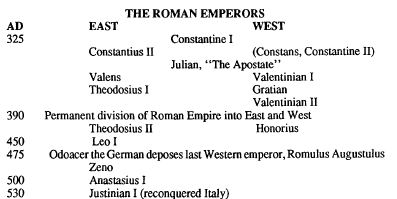
The Eastern Empire continued until the Ottoman Turks took Constantinople in the 15th century. The last emperor, Constantine, was slain, and the church of St. Sophia was turned into a mosque.
 The Origin of the Organic World – Part One