
Many of us learned what it means to be a Bible student by reading Bro. Harry Whittaker’s Exploring the Bible.1For a decade or more, I used to read this little book in the first week of each year, just to remind myself of the methods he describes. His promotion of “do it yourself” Bible study methods and his lifelong example of applying them remain an inspiration to me. My thoughts will do little to add to his wisdom.
This article is divided into two major sections. The first section emphasizes the importance of regular reading of the Bible. Bible students read seriously, carefully, thoughtfully, and analytically. They observe, interpret, and apply the teachings of the Bible. It isn’t like a novel you read once. Rather, the Bible is like the essentials of life, like the air we breathe, the food we eat, the water we drink, so we must read it routinely. The second section highlights the importance of context in understanding the Bible. It uses the book of Exodus as a source of examples to illustrate some Bible study methods that use context as a key to interpretation.
Read the Bible
Elementary reading and more. To study the Bible you must first read the Bible. There are multiple levels of reading.2Elementary reading answers the question: “What does the sentence say?” We learn to read at this level in elementary school. Of course, we learn to read in our native language, which, for most of my audience here, is English. The original texts of the Bible are mostly in (Biblical) Hebrew and (koine) Greek. Unless we learn these ancient languages (and few of us have the time or inclination to do so), we will need to read the Bible from a translation. There are many excellent English translations of the Bible.3A good Bible student will want to read from multiple translations. I use the AV/RV Interlinear as my primary study Bible. It has both the King James Version and the (English) Revised Version, and the best marginal references of any Bible I know. I also read from the New International Version (NIV), the New Revised Standard Version (NRSV), the English Standard Version (ESV), the Message, the New English Translation (NET), and others. The New English Translation (NET) has the best translation notes of any Bible I know.
The major difference between a Bible reader and a Bible student is that a student reads with additional purpose than merely determining what the text says. Knowing what the Bible says is critical, but it is only the beginning. From a cognitive perspective, we should also strive to understand, apply, analyze, synthesize, and evaluate what the Bible has to say.4
Bible marking and notes. While you are reading, you should mark your Bible:
- Highlight repeated words; the syntactic structure of sentences; the logic of paragraphs, chapters, and books.
- Number the patterns for lists (e.g., the “3 + 3 + 1” pattern of creation in Genesis 1:1-2:3; the “3 major + 12 minor” pattern for the patriarchs, for the judges, for the prophets, and, approximately, for the kings of Judah; the “12 + 1” pattern in Mark’s gospel for Jesus and the 12 apostles, the 12 Jewish + 1 Gentile healings, and the 5 + 7 + 1 loaves for the 5,000, the 4,000, and Jesus’ loaf in the boat and at the last supper; the multiple sevens of Revelation.
- Identify parallel texts (e.g., Chronicles with Samuel and Kings; the gospels Matthew, Mark, Luke, and John; the epistles with Acts; Ephesians with Colossians; Jude with 2 Peter; 1 John with the gospel of John).
- Mark elements of type scenes (e.g., engagement at a well in a foreign country).5
- Note poetic parallelisms and contrasts in the Psalms and Prophets6and in the sayings of Jesus.7
You should also keep a notebook handy for jotting down questions, comments, thoughts, lists, etc. Some of you may prefer to do these things with modern electronic devices. Regardless of the technology, a good Bible student always takes notes.
A three-step process. Howard G. Hendricks and William D. Hendricks, in their book, Living by the Book, suggest a three-step process for Bible study: “Step 1, Observation; Step 2, Interpretation; Step 3, Application.” They give good advice for each of these steps.
For the Observation step, they recommend ten useful strategies: “Read Thoughtfully; Read Repeatedly; Read Patiently; Read Selectively; Read Prayerfully; Read Imaginatively; Read Meditatively; Read Purposefully; Read Acquisitively; Read Telescopically.” They also identify six things you should look for: “Things that are… Emphasized, … Repeated, … Related, … Alike and Unlike, … True to Life.” They encourage their readers to summarize their observations, often with a chart or table.
For the Interpretation step, they point out that it is critical to identify the type of literature a text is. That is, what is its genre? In my opinion, this is perhaps the most important aspect of being a good Bible reader or student. There are significant differences in how we read narrative texts versus poetry, and historical records versus legal tracts versus prophetic writings versus apocalyptic literature. Misjudging the genre or applying the wrong methods to a genre can prevent us from properly grasping the meaning God intended in the various kinds of literature He gave us in the Bible. The results can be disastrous. One author uses the movie Galaxy Quest to illustrate what can happen:8the premise of the story is that a group of aliens under attack reach out to the cast of a now off-the-air science fiction television show, thinking that the episodes were a historical record of events that had actually happened and so expecting that the cast of the TV show could actually help them in their current perils. The parody is easy to see which is why it is funny. Unfortunately, many miss the analogous misinterpretations of the Bible caused by genre errors.
They list five keys to interpretation: Content, Context, Comparison, Culture, and Consultation. Content is based on the observations made in Step 1. We will look at some of the other keys in the second section of this article.
For the Application step, they list four steps: Know, Relate, Meditate, Practice. They identify nine questions to ask: “Is there an example for me to follow? Is there a sin to avoid? Is there a promise to claim? Is there a prayer to repeat? Is there a command to obey? Is there a condition to meet? Is there a verse to memorize? Is there an error to mark? Is there a challenge to face?”
Recap. Read the Bible. Read it over and over again. Read it in different translations. Read it for different purposes. Observe. Interpret. Apply. These ideas are illustrated in “Hearing the Word: Studies on the Parable of the Sower,” The Tidings, Special Issue, August, 2009, which presents six studies, each of which applies a general method of studying. The epilog summarizes:
“These studies encourage readers to seek the full meaning of God’s Word. There is no end of searching, because God’s Word has no limits. Examine a passage in its immediate context. Study it in conjunction with its parallels, seeking exhortation from their similarities and their differences. Find the allusions to Old Testament Scriptures. Memorize passages and meditate upon them, especially foundational passages like the Shema and the Parable of the Sower. Draw exhortations from the examples of Bible characters. Apply these lessons in your daily life.”
The importance of context
A brother once said that most Christadelphians will never be great textual scholars, but we should all strive to be great contextual scholars. I agree with this sentiment and hope to illustrate it in the following examples based on Exodus.9
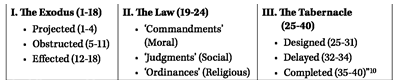
Outline of Exodus. In his book Explore the Book, J. Sidlow Baxter has four lessons on Exodus, and for each of these he recommends reading some or all of Exodus; in particular: “(1) Read Exodus 1-40 through twice, and Exodus 1-18 a third time; (2) Read Exodus 19-24 three times; (3) Read Exodus 25-34; and (4) Read Exodus 25-31; 35-40.” Baxter provides the following outline (p. 74):
“The Book of Exodus: The Divine Power, Holiness, and Wisdom
The Following Table Gives An Alternative Outline;
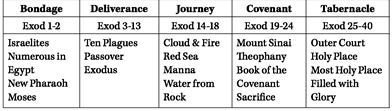
The preceding context: Continuing where Genesis left off (Exod 1-6). The opening chapters of Exodus explicitly connect it to Genesis, as illustrated by the following links. The family tree in Exodus 1:1-5 repeats the one in Genesis 46:8-27. The death of Joseph (Exod 1:6) echoes the last verse of Genesis (50:26). The emphasis on the increasing population of the children of Israel (Exod 1:7 9, 12, 20; cf. Acts 7:17) starts the fulfillment of the promise to Abraham that his seed would become a great nation, increasing almost without limit (Gen 12:2; 13:16; 15:5; 22:17). The affliction of Israel by the Egyptians (Exod 2:23-25; 3:17; 6:5) fulfills the prophecy to Abraham that his seed would be afflicted in a strange land (Gen 15:13-14) and Joseph’s faithful expectation based on it (Gen 50:24-25). This prophecy to Abraham is also echoed in Moses’ naming of his son Gershom (Exod 2:22) and in the Israelites leaving Egypt with the wealth of their neighbors (Exod 3:21-22; 11:2-3; 12:35-36). The references to God taking them to a land flowing with milk and honey (Exod 3:8, 17; 6:4, 8; 33:21) pick up on the promises to the patriarchs (Gen 12:1, 7; 13:15, 17; 15:7, 18-21; etc.), including the list of current inhabitants. When God appears to Moses, He emphasizes that he is the God of Abraham, Isaac, and Jacob (Exod 3:6, 15-16; 4:5; 6:3). How can one discover these connections? Most of them are in the marginal references of any good Bible. Others will ring out as you become more familiar with the text.
The call of Moses, the prototypical reluctant prophet (Exod 2-7). On eight separate occasions, Moses challenges the call from God (Exod 3:11; 3:13; 4:1; 4:10; 4:13; 5:22-23; 6:12; 6:30). Read Exodus 2-7 to find out God’s responses to these objections, and to see how serious the situation was. At one point it says that God was angry with Moses (Exod 4:14) and at another that God attempted to kill Moses (Exod 4:24-26). On the other hand, it also states that God assured Moses by guaranteeing that He would be with Moses; by declaring His name and its meaning; by providing signs as evidence; by reminding Moses that He is the maker of man’s mouth; and by promising that He would put His words in Moses’ mouth. This pattern of reluctance and reassurance is also exhibited, for example, by Isaiah 6, Jeremiah 1, Ezekiel 1-3, and, of course, Jonah. Have you ever been hesitant to fulfill God’s calling for you? You know, the assignments He has clearly prepared you for, the ones you may have been less than eager to do, the ones you tried to get out of by providing any number of lame excuses? I know I have, and I find comfort that despite Moses’ reluctance, God still reckons him to have been faithful (Heb 11:23-29; cf. Acts 7:17-44).
The “3 + 3 + 3 + 1” pattern of the ten plagues (Exod 7-12). The LORD provides “3 + 1” signs to Moses (Exod 4:1-9, 21-23), foreshadowing the ten plagues, which follow a “3 + 3 + 3 + 1” pattern. For the first plagues of each series (1, 4, 7) Moses is to go “in the morning” and he is to “stand before Pharaoh” when he comes to the water. For the second plagues of each series (2, 5, 8) Moses is to “Go in unto Pharaoh”, that is, at his palace. There is no warning for the third plague in each series (3, 6, 9). Aaron is the agent for the plagues in the first series (1, 2, 3); Moses is the agent for the third series (7, 8, 9); for the second series, God is the agent for the first two plagues (4, 5), and Moses for the third (6); and God is the agent for the tenth plague, the killing of the firstborn. The Egyptian magicians are able to mimic the first two plagues (1, 2), but not the third (3) or the sixth (6). The purpose of the plagues is stated multiple times: “That thou shalt know that I am the LORD”, which applies to both the Egyptians and the Israelites. It is highlighted that plagues 4-10 do not come upon the Israelites. For each of plagues 7-10 it is emphasized that there is “none like it” either before or after. Pharaoh hardens his own heart for plagues 1-5 and 7; whereas, God hardens his heart for plagues 6, 8, 9, and 10. Pharaoh promises that he will let the Israelites go after plagues 2, 4, 7, and 8, only to renege on his word. It is useful to put all this information in a table including the supporting verses for each of the details (see the table below, patterned after Sarna, Exploring Exodus, p. 76). The plagues are referred to in the Psalms (Psa 78; Psa 105) and the language of the plagues is used in Revelation (Rev 8-9 trumpets; Rev 16 vials).
Liturgical contexts10(Exod 12-19). Over 25 years ago I stumbled upon a book that had a profound influence on me; it added a whole new aspect to my study of the Bible. The book was Midrash and Lection in Matthew by Michael Goulder. He emphasizes the Jewish calendar and the reading plan associated with it. The results are astonishing. To give just a couple examples, the readings for Passover include the special festival reading Exodus 12-15 (Passover and the crossing of the Red Sea), the third weekly Torah reading, Genesis 12-17 (Abraham), and readings from the book of Joshua in the Former Prophets. There are many connections between these three passages. Genesis 12:10-13:2 is a microcosm of the Exodus: Abram goes down to Egypt because there is famine in the land just like Joseph and family would later go down to Egypt because there is famine in the land. Abram sojourns just like Israel would be a sojourner in a strange land. In both cases, God inflicts plagues upon Pharaoh. Abram comes out of Egypt with great wealth just like the Israelites would. Further, as mentioned above, Genesis 15:13-14 is a prophecy of the Exodus.
Also, the record in Joshua 1-5 is told in a way that highlights the parallels with the Exodus. Joshua is to be a prophet like unto Moses. God would be with Joshua as he had been with Moses. Joshua leads Israel through the Jordan River on dry ground just as Moses had led their parents through the Red Sea on dry ground; the connection between these two events is stated explicitly in Joshua 4:23. After they are circumcised at Gilgal, they eat the Passover just like their parents had eaten it 40 years earlier. Like Moses, Joshua is told to take off his shoes because the ground he is standing on is holy. The parallels are obvious and abundant.
The liturgical context for Passover also includes Psalms 105-118 and the latter chapters in each of the gospels, which make it clear that Jesus was crucified and raised at Passover time. Comparable results can be found for the feasts of Pentecost (e.g., Exodus 19-20; Psalm 119; Daniel 2-7; Matthew 5-7) and of Tabernacles (e.g., Psalms 90-106; Isaiah; Matthew 13).11
“When studying a book of the Bible, we are used to asking questions like: Who wrote it? Who was it written to? When was it written? Why was it written? Where was it written from? Answers to these questions help us to understand the book better because they give a setting for the book, a setting which almost certainly influenced what was written and how it should be understood… Michael Goulder… caused me to see the importance of two other questions that require answers: When was it read? What was it read with?”
The subsequent context: Leviticus and the Tabernacle (Exod 19-40). The floorplan of the Tabernacle is repeated seven times in Exodus (Exod 25-30; 31:1-11; 35:1-19; 35:20-39:32; 39:33-43; 40:1-16; 40:17-38). In her book Leviticus as Literature, anthropologist Mary Douglas observes that the layout of the Tabernacle acts as a spatial mnemonic for the literary structure of Leviticus. The following diagram overlays the chapters of Leviticus on the layout of the Tabernacle. Leviticus 1-17 corresponds to the Outer Court; Leviticus 18-24 corresponds to the Holy Place; and Leviticus 25-27 corresponds to the Most Holy Place. These three zones of holiness also correspond to the three zones of holiness at Mount Sinai. All of this is a reflection of the gospel with shadows of Christ’s sacrifice and our baptism portrayed in the Outer Court (Lev 1-17); our current life of fellowship in the Holy Place (Lev 18-24); and our future immortal life in the Kingdom in the Most Holy Place and the Year of Jubilee (Lev 25-27).12
Conclusion
Reading and studying the Bible is like compound interest, the more you do it, the more it pays off. You will never read a book or chapter the same way twice.
Each time you read a passage you will have a new outlook based on what you have experienced since the last time you read it. As you read and study the Bible over and over, you strengthen the neural pathways in your brain; you are almost literally filling your mind with God’s word. This makes it easier to recognize patterns and connections, and to see passages in all their contexts.
- Exploring the Bible is still available in print from the Christadelphian Office and other book sellers. Bro. Whittaker’s follow up book, Enjoying the Bible, is also full of methods with lots of examples. The Joy of Bible Study, by Harrington Lee, published in 1910, is another book comparable to these, but it is long-since out of print; a kind brother gave me a copy when he was pruning his library.
- In their excellent book, How to Read a Book, Mortimer J. Adler and Charles Van Doren identify four levels of reading: Elementary Reading (just being able to read the words, sentences, etc.), Inspectional Reading (preliminary skimming and preparatory reading), Analytical Reading (serious study of a text), and Syntopical Reading (reading multiple texts together). Their ideas have influenced many students of literature, including myself and this present article.
- See Bro. Steve Davis, “The Bible Today”, The Tidings, August, 2015, pp. 361-367.
- Bloom’s Taxonomy of Educational Objectives: The Classification of Educational Goals. Handbook I: Cognitive Domain identifies these six levels of cognition: Knowledge, Understanding (or Comprehension), Application, Analysis, Synthesis, and Evaluation.
- Robert Alter, The Art of Biblical Narrative, Chapter 3, “Biblical Type-Scenes and the Uses of Convention.”
- Robert Alter, The Art of Biblical Poetry.
- See Joe Hill, “The Sermon on the Mount (4): The Poetry of Jesus,” The Tidings, April, 1992, pp. 121- 125, based on Michael Goulder, Midrash and Lection in Matthew, chapter 4.
- Steven L. McKenzie, How to Study the Bible, p. 14.
- The examples in this section are based on years of reading the text and have also been influenced by many writers and speakers. Among others, these include: Avigdor Bonhek, Studying the Torah: A Guide to In-Depth Interpretation; Michael Fishbane, Biblical Text and Texture: A literary reading of selected texts; Nahum M. Sarna, Exploring Exodus: The Origins of Biblical Israel; Mark Vincent, The Exodus: A Commentary on Exodus 1-15; as well as others mentioned below.
- The word “liturgical” means things associated with public worship services. For Israel, these revolve around the annual calendar of feasts and fasts (Passover, Pentecost, Ninth of Ab, Trumpets, Atonement, Tabernacles, Purim, Hanukkah) as well as the weekly synagogue service. For each of these days, there were and still are special readings, psalms, activities, and words of prophecy (like our exhortations), which together make up the liturgy. There is evidence that the New Testament ecclesias developed liturgies around the same Jewish calendar, adding appropriate material about how Jesus fulfilled the liturgical themes, thus proving his claim, “Think not that I am come to destroy the law, or the prophets; I am not come to destroy, but to fulfill.” Similarly, Paul states that the holy days are “a shadow of things to come; but the body [substance, reality] is Christ.”
- For details, see Joe Hill, “An Ancient Bible Companion,” The Tidings, January, 1993, to December, 1994, based on Michael Goulder’s books Midrash and Lection in Matthew and The Evangelists’ Calendar, and Joe Hill, “Patterns in the Book of Psalms,” The Tidings, 6/2000, 8/2000, 10/2000, 12/2000, 2/2001, based on Michael Goulder, “The Fourth Book of the Psalter,” Journal of Theological Studies, October, 1975, 269-289. See also, Michael Goulder’s books, The Psalms of the Sons of Korah and Isaiah as Liturgy.
- For details, see Joe Hill, “Leviticus and the Tabernacle,” The Tidings, December, 2010, to October, 2011.
 The Origin of the Organic World – Part One