
The Trinity and worshiping images
In the Nicene Creed, we say “… We believe in the Holy Spirit, the Lord, the giver of life, who proceeds from the Father and the Son. With the Father and the Son he is worshiped and glorified…” However, this is wrong — it is not Biblically correct. The Trinity is not a Biblical concept, but a pagan one. It is not a term mentioned in the Bible, and even the concept cannot be found in the Bible. The idea of the Trinity came about three hundred years after the Bible was written:
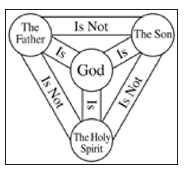
Encyclopedia Britannica has these interesting points on the Trinity:
Neither the word trinity nor the explicit doctrine appears in the New Testament… the doctrine developed gradually over several centuries and through many controversies. Initially, both the requirements of monotheism inherited from the Old Testament and the implications of the need to interpret the biblical teaching to Greco-Roman religions seemed to demand that the divine in Christ as the Word, or Logos, be interpreted as subordinate to the Supreme Being. An alternative solution was to interpret Father, Son, and Holy Spirit as three modes of the self-disclosure of the one God but not as distinct within the being of God itself… It was not until the fourth century that the distinctness of the three and their unity were brought together in a single orthodox doctrine of one essence and three persons1.
In commenting on this reference it has been noted: “Britannica is confessing that the formulation of the doctrine was heavily influenced by the interpretations of Greek and Roman religious thought. Why should pagan thought even be considered when interpreting scripture? Again the answer is clear: the development of the doctrine was a compromise. A compromise of paganism into Christianity at the expense of Biblical truth,”2God said: “Hear, O Israel: The LORD our God is one LORD,” (Deut 6:4); and: “I am the LORD your God, who brought you out of the land of Egypt, out of the house of bondage,” (Exod 20:2). God did not say “we” are your God.
Jesus is the Son of God (Luke 1:35). He was flesh, or man. Jesus is not God, nor is he co-equal with God. Consider the following points:
If he were God, he would not have to be raised by God (Acts 3: 26; Gal 1:1), or exalted by God (Phil 2: 9) — he could do it himself.
In addition:
- In Mark 1: 12-13, and Matt 4:1-11, Jesus is tempted, but remains sinless. In Heb 4:15, Paul writes that Jesus can sympathize with our weaknesses because he was “in all points tempted as we are, yet without sin.” Now, James (1:13) writes, “God cannot be tempted.” Since Jesus was tempted, yet God cannot be tempted, then Jesus cannot be God.
- God cannot die, because He alone has immortality, and God cannot be seen by men (1 Tim. 6:16); however, Jesus died (Rev 1:18), and he was seen by men. Therefore, Jesus is not God.
- “The child [Jesus] grew and became strong in spirit, filled with wisdom; and the grace of God was upon him,” (Luke 2:40). If Jesus was God, why did he have to become strong in spirit and filled with wisdom? Would this Jesus/ God not automatically be filled with the spirit and wisdom of God? Again, Jesus said: “I can of myself do nothing. As I hear, I judge: and my judgment is righteous, because I do not seek my own will but the will of the Father who sent me, (John 5:30). And, “when you crucify the Son of Man, then you will know that I am he, and that I do nothing of myself; but as my Father taught me, I speak these things,” (John 8:29). These statements show that Jesus and God are two distinct beings, God is the Father, and Jesus is the Son of God.
The head of Christ is God (1 Cor 11:3); Jesus is subject to God (1 Cor 15:27-28); and Jesus stated that his Father is greater (John 14:28). Therefore, Jesus is not co-equal with God. This truth is put clearly thus: At his second coming:
“Christ will overcome all spiritual rulers, authorities, and powers, and will hand over the Kingdom to God the Father. For Christ must rule until God defeats all enemies and puts them under his feet. The last enemy to be defeated will be death. For the Scripture says, ‘God put all things under his feet.’ It is clear, of course, that the words ‘all things’ do not include God Himself, who puts all things under Christ. But when all things have been placed under Christ’s rule, then he himself, the Son, will place himself under God, who placed all things under him; and God will rule completely over all” (1 Cor 15: 24-28).
Jesus shared our human nature, our flesh: Jesus was “made of woman” (Gal 4:4);
“…concerning His Son Jesus Christ our Lord, who was born of the seed of David according to the flesh, and declared to be the Son of God with power according to the Spirit of holiness, by the resurrection from the dead,” (Rom 1:3-4);
“Inasmuch then as the children have partaken of flesh and blood, he himself likewise shared in the same, that through death he might destroy him who had the power of death” (Heb 2:14);
“…who in the days of his flesh, when he had offered up prayers and supplications, with vehement cries and tears to Him who was able to save Him from death, and was heard because of his godly fear, though he was a Son, yet he learned obedience by the things which he suffered. And having been perfected, he became the author of eternal salvation to all who obey him” (Heb 5:7-9);
“Every spirit that confesses that Jesus Christ has come in the flesh is of God, and every spirit that does not confess that Jesus Christ has come in the flesh is not of God. And this is the spirit of the Antichrist, which you have heard was coming, and this is now already in the world” (1 John 4:2-3).
The Holy Spirit
The Holy Spirit is not God. The Holy Spirit is not referred to as Lord in the Bible. The Holy Spirit is called Helper, Comforter, Spirit of Truth in John 14: 16-18. The Holy Spirit is not worshiped in the Bible. These beliefs came from man, not God. The Holy Spirit is not the “giver of life”, God is.
In Gen 1:7, the Bible reveals that God gives Adam life, not the Holy Spirit: “And the Lord God formed man of the dust of the ground, and breathed into his nostrils the breath of life; and man became a living being [soul].” God did not need the help of the Holy Spirit to give life.
The Holy Spirit is God’s breath, spirit, or power, or word (Gen 1:2; Psa 33:6 9) – whatever God says, is accomplished (Gen 1:3). God’s spirit/breath/word is both intelligent and powerful. We are told that in the beginning, “wisdom” accompanied God in Creation (See Prov 8:22-31). In Prov 8:1-3 and 9:1-3, this wisdom is personified as a woman (“her”, “she”). Thus, the Holy Spirit is not a “being” separate from God, to be worshipped or glorified; rather, it is God’s word or power going forth from God.
In my considerations of the Trinity, eventually my inability to fully understand it was excused because the doctrine is a “mystery”, yet in the Bible, there is no “mystery” about who God is or what God’s plan for Creation and salvation is: The mystery is fully revealed in Jesus the Christ.
“And he said to them, ‘To you it has been given to know the mystery [secret; hidden truths] of the kingdom of God’ ” (Mark 4:11);
“For I do not desire, brethren, that you should be ignorant of this mystery” (Rom 11:25);
“Now to Him who is able to establish you according to my gospel and the preaching of Jesus Christ, according to the revelation of the mystery kept secret since the world began but now made manifest, and by the prophetic Scriptures made known to all nations” (Rom 16:25-26);
“…this is a great mystery, but I speak concerning Christ and the church” (Eph 5:32).
Throughout the New Testament all “mysteries” have been revealed. It is in fact, our duty to know these mysteries by reading the Scriptures.
Worshiping images:
God said:
“You shall not make for yourself a carved image – any likeness of anything that is in heaven above, or that is in the earth beneath, or that is in the water under the earth; you shall not bow down to them nor worship them.
For I, the Lord your God, am a jealous God, visiting the iniquity of the fathers upon the children to the third and fourth generation of those who hate Me, but showing mercy to thousands, to those who love Me and keep My commandments” (Exod 20: 4-6).
“Do not make idols or set up statues, stone pillars, or carved stones to bow down to; I am the Lord your God,” (Lev 21:1).
From this, I understand that it is a sin against God to even make images or statues. In Roman Catholic Churches, we have many statues and images, some set upon pillars: Jesus on a cross, statues of Mary, images of people the Roman Catholic Church has said are saints, etc. We are taught to use the rosary beads, which include the image of Jesus on the cross, for prayer, and in many rosary booklets, are taught to kiss the cross as a sign of reverence/worship. At Melancthon, Ontario, a stone pillar was recently erected, and a statue of Mary was set upon it for reverence, worship and prayer. “Worship” in Hebrew means “to bow”, and is translated as bow, bow down, obeisance, reverence, fall down, stoop, and crouch.
As we enter the pew, we kneel, or bow, to the tabernacle. According to Scripture, this is a sin.
At Mass on Good Friday, we worship the carved image of a cross. From pages 306-307 of the 1996 Sunday Missal, it says: “…The one carrying the cross stops, lifts it up, and sings the invitation: This is the wood of the cross. All respond: Come, let us worship. After each response all kneel and venerate the cross briefly in silence as above… they make a simple genuflection or perform some other appropriate sign of reverence according to local custom, for example, kissing the cross. In a few words he invites the people to venerate the cross and then holds it up briefly for them to worship in silence. After the veneration, the cross is carried to its place at the altar, and the lighted candles are placed around the altar or near the cross.” According to God’s Word in the Bible, I sin when I participate in this Easter ritual.
God warns us through “Your carved images I will also cut off, and your sacred pillars from your midst; you shall no more worship the work of your hands; I will pluck your wooden images from your midst…And I will execute vengeance in anger and fury on the nations that have not heard” (Mic 5:13-15): Because: “the hour is coming and now is, when the true worshipers will worship the Father in spirit and truth; for the Father is seeking such to worship Him. God is Spirit, and those who worship Him must worship in spirit and truth” (John 4:23-24). Thus, we are told not to use any type of image in our worship of God; we must worship God in spirit. We are told to fix our eyes not on what is seen, but on what is unseen, for what is seen is temporary, but what is unseen is eternal (2 Cor 4:18).
 The Origin of the Organic World – Part One