
Introduction
In our lives, each one of us, has experienced highs and lows. They are unavoidable and necessary for our growth in the Truth and to develop our character according to the will of the Father. For some of us, we might only experience minor lows and great highs. Others might experience great lows and very few high points. In either case, when we do have low points in our lives, there are many great examples in the Bible that we can take lesson from. In this article we will be looking a the life of David so that when we do have a low, we know that David probably had it a lot worse off than we could ever really imagine. Now with that being said, here in North America we are very blessed to have the freedoms and opportunities to believe what we want. In other countries though, people are sometimes less fortunate and can probably relate to David’s experiences a lot better than we could. Regardless of where we live, we will have lows in our lives as David did. We will have to encounter uncomfortable or desperate situations where we might make wrong decisions. But never forget the example we have of David during his time as a refugee.
Our main focus will come from 1st Samuel 27 to 30 when David is at the latter part of his exile. Before we get started though, let us take a look at some context at the beginning of when David started running from Saul. It is very important that we understand the mindset of David and how he went from a man of great faith, to desperate actions of deception and self-trust. We all know the stories of when David defeated the bear and the lion. One of the most famous stories is when David defeated the champion of the Philistines with just a stone, sling, and great faith in God, or when he defeated countless waves of Philistines for Saul. Each time he had great faith that God would take care of him. But something changed in David the night that it was confirmed that Saul wanted to kill him.
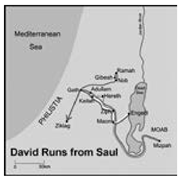
After all the great battles David had won, only one man could strike fear in him: King Saul, the anointed of the Lord. Saul wanted to kill David because he knew that the kingdom would be rent from him and his family. He hated that David was going to take that away so he tried to take matters into his own hands. But, there is a question to be asked of David. Was he running out of fear from Saul or was he running from himself? He knew that he couldn’t kill the Lord’s anointed, but what if the opportunity arose? David knew that if it came to him and Saul in a battle, there would be a possibility that either Saul would kill him, or he would have to kill Saul. So David ran. He didn’t just run for his life, but perhaps also for the life of Saul. Latter on when David had the opportunity to kill Saul in the cave, he couldn’t because he knew that Saul was anointed by the Lord. Even but just cutting off the hem of the king’s garment, he lamented for doing so.
During David’s exile he made many mistakes. The first mistake was rather than putting his faith in God, he had Johnathan lie so they could see if Saul really wanted to kill him or not (1st Samuel 20). He then lied to Ahimelech the priest in Nob in 1st Samuel 21 when he asked for supplies. David feared that if he were to tell anyone that he was running from Saul, that they turn him over. So he lied and told the priest he was on a secret mission from Saul. He was hoping that he would go unnoticed, but that wasn’t the case unfortunates. The lie was not the main problem of this encounter though. David had an opportunity and a sign from God that he needed to ask for guidance and strength. When the sword of Goliath was presented to him by the priest, it was sitting behind the ephod. This was a sign that David needed to put his trust and faith in God rather than putting his trust in the things of the flesh. In a moment of weakness, he chose the sword over help from God. This was not a general trend in David’s life, nevertheless, one thing that is interesting, it doesn’t appear as though David ever asked God if Saul would truly kill him. He always asked if he would be turned in or if he should go and attack an enemy, but he never asked God specifically what to do about Saul. So David was running, and we can see that it was a difficult time for his faith.
Now that we have covered some context and asked a few questions, let’s turn our attention to 1st Samuel chapter 27. By this time in David’s run from the king, he has encountered many supporters and many more who were against him. He has learned that he needs to go to God before he makes any move. Little by little he is learning about becoming a Godly leader and king. He had to have great humility, compassion, understanding and wisdom. Only through the trials God put before him could he understand what was expected of him. With any trial, there can come a point where our faith is at its lowest. We know that David was exhausted, torn down, depressed and in dire need of encouragement:
“I shall now perish one day by the hand of Saul: there is nothing better for me than that I should escape into the land of the Philistines; and Saul shall despair of me, to seek me any more in all the borders of Israel: so shall I escape out of his hand” (1 Sam 27:1 RV)
I’m sure that the people with David were feeling close to the same as him, but they kept following him. They knew he was a stronger, more Godly and far better a leader than the alternative.
David, as the strong leader that he was becoming, made one of the boldest, and probably hardest of decisions he could make. He chose to take his men and people into the hands of the Philistines, the enemy of Israel and God. Let’s just take a moment to reflect on what was really going on. David was loved so much by his men. They trusted him and would follow him anywhere he went. That says that David was a great leader. He was able to convince 600 men plus all their families to go into the land of the Philistines. David was desperate to keep the people safe from the wrath of Saul and he knew that Saul would never attempt to follow him or his people there. It is hard to say what he was thinking when he made that decision but we know one thing is certain: he did not enquire of the Lord about what he was about to do. Just like the instance at Nob, David did not call upon the Lord for guidance. So during their stay in the land of the Philistines, David was put into some very difficult situations. Despite his lack of communication, God was still watching over him and the people.
Within a short period of time, David had gained the trust of the king of Gath, Achish. Luckily for him, Achish was easily deceived and David exploited this weakness. This act of trickery was the last step to pulling David in deep with the Philistine ranks and started a chain reaction of events that became out of his control, because unfortunately, as we will see, his trickery worked better than he probably expected.
Miag
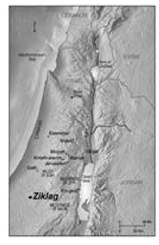
With great trust, Achish gave David Ziklag as his home base. This southern city had once belonged to Judah in the time of the judges but was later invaded and controlled by the Philistines. It was only fitting that David would take back a part of Israel for him and his people to call home. In considering the meaning of Ziklag1from the Strong’s concordance, it means “winding.” Ironically, the path that David had taken was one of uncertainty and the things he was forced to do were uncharacteristic of him. With this in mind, we can get a good picture of the mindset David had during this time. His thoughts and actions were truly wandering in the presence of the enemy. It is thought that during the time David was in the land of the Philistines, he didn’t write any psalms which likely means he was spiritually struggling and slightly influenced by his surroundings. Regardless though, he still was thinking ahead to when he would become king. David knew that he and his men couldn’t just be idle, there was work to be done. So David began to finish wiping out the Canaanites and other enemies, something Saul should have done during his own time as king.
David was only looking for a place of refuge for himself and for those who fled from Saul’s insanity. But, rather than getting Ziklag as a temporary home, it became a dangerous trap. You see, David did such a good job of making Achish believe he had “made Israel, his people, to abhor him” (1 Sam 27:12), that in the king’s mind, David and his men would be at his disposal for ever. Achish made him “keeper of his head” or his personal bodyguard. This eventually comes into to play later on 1st Samuel 28, when the Philistines gathered their armies to fight against Israel.
Now that David was put into his position of stature, he and his men were being forced to fight against Saul and his armies. Achish said: “Understand that you and your men are to go out with me in the army” (1 Sam 28:1 ESV). David now had to make a choice. Either he and his men had to fight against Saul, or they would have to go in to battle and turn on the Philistine armies. Both options could have had great consequences. The angels were working in the background though to keep that from happening. When Achish and David arrived at the front lines, the princes of the Philistines feared that this adopted Philistine army would turn on their forces during the battle. God knew that something terrible would have happened to David and his men that day, so he created another path for them to escape harm, yet again.
The Amalekites

After the men were dismissed from the battle, they made their way back to Ziklag. Upon their return to their home, they saw that the Amalekites had invaded and burned Ziklag. All those who stayed behind, the women, children and the elderly were taken captive and led away by the Amalekites. From the time David started his stay with the Philistines to now, he had not written any psalms or asked for guidance from God. David’s mind had been influenced by the Philistines and it seems that up until this point, David felt that he was in control. If you think about all the times David went to God for guidance, he did not ask for it before going into the land of the Philistines, or at least we are not told that he did. It seems that David felt he was in control of the situation, But reality struck when the men he was with began to speak against him and threatened to stone him. The men were infuriated with David because he had led them into this situation and now all of their families were taken captive by the enemy. Due to the extreme situation, David finally went to God for guidance:
“And David said to Abiathar the priest, the son of Ahimelech, ‘Bring me the ephod.’ So Abiathar brought the ephod to David. And David inquired of the LORD, ‘Shall I pursue after this band? Shall I overtake them?’ He answered him, ‘Pursue, for you shall surely overtake and shall surely rescue’ ” (1 Sam 30:7-8 ESV).
David was no longer in control and was on the verge of destruction by his own men. Those who were so dedicated to David just days before, wanted to turn on their leader and kill him. David had no other choice than to turn to God for guidance, and God delivered his servant from destruction. With the help of God the men of David were able to recover everything down to the smallest items. It was a great day for David and the mighty men since God had provided for them. When they returned to where they had left the men left behind, some of the wicked men who went to the spoil, did not want to share their newly gained wealth. The great leader that David had become knew he had to take care of those men who did not partake in the raid, so he made a rule. All those who bring back spoils of war must distribute to those who stayed behind to protect the camp. They may have not been at the front lines, but they still had jobs to do, so why shouldn’t they partake? David also sent spoils to his friends, the elders of Judah. David was a wise and strong leader as he had learned to be from his time running from Saul.
The lessons
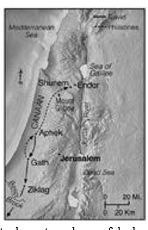
There are so many lessons for us to learn from all of David’s trials while living in the land of “wandering” called Ziklag. The most apparent lesson is be specific when talking with God, and asking for his guidance. During his time of running from Saul, even from the beginning, David never asked what to do specifically about Saul wanting to kill him. When he did inquire of the Lord, it was about his next move. When we pray to God about a problem or needing assistance, we have to be specific with what we ask for. Now in David’s case, much like our own, it was necessary for him to go through the things he did in order to be exercised and molded into what God needed him to be as king.
The next thing we can take away is that we have to be extremely careful about who we associate ourselves with. David got himself so deep in with Achish that for a time, he was distanced from God. We know he didn’t write any psalms during his stay and we are not told that he inquired of the Lord until he was desperate. We cannot forget though, that David was still a man of God, he always had God’s people at the forefront of his mind.
The lesson for us
That bring us to the next point. Being a part of an ecclesia, we must look after everyone in it! We have to support those who are busy working in the forefront of our ecclesia, but we also have to take care of those who seem less involved. Just as David did when he distributed the spoils of the Amalekites to those who did not fight. Everything David did was for his “ecclesia” and we need to take example of that in our lives. David was a Godly man and he made many mistakes, but, he knew that he had to endure them to be prepared for kingship. We too will make mistakes, but let us be reminded that we are being shaped and molded to be fit vessels for God’s plan when His son sets up the Kingdom on earth. Let us rejoice and have hope in that coming Kingdom!
 The Origin of the Organic World – Part One