
This exhortation is based on the healing of the infirm, or bowed, woman in Luke 13. It would appear that during most of the last year in the Lord’s ministry, there was a concerted move to deny Jesus any opportunity of preaching in the synagogues. In the gospel record of this period Jesus’ preaching on a Sabbath is mentioned only this once. And in this instance the ruler of the synagogue and a number of the congregation were hostile. So perhaps this occasion was deliberately laid on so that they might have opportunity to object, which is exactly what transpired.
“And [Jesus] was teaching in one of the synagogues on the Sabbath” (Luke 13:10).
Some of us will be familiar with the idea that each of the Gospels emphasizes a different aspect of Jesus’ role, and that each of these aspects relate to one of the four faces of the cherubim. It is said that Luke’s gospel relates to the face of a man, and that it emphasizes Jesus as the Man. One brother has suggested more specifically that it emphasizes Jesus as the perfect Priest.
Five of the seven recorded Sabbath day miracles are recorded in Luke’s gospel; more than any other Gospel. Perhaps Luke is emphasizing Jesus as the perfect Man, or Priest, who understands the true significance of the Sabbath. Keep that in mind as we read on.
The bowed woman
“And, behold, there was a woman which had a spirit of infirmity eighteen years, and was bowed together, and could in no wise lift up herself” (Luke 13:11).
The subject of Jesus’ miracle was a woman who had “a spirit of infirmity”, or literally, ‘a spirit of feebleness, or weakness’ and she was “bowed together”. The ESV translates “She was bent over and could not fully straighten herself”.
Most think that this was a physical disease, such as curvature of the spine, although some believe it was a mental condition. Whatever the underlying cause was, the outward symptom of her problem was severe. She was “bowed together” and she could not lift herself up. The words “bowed together” in the original means ‘bent double’, or as we might say, ‘doubled-over’, so she could probably look forward only with extreme difficulty, and to lift up her eyes to heaven was impossible. And perhaps the learned in the audience were thinking of Isa 45:2, for there the Hebrew word for crooked also means to glorify.
In verse 16, Jesus says that Satan had bound her. In saying that, Jesus is connecting her condition with man’s great adversary: sin.
As Brother Edward Whittaker helpfully put it: “Disease is part of the legacy of sin.”1In other words, disease is a by-product of Adam’s sin. It relates to the curse of mortality, which includes weakness and disease, and that applies to all of Adam’s offspring.
Eighteen years
The fact that she was in this condition for “eighteen years” similarly connects her condition with the problem of sin and its cruel bondage. For example, let us go to an example to such bondage:
“And the children of Israel did evil again in the sight of the Lord: and the Lord strengthened Eglon the king of Moab against Israel, because they had done evil in the sight of the Lord. And he gathered unto him the children of Ammon and Amalek, and went and smote Israel, and possessed the city of palm trees. So the children of Israel served Eglon the king of Moab eighteen years” (Jdgs 3:12-15).
This period of 18 years is used the same way later in Judges:
“And the children of Israel did evil again in the sight of the Lord, and served Baalim, and Ashtaroth, and the gods of Syria, and the gods of Zidon, and the gods of Moab, and the gods of the children of Ammon, and the gods of the Philistines, and forsook the Lord, and served not him. And the anger of the Lord was hot against Israel, and He sold them into the hands of the Philistines, and into the hands of the children of Ammon. And that year they vexed and oppressed the children of Israel: eighteen years, all the children of Israel that were on the other side Jordan in the land of the Amorites, which is in Gilead” (Jdgs 10:6-8).
When Israel turned from God, they were enslaved to their enemies, for eighteen years. Turning from God, put them in bondage to sin.
From a practical perspective, what can we learn from the fact that the woman back in Luke 13 suffered in her condition for eighteen years? Let us stop and think about this for a moment. She was doubled over and unable to stand upright for eighteen years.
There was an article that was written by a sister many years ago. In writing about this bowed woman, the sister said that she herself had spent a half day walking around her home doubled over. She commented on how grim it was, always looking down at the ground, how dissatisfying it was to sit or lie down to rest, and how difficult it was to eat and drink.
But this woman in Luke was in this condition for eighteen long years. Until now, there was no one who could help her or release her from the bonds of “the legacy of sin”.
Although her physical condition was very difficult and the prognosis bleak, and despite the fact that it would have been very difficult and humiliating for her to make the trek to the synagogue, she did it. We aren’t given many details about her. For example, we don’t know her name, and we aren’t told about anything that she may have said on this occasion. But the very fact that she was at the synagogue tells us something about her. Even so, since the women in the synagogue worshiped away from the eyes of the men members of the congregation, it may well have been that she did not come face to face with her Lord until after the meeting had ended. But the fact that she was there suggests that she had a very strong faith. Why else would she have been there, and why would Jesus have called her out of the crowd? We know she had faith because in verse 16, Jesus calls her a “daughter of Abraham” and Paul tells us: “that [Abraham is] the father of all them that believe” (Rom 4:11).
Be that as it may, we know that this pitiful, hunched figure, who could in no wise lift herself up, was seen by the Lord Jesus and that his compassion welled up for her. Had this woman heard about Jesus’ teaching and his healing power? Did she wonder if he was the Messiah?
Sometimes Jesus performed a healing miracle in response to a request. And there are other times, like this one, when Jesus seeks out a person without being asked to do so. The sight of her doubled over would have been something that would catch the eye, especially the sympathetic eyes of Jesus, the perfect Priest.
“And when Jesus saw her, he called her to him, and said unto her, Woman, thou art loosed from thine infirmity. And he laid his hands on her: and immediately she was made straight, and glorified God” (Luke 13:12-13).
Jesus called her out of the crowd and she responded. He spoke words of promise to her and she believed. He touched her, and she was cured and stood upright. Then she glorified God. There’s a process here in these few words and we should consider it.
The bowed woman is a parable of our condition. We all have a nature that is bowed down, prone to sin, and mortal. It’s our misfortune, not our crime. Unless God intervenes, we remain in bondage to sin. So God seeks us out and calls us to Him. We have to decide whether to respond to His call. He speaks words of promise to us and we choose whether to believe His words. Lastly, if we draw near to Him, through prayer and by applying ourselves to His word, He can touch us, free us from the bonds of sin through His son, and make us to stand upright. So we can glorify Him.
The bowed woman should also cause us to think about our perspective. For example, what direction are we facing?
Are we looking down at the ground, obsessed and focused on the here and now, and all of the issues that press on us, or are we looking ahead, to God’s kingdom and trusting that God will get us through our present difficulties?
Healing on the Sabbath day
The other main lesson in this story is what we noted at the outset: that this miracle was performed on the Sabbath day. Of the seven times that Jesus healed on the Sabbath day, he did it in the synagogue three times, and on all seven occasions, it put him in direct conflict with the Jewish leaders, specifically, the Pharisees.
The Pharisees were obsessed with external rituals and tradition, and they had no grasp of the deeper principles involved in God’s laws. Look at how the ruler of the synagogue reacted to the healing of the bowed woman.
“And the ruler of the synagogue answered with indignation, because that Jesus had healed on the sabbath day, and said unto the people, There are six days in which men ought to work: in them therefore come and be healed, and not on the sabbath day” (Luke 13:14).
On two previous occasions, when Jesus healed the impotent man and the man with the withered hand, the Jewish leaders actually sought to destroy Jesus because he had healed on the Sabbath. So, this is the issue that triggered their plotting against him.
Look at Jesus’ response to the ruler of the synagogue.
“The Lord then answered him, and said, Thou hypocrite, doth not each one of you on the sabbath loose his ox or his ass from the stall, and lead him away to watering?” (Luke 13:15).
Jesus called him a hypocrite for allowing the care of animals on the Sabbath and opposing the healing of a child of Abraham.
Work on the Sabbath
Then Jesus proceeds to teach that the act of healing and loosing someone from bonds is in fact a most appropriate work on the Sabbath day.
“And ought not this woman, being a daughter of Abraham, whom Satan hath bound, lo, these eighteen years, be loosed from this bond on the Sabbath day?” (Luke 13:16).
Jesus’ objective of healing on the Sabbath, of all days, involved more than challenging the traditions of the Jewish elders. As the perfect Priest, he was teaching the people about the true meaning of the Sabbath and what the Sabbath foreshadowed. Jesus was saying that his acts of healing should not merely be tolerated or accommodated on the Sabbath, but that they were part and parcel of the Sabbath. It was a core element of the Sabbath day. Jesus’ teaching was based on his sharp understanding of what God had said in the Law and the Prophets regarding the Sabbath.
It was clear that the children of Israel were commanded in the Law to do no work on the Sabbath. But the work they were not to do on the Sabbath was qualified by the work they were to do on the other six days of the week.
Three times in the Law, God instructed Israel that they had six days a week to do their own work. Let’s look at one of these examples.
“Six days thou shalt do thy work, and on the seventh day thou shalt rest: that thine ox and thine ass may rest, and the son of thy handmaid, and the stranger, may be refreshed” (Exod 23:12).
Note the emphasis: they had six days to do their own work, and the natural extension was that they were not to do their own work on the Sabbath. It was to be a day of refreshing.
Isaiah leaves no doubt that this is the intended emphasis.
“If thou turn away thy foot from the sabbath, from doing thy pleasure on my holy day; and call the sabbath a delight, the holy of the Lord, honourable; and shalt honour him, not doing thine own ways, nor finding thine own pleasure, nor speaking thine own words. Then shalt thou delight thyself in the Lord;” (Isa 58:13-14).
They were not to do their own work but they were expected to honor God and to delight themselves in Him and His works. How?
“Is not this the fast that I have chosen? to loose the bands of wickedness, to undo the heavy burdens, and to let the oppressed go free, and that ye break every yoke? (Isa 58:6)
Jesus fully appreciated this: that God wanted His people to honor Him on the Sabbath, by removing the burden of sin and through works of compassion and grace.
There is one final passage regarding the Sabbath that Jesus clearly appreciated and that helps us to understand its true significance.
“Wherefore the children of Israel shall keep the Sabbath, to observe the Sabbath throughout their generations, for a perpetual covenant. It is a sign between me and the children of Israel for ever: for in six days the Lord made heaven and earth, and on the seventh day he rested, and was refreshed” (Exod 31:16-17).
The Sabbath was a token of Israel’s special relationship to God, but it was also significant, or typical, of something greater than itself. It was a symbol that foreshadowed the great age to come, when man would rest from the works of sin, and would be wholeheartedly devoted to the service of God, and when the burden of sin and its legacy will be removed.
When Jesus healed people on the Sabbath day, it proved that he was the Messiah, and it was a demonstration of what the Messianic, or Kingdom age would be like. Brother LG Sargent put it this way:
“When Jesus on the Sabbath performs the works of the Messianic Age proclaiming liberty to the captives, the opening of the prison to them that are bound, opening the eyes of the blind and the ears of the deaf, and causing the dumb to sing — he is acting as the Messiah. In him the Messianic Age has come near, the Kingdom of God has approached. For that work no day is so appropriate as the Sabbath. He is Lord of the Sabbath because he is Lord of the Age which it prefigures: and his action in deliberately performing miracles on the Sabbath in itself implies a Messianic claim.”2
The Jewish leadership should have known that. They should have recognized the Messiah wielding the power of God in their synagogue — the power of the Kingdom Age.
Comparison with Isaiah3
And so let us return to Isaiah:
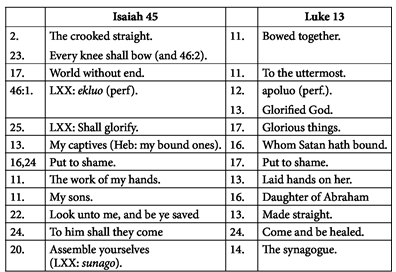
It was almost as though Jesus was bidding his listeners, who would have been even more familiar with the Old Testament than we are, to look at that prophecy!
One last passage
There is one last passage I’d like to look at together before we conclude. It’s Psalm 92. Title: “A Psalm. or song, for the Sabbath day”. It casts a light on the synagogue that we read about in Luke 13. There were two kinds of people in the synagogue the day that Jesus loosed the bowed woman from the bonds of the adversary.
First, there were those who rejoiced in the wonderful works of God, the works of the Sabbath day and of the messianic age.
“It is a good thing to give thanks unto the Lord, and to sing praises unto thy name, O most High: To shew forth thy loving kindness in the morning, and thy faithfulness every night, Upon an instrument of ten strings, and upon the psaltery; upon the harp with a solemn sound. For thou, Lord, hast made me glad through thy work: I will triumph in the works of thy hands. O Lord, how great are thy works! and thy thoughts are very deep” (Psa 92:1-5).
And sadly, there were those who did not understand, or recognize, the works of God in their midst. They did not understand the true meaning and purpose of the Sabbath. They were the “brutish” or beast-like. “A brutish man knoweth not; neither doth a fool understand this” (Psa 92:6).
They claimed that Jesus’ works were evil, but in fact, it was they that were “workers of iniquity”.
“When the wicked spring as the grass, and when all the workers of iniquity do flourish; it is that they shall be destroyed for ever: But thou, Lord, art most high for evermore. For, lo, thine enemies, O Lord, for, lo, thine enemies shall perish; all the workers of iniquity shall be scattered” (Psa 92:7-9).
And lest we miss her, the bowed woman is also here in this Psalm:
“The righteous shall flourish like the palm tree, he shall grow like a cedar in Lebanon” (Psa 92:12)
The Hebrew for palm tree is derived from a root word that means “to be erect”. Here then is the bowed woman: a true daughter of Abraham, by her faith. She rejoiced in the wonderful works of God, and looked forward to the messianic age to come, and she recognized the promised Messiah in Jesus. Because of her faith, Jesus singled her out and made her to stand upright like the palm tree, and like a cedar in Lebanon.
Conclusion
As we remember Jesus, the Messiah, and Lord of the Sabbath, and king of the Age to come, let us be thankful that he has called each of us out of the crowd and that he has given us the opportunity to be loosed from sin’s bondage and to stand upright, and glorify to glorify God.
As we partake of the bread and wine, may we resolve to devote ourselves to God’s work and service in the week ahead, and may the great age of healing, rest and time of refreshing come soon.
- The Testimony, 1973, p. 423. Full sentence is “Because disease is part of the legacy of sin, in the New Testament it is often attributed to Satan. Satan, which literally means ‘adversary’, is clearly being used as a term for an adverse state within the body or mind of the individual affected.”
- The Christadelphian, 1946, p. 4.
- From “Studies in the Gospels” by Harry Whittaker.
 The Origin of the Organic World – Part One