
It is easy to suppose that teaching is telling. In other words, if we tell our Sunday schoolers something they will learn it. Lecturing and storytelling are prime examples of this kind of teaching. To be sure, some students learn a lot from a lecture, and many of them remember important details of a story long after it has been told. It also goes without saying that it is important for the children to develop good listening skills. But good teaching often requires more than telling, because learning often involves more than listening. Some students are not good auditory learners, and for them other ways of receiving information are important.
Using all the common senses
There are several ways that students take in information. Hearing is just one of them. Seeing is another. When we draw on sound and sight at the same time, we have audio-visual instruction. Audio-visual instruction is often more effective than either one alone. Audio-visual materials are more engaging. It is no surprise that children often pay close attention to age-appropriate DVDs, and adults often find lectures more compelling when PowerPoint or Keynote illustrations are used.
There are other ways of taking in information as well. Manipulating objects can be instructive. Children learn by handling and manipulating things. Drawing, coloring and writing are common manipulative activities. So are doing jigsaw puzzles, working with matching cards, and physically putting things in order (e.g., sequencing). Often there is room to increase the use of manipulatives in Sunday school and to draw on their unique instructional power.1
Physical movement is a fourth way in which the senses are engaged and learning can take place. Skits, charades, finger puppets, and songs with body movements are just a few of the learning activities that involve physical movement.
There will even be times when the engagement of smell and taste are appropriate in a Sunday school lesson. The point is that all of our God-given senses allow us to take in information that contributes to learning.
Children differ
It is recognized that children differ in how they learn, and at least part of this has to do with the different ways in which they take in information. Some are excellent auditory learners. Others are more visual. Still others respond well to tactile (handling) or kinesthetic (moving) activities. Teachers are not the first to recognize this fact. The Bible honored these differences in people long ago.
“For the body is not one member, but many. If the foot (moving) shall say, Because I am not the hand (handling), I am not of the body; is it therefore not of the body? And if the ear (hearing) shall say, Because I am not the eye (seeing), I am not of the body; is it therefore not of the body? If the whole body were an eye, where were the hearing? If the whole were hearing, where were the smelling? But now hath God set the members every one of them in the body, as it hath pleased him. And if they were all one member, where were the body?” (1 Cor 12:14-19).
In the body of Christ we are not all alike, and we complement each other by serving with our different God-given strengths. Similarly, a body of instruction is more effective when it engages the different ways that children take in information and learn.
Can it really be done?
Is it possible for a teacher to accommodate so many differences in a single Sunday school class? Actually quite a lot can be done. Give a little thought to the things you already do and you may be able to find ways to engage more of the common senses. Think again about the examples of lecturing and storytelling. Each of these can be
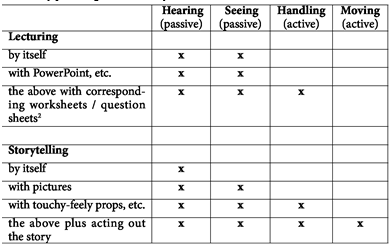
Go ahead. Evaluate the things you do in Sunday school. See if there are ways you can add something to engage more of the common senses. Almost certainly you will improve instruction in the process.
 The Origin of the Organic World – Part One