
The apostle Paul is one of the most important people to have ever lived. Paul’s transformation from sinner to saint is a pattern for us all. His call and preaching efforts make up over half of the book of Acts. His epistles make up nearly half of the New Testament. It is difficult to imagine how any of us would have been able to understand the gospel without Paul’s efforts. As the apostle to the Gentiles (Rom 11:13; 1 Tim 2:7; 2 Tim 1:11), his mission was nothing less than to deliver the Gentiles as an acceptable and holy offering to God: “That I should be the minister of Jesus Christ to the Gentiles, ministering the gospel of God, that the offering up of the Gentiles might be acceptable, being sanctified by the Holy [Spirit]” (Rom 15:15).
On the other hand, Paul is also the most misunderstood of the apostles. His epistles are full of polemics, with Paul defending his one true gospel against bad doctrine and bad behavior. Even his good partner Barnabas1found himself opposed to Paul on more than one occasion (e.g., Acts 15:36-39). Surprisingly, Peter and Barnabas and other Jewish believers in Antioch were persuaded by some brethren who came from James (the Lord’s brother and ‘Recording Brother’ for the Jerusalem Ecclesia) that Paul’s policies concerning Jewish and Gentile believers eating together was mistaken (Gal 2:11-14). Peter would later write,
“And account that the long suffering of our Lord is salvation; even as our beloved brother Paul also according to the wisdom given unto him hath written unto you; as also in all his epistles, speaking in them of these things; in which are some things hard to be understood, which they that are unlearned and unstable wrest, as they do also the other scriptures, unto their own destruction” (2 Pet 3:15-16).
Paul’s background
Acts and the epistles enable us to construct a fairly detailed resume for “Saul, who also is called Paul” (Acts 13:9).
Born in Tarsus, a city in Cilicia: “I [Paul] am verily a man which am a Jew, born in Tarsus, a city in Cilicia” (Acts 22:3; cf. 21:39; 23:34).
A free born Roman citizen:
“And as they bound him with thongs, Paul said unto the centurion that stood by, Is it lawful for you to scourge a man that is a Roman, and uncondemned? When the centurion heard that, he went and told the chief captain, saying, Take heed what thou doest: for this man is a Roman. Then the chief captain came, and said unto him, Tell me, art thou a Roman? He said, Yea. And the chief captain answered, With a great sum obtained I this freedom. And Paul said, But I was free born. Then straightway they departed from him which should have examined him: and the chief captain also was afraid, after he knew that he was a Roman, and because he had bound him” (Acts 22:25-29).
A tentmaker: “After these things Paul departed from Athens, and came to Corinth; and found a certain Jew named Acquila…with his wife Priscilla…and came to them. And because he was of the same craft, he abode with them, and wrought;
for by their occupations they were tent makers” (Acts 18:1-3). This occupation allowed Paul to move around freely. He could easily find work in any of the cities he visited. This particular trade put him in contact with lots of people, making it easy for him to share the gospel.
A Hebrew of the Hebrews:
“If any other man thinketh that he hath whereof he might trust in the flesh, I more: Circumcised the eighth day, of the stock of Israel, of the tribe of Benjamin, a Hebrew of the Hebrews” (Phil 3:4b-5; cf. Rom 11:1; 2Cor 11:22).
A Pharisee, son of a Pharisee:
“…brought up in this city [Jerusalem, Acts 21:15, 17] at the feet of Gamaliel, and taught according to the perfect manner of the law of the fathers, and was zealous toward God, as ye all are this day” (Acts 22:3; cf. Gal 1:13-14).
“My manner of life from my youth, which was at the first among mine own nation at Jerusalem, know all the Jews; which knew me from the beginning, if they would testify, that after the most straitest sect of our religion I lived a Pharisee” (Acts 26:4-5; cf. Acts 23:6; Phil 3:5-6).
Concerning zeal, persecuting the church: Luke depicts Saul’s persecution of the way, including Paul’s defense before the Jews and then before Agrippa:
“Saul, yet breathing out threatening against the disciples of the Lord, went unto the high priest, and desired of him letters to Damascus to the synagogues, that if he found any of this way, whether they were men or women, he might bring them bound unto Jerusalem” (Acts 9:1-2).
“I [Paul] persecuted this way unto the death, binding and delivering into prison both men and women” (Acts 22:4; see also vv. 5, 17-20; Acts 7:57- 8:3; 26:9-11).
Paul’s persecution of the ecclesia before his call is a recurring theme in his epistles: “For I am the least of the apostles, that am not meet to be called an apostle, because I persecuted the church of God” (1 Cor 15:9). “For ye have heard of my conversation in time past in the Jews’ religion, how that beyond measure I persecuted the church of God, and wasted it” (Gal 1:13). “Concerning zeal, persecuting the church” (Phil 3:6). The burden of this terrible sin weighed heavily on Paul’s conscience. It made him feel inadequate to be an apostle. He could not forget the damage he had inflicted owing to a religious zeal caused by his own ignorance and unbelief.
On the other hand, Paul’s transformation from persecutor to preacher prompted the Judaean ecclesias to glorify God in him:
“Afterwards I came into the regions of Syria and Cilicia; and was unknown by face unto the churches of Judaea which were in Christ: But they had heard only, that he which persecuted us in times past now preacheth the faith which once he destroyed. And they glorified God in me” (Gal 1:21-24).
Paul’s call out of darkness into light
Saul was transformed on the road to Damascus, when Jesus appeared to him in a light from heaven (Acts 9:1-22; 22:4-21; 26:12-23). As if dead and in the grave, he was without sight and didn’t eat or drink for three days, after which scales, as it were, fell from his eyes and he was baptized. Immediately he preached Christ in the synagogue, that he is the Son of God. He was called to preach the gospel to Gentiles, to be the apostle to the Gentiles.2
The calling of a prophet: arguing that his gospel came by revelation directly from Jesus Christ (Gal 1:10-24), Paul writes, “But when it pleased God, who separated me from my mother’s womb he called me by his grace, to reveal his Son in me, that I might preach him among the heathen; immediately I conferred not with flesh and blood” (Gal 1:15-16). Here Paul uses the same language as Jeremiah’s calling to become a prophet unto the nations: “Before I formed thee in the belly I knew thee; and before thou camest forth out of the womb I sanctified thee, and I ordained thee a prophet unto the nations” (Jer 1:5; cf. Isa 49:1-8). As Isaiah prophesied, Paul was to be a light unto the Gentiles (Acts 13:46-48; 26:22-23; cf. Isa 42:6; 49:6; 60:3).
One born out of due time: Listing the resurrection appearances of Christ, Paul writes,
“And last of all he was seen of me also, as of one born out of due time. For I am the least of the apostles, that am not meet to be called an apostle, because I persecuted the church of God. But by the grace of God I am what I am: and his grace which was bestowed upon me was not in vain; but I laboured more abundantly than they all: yet not I, but the grace of God which was with me. Therefore whether it were I or they, so we preach, and so ye believed” (1 Cor 15:8-11).
Having seen the glorified Lord, Paul was born again. This birth was premature because it happened before the time had come for the nation of Israel to repent.3Paul becomes a type of the future salvation of God’s chosen people, when “they shall look upon him whom they have pierced, and shall mourn for him”.
A pattern for all believers: More generally, Paul’s life-changing experience provided evidence for the essence of his gospel and established a pattern for all believers: if I Paul, the worst of all sinners, can obtain mercy and be saved through Jesus Christ, then anyone who believes in him can do the same:
“And I thank Christ Jesus our Lord, who hath enabled me, for that he counted me faithful, putting me into the ministry; who was before a blasphemer, and a persecutor, and injurious: but I abtained mercy, because I did it ignorantly in unbelief. And the grace of our Lord was exceeding abundant with faith and love which is in Christ Jesus. This is a faithful saying, and worthy of all acceptation, that Christ Jesus came into the world to save sinners; of whom I am chief. Howbeit for this cause I obtained mercy, that in me first Jesus Christ might shew forth all long suffering, for a pattern to them which should hereafter believe on him to life everlasting” (1 Tim 1:12-16).
The signs of an apostle: Paul was filled with the Holy Spirit: “And Ananias went his way, and entered into the house; and putting his hands on him said, Brother Saul, the Lord, even Jesus, that appeared unto thee in the way as thou camest, hath sent me, that thou mightest receive thy sight, and be filled with the Holy [Spirit]” (Acts 9:17). “Then Saul, (who is also called Paul,) filled with the Holy [Spirit]” (Acts 13:9). Beyond this, he had the power to convey the Holy Spirit to others, which only the apostles could do: “And when Paul laid his hands upon them, the Holy [Spirit] came on them; and they spake with tongues, and prophesied” (Acts 19:6; cf. 2 Tim 1:6; Acts 8:14-25).
He spoke with tongues and had the gift of prophecy: “I thank my God, I speak with tongues more than ye all” (1 Cor 14:18). “Though I speak with the tongues of men and of angels, and have not charity, I am become as sounding brass, or a tinkling cymbal. And though I have the gift of prophecy, and understand all mysteries, and all knowledge; and though I have all faith, so that I could remove mountains, and have not charity, I am nothing” (1 Cor 11:1-2).
Paul had an abundance of revelations, and wrought the signs of an apostle:
“It is not expedient for me doubtless to glory. I will come to visions and revelations of the Lord. I knew a man in Christ above fourteen years ago… of such an one will I glory: yet of myself I will not glory, but in my infirmities… And lest I should be exalted above measure through the abundance of revelations, there was given to me a thorn in the flesh, the messenger of Satan to buffet me, lest I should be exalted above measure… Therefore I take pleasure in infirmities, in reproaches, in necessities, in persecutions, in distresses for Christ’s sake: for when I am weak, then am I strong… Truly the signs of an apostle were wrought among you in all patience, in signs, and wonders, and mighty deeds” (2 Cor 13:1-12; cf. Acts 14:3; Rom 15:19).
Paul emphasizes that the signs of an apostle include not only signs, wonders, and mighty deeds, but also infirmities, reproaches, necessities, persecutions, and distresses for Christ’s sake.4It is difficult to identify Paul’s “thorn in the flesh”; but it seems to have been a recurring health condition that incapacitated the apostle whenever it surfaced.
Paul’s preaching and epistles
We cannot go into the details of Paul’s missionary journeys or his epistles in this short biography. He preached the gospel from Jerusalem and Antioch in the east to Rome (Acts 13-28) and possibly Spain (Rom 15:22-29) in the west. He summarizes his life as a preacher in poignant language:
“Are they ministers of Christ? (I speak as a fool) I am more; in labours more abundant, in stripes above measure, in prisons more frequent, in deaths oft. Of the Jews five times received I forty stripes save one. Thrice was I beaten with rods, once was I stoned, thrice I suffered shipwreck, a night and a day I have been in the deep; In journeyings often, in perils of waters, in perils of robbers, in perils by mine own countrymen, in perils by the heathen, in perils in the city, in perils in the wilderness, in perils in the sea, in perils among false brethren; In weariness and painfulness, in watchings often, in hunger and thirst, in fastings often, in cold and nakedness. Beside those things that are without, that which cometh upon me daily, the care of all the churches” (2Cor 11:23-28; cf. 2Cor 4:1-18).
Paul ministered unto the saints in four ways: he visited them directly when he could; and when he wasn’t free to go himself, he sent surrogates to minister on his behalf,5he wrote epistles to them as an apostle of Jesus Christ by the will of God,6and he prayed for them incessantly.7
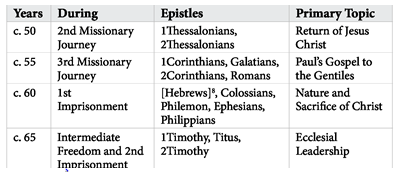
Paul’s epistles fall into four major groups, differentiated by time, topics, and recipients:
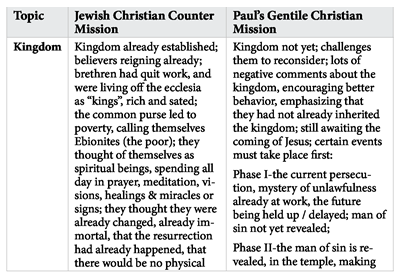
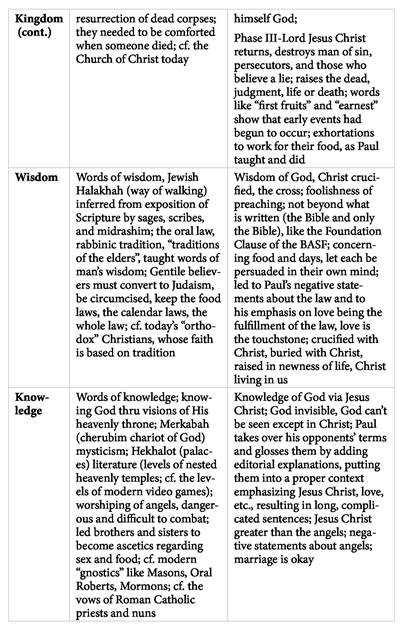
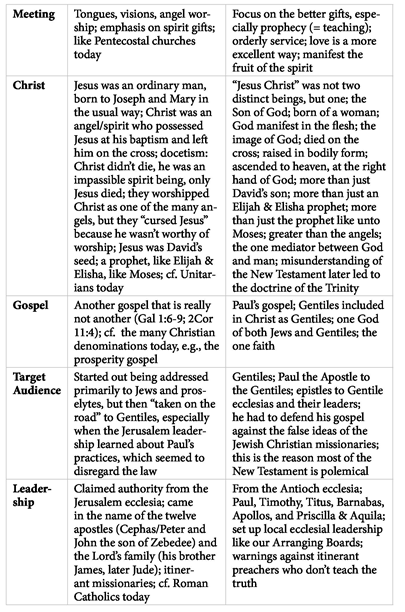
Although Paul wrote to address specific issues of his day, his epistles are surprisingly relevant today. The epistles are full of arguments against the false doctrines of the Jewish Christian counter mission:
An example to be followed
Paul uses himself as a powerful exhortation for us all, that we should be followers of him as he was of Christ:
“Be ye followers of me, even as I also am of Christ. Now I praise you, brethren, that ye remember me in all things, and keep the ordinances, as I delivered them to you” (1 Cor 11:1-2).
“Brethren, I count not myself to have apprehended: but this one thing I do, forgetting those things which are behind, and reaching forth unto those things which are before, I press toward the mark for the prize of the high calling of God in Christ Jesus. Let us therefore, as many as be perfect, be thus minded: and if in any thing ye be otherwise minded, God shall reveal even this unto you… What things also you learned and you received, and you heard and you saw in me, these things perform you; and the God of peace shall be with you” (Phil 3:13-15; 4:9).
“For I am now ready to be offered, and the time of my departure is at hand. I have fought a good fight, I have finished my course, I have kept the faith: Henceforth there is laid up for me a crown of righteousness, which the Lord, the righteous judge, shall give me at that day: and not to me only, but unto all them also that love his appearing” (2 Tim 4:6-8).
What a remarkable man was the apostle Paul! What a wonderful example for us to follow! It will be a delight to meet him in the kingdom. The grace of the Lord Jesus Christ be with us all. Amen.
- Acts 9:27; 11:22-26; 11:27-30; 12:25-15:35; 1 Cor 9:6; Gal 2:1, 9.
- Acts 9:15-16; 22:21; 26:16-23; Gal 2:2, 7-9; Eph 3:1-13; cf. Acts 28:30-31; 1 Cor 15:1-4.
- Lev 26:40-46; Deut 30:1-10; Ezek 20:33-44; Hos 2:14-23; Zech 12:9-13:6; Acts 3:19-21; Rom 11:12, 15, 23-32.
- Matt 5:11-12; Acts 2:22, 43; 5:12; ct. Matt 24:24; Mark 13:22; 2 Thess 2:9.
- E.g., 1 Cor 4:17; 2 Cor 12:17-18; Phil 2:25-30; 1 Thess 3:1-5; 2 Tim 4:12; Philemon 4.
- See Rom 1:1, 7; 1 Cor 1:1-2; 2 Cor 1:1; Gal 1:1-2; Eph 1:1; Col 1:1-2; 1 Tim 1:1-2; 2 Tim 1:1-2; Tit 1:1-4.
- E g., Rom 1:9; Eph 1:15-16; Phil 1:3-4; Col 1:3, 9; 1 Thess 1:2-3; 2 Thess 1:11; 2 Tim 1:3
 The Origin of the Organic World – Part One