
The Philippians 4:8 challenge
Do you look at your ear-budded teenagers and fear for what they are listening to on their MP3 players or smart phones? Do you suspect that you are struggling against worldly forces that have a greater influence on them than your all-too-brief Sunday school lesson? If so, here is something you can do about it! Teach them to use Bible truths to examine the moral quagmire they wallow in at school, in the movie theater, when they watch television or are on the Web — and when the ear buds are plugged in.
You have to help them understand that music can be a very wonderful or a truly dangerous form of communication. It can put the listener in an accepting mood that is valuable for worship and preaching, but it can also insidiously pervert the thinking. Music is a very important part of human expression. When words fail us, we often use music to express our ideas more effectively. Music is designed to affect our emotions and to be appreciated on a sub-intellectual level as well as an intellectual level.
I am not saying that all media are evil. But as I watch and listen, in order to discuss this with my students, I find a lot that is objectionable in the media on the basis of scriptural values. Here is my short list:
- Lack of respect for fellow humans;
- Frequent description of sexual acts in a wrong context, outside marriage;
- Obscene language;
- Avocation of injurious sexual practices;
- Avocation of homosexuality;
- Description and acceptance of the abuse of women;
- Sexually evocative dress, even for little children;
- Avocation of suicide or murder,
- Materialism
Rather than hit your students over the head with this horrifying list, a more successful approach is to inspire them with the ideals of the Bible. As you teach them, remember that teen idealism is not yet tempered by reality. Also remember that our reality is rapidly changing. Teens today face challenges to their faith that older generations did not experience. Teach your teens the importance of everyday practices such as good listening habits, and teach them to evaluate what they hear and see on the basis of godly principles.
An evaluation strategy
The following is a short unit of study that equips your teens to evaluate media, including the music they listen to, in terms of Bible truths. It starts with an all-important theme verse:
“Finally, brothers, whatever is true, whatever is noble, whatever is right, whatever is pure, whatever is lovely, whatever is admirable — if anything is admirable, if anything is excellent or praiseworthy — think about such things” (Phil 4:8).
Week 1
Start off with a word study of Phil 4:8. Divide your class into teams. Assign each team (or individual if your class is small) the task of studying one of the adjectives used in the verse. Ask each team to find other verses that describe or exemplify the particular qualities of the adjective. You will want to have a concordance and a good English dictionary on hand for your students to use. They should also be encouraged to use the cross-references in their Bibles. Have each team arrive at a definition of the adjective and write it down on a large piece of paper with Bible references. For example:
Pure = undefiled (James 1:27; 3:17; 1 John 3:3; Matt 5:8)
Post their papers in your class area. You may also want to provide magazines and have each group create a montage that illustrates their definition. Discuss their findings.
At the end of the class, discuss with your students what musical genres they enjoy. In recent discussions with my teen students, I have found a surprising variety of styles that they like. Have them identify specific songs and artists that are currently popular, and ask them to bring in the words of their favorite song for the next class. They can either write down the words by listening, or get them from the Web by searching “lyrics” and the title of the song.
Week 2
Just in case your students forget to bring in the words, search the Web to find a video or MP3 of a currently popular song. Key off the songs and artists that your students identified in Week 1. You can legally get MP3s of the songs on iTunes for minimal cost. There are also videos of some songs on the web that have the lyrics scrolling across the screen. If the images aren’t objectionable, this may be useful in Week 2.
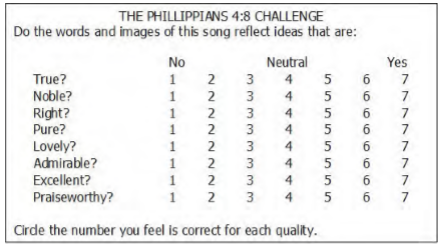
If your students bring in songs, have them evaluate the words with the following rebus. Otherwise you can surprise them with the fact that you’ve found their music on the Web, and have class members evaluate the words you brought in. Do not state your opinion of the song! Let your students reach their own conclusions. The form follows at the end of this article.
After your students have completed their forms, gather them for discussion. Here are some questions you might ask them:
- How did your selection stack up against the Philippians 4:8 challenge? Why?
- What effect does listening to this music and / or seeing these images have on the way you think, act, or feel?
- Have you changed your mind about this music? Why?
Allow the students to draw their own conclusions about their selections. You are planting seeds for future evaluations; don’t discourage their efforts. Help them learn to make Bible standards the foundation of their life.
 The Origin of the Organic World – Part One