
A year ago I inquired about the display case in our local library. One month it.had a display of children’s books, followed by one of dolls and then a display of lace. When I inquired about the possibility of a Bible display, I was told, “Oh, I don’t know, that’s very controversial. One woman wanted to do a display on angels and she was turned down.”
“But,” I responded, “It’s the world’s all-time best seller and it’s filled with history, knowledge and wisdom, unlike many of the really ‘controversial’ books on the library’s shelves.”
I persevered for three months and was finally told I could do the display but to be very careful about its content. I promised to be strictly generic!
Our county has 13 libraries and the first I tried brought many comments but no real contacts. For one thing, I only posted my name in the case as “display by…” The second site brought the same response, but it was a very small branch with limited traffic.
Now the display is in the main branch which has heavy traffic. I have heard nothing but positive comments and four contacts who took the time to find out from their research librarian how to get in touch with me. As a matter of fact, the research librarian said he has not had such a response to any of the displays done in the past. There is one more week to go at this location and our ecclesia rented a P.O. box so that we can post it in the display for any comments and inquiries.
Bible display
Using the library’s display case, we have arranged the material to be placed on three shelves with the middle shelf being the centerpiece.
Top shelf
This contains several versions of the Bible, a Bible in chronological order and a couple of books on how we got our Bible. The Bible versions are identified as to objective and targeted reading level. In addition, display cards contain comments from famous people about the Bible, information from various sources about what makes the Bible unique and a Bible Companion.
Middle shelf
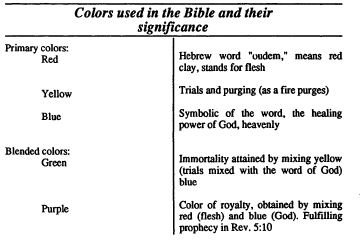
This is the main display and could be a stand-alone if need be. Various ribbons (see illustration) draw attention to the fact all of the information is tied to the Bible. The display sheets cover world history and archaeology in relation to the Bible, prophecy (with a special card on Daniel’s image), creation in contrast to evolution and the evidence for the resurrection of Jesus. The witness of science with respect to the Bible is covered along with the history of the Jews as proof the Bible is accurate. In addition, two charts point out the pattern behind colors and numbers in the Bible. There is also a note of caution about Bible reading and the address to contact for further information.
Bottom shelf
This contains a variety of material one could use to study the Bible including concordances, Bible handbooks, Bible atlas, interlinear Bible, books on the Dead Sea scrolls, Bible computer programs, an audio Bible, etc.
Further information
Sis. Connie does not have time or facilities to supply pre-made materials to others but she has supplied photocopies of pertinent material to the “Tidings.” We can copy these on request or Sis. Connie would appreciate someone taking responsibility to copy and distribute the package. For further information contact the “Tidings” or Sis. Connie Bonvechio (407)644-1659.
On following pages are the contents of some of the display cards.
A Word Of Caution
Remember playing the game of telephone as a child? The first person’s story differed tremendously from the person at the end of the line.
It should be impressed upon any Bible reader or student to read the words for himself, thereby casting aside those items which have been heard, but are not within the pages of scripture.
As one reads, and/or studies the Bible, one must remember to do so with an open mind: objectively — putting aside all preconceived ideas (which are subjective) and might impede true study. Tradition and dogma are handicaps in Bible study.
Along the same lines, have you ever thought how much dogma stands in the way of real progress? Webster’s dictionary defines dogma as: 1. “Something held as an established opinion;” or 2. “A point of view or tenet put forth as authoritative without adequate grounds.” Notice that dogma is not fact — it is only opinion which is so strongly held that it is considered fact. Progress is made only when dogma is replaced by fact. Dogma is comfortable for most people so it is not easily changed. In fact, it is the glue of any status quo — and the basis of many governments and organizations today.
Dogma may be comfortable, but it can be dangerously limiting. It blocks progress and perpetuates falsehood. It takes an enormous amount of energy and considerable time to loosen the hold of dogma.
Read it for yourself and then decide if the actual contents of the Bible agree with what you have heard it says!
Creation
Many people believe that this wonderful world of ours came about by chance. They think some spark of life just happened and from its beginning, over millions of years, there came the ordered and beautiful world we see today. Marvelous things like our eyes that see and our ears that hear just came about by chance. Tell that to a physician who sees the body at work in such ways that man is still bewildered by some of its machinery! Tell an avid gardener that his garden just happened! And tell a mother who is holding her child for the very first time that he evolved from an amoeba.
Not so many years ago most scientists believed the “theory of evolution,” but today more and more well-known and well-qualified scientists are coming back to the view that the evidence of design and order around us speaks of a Great Designer. The magnificence of nature in all its splendor could not have just been the result of chance. The Bible says, “In the beginning God created the heavens and the earth.” It does not tell us how He did it, and if it did we probably would not understand it anyway. But one thing is for sure, if the rest of the evidence on this display is factual and secure, accepting the account of creation does not seem difficult as opposed to accepting an unproven theory. You be the judge!
A Unique Book
It is the best seller of all time.
It sold over 15 million copies last year.
It took over 1500 years to write — over 40 generations of time.
It was written by over 40 authors from every walk of life — kings, peasants, poets, scholars, philosophers, fishermen, statesmen and more!
Written on three different continents: Asia, Africa and Europe.
Written in three languages: Hebrew, Aramaic and the N. T. in Greek.
It is printed in 273 different languages.
It is popularly priced from $2 to $25.
Its subject matter covers every subject under the sun.
It is a progressive revelation dealing with “God’s redemption of man.”
The tree of life, forbidden in Genesis, is opened in Revelation.
The principles laid down within its pages agree throughout the book even
though it was written by so many different writers!
It is translated into many different versions, with various levels of difficulty.
It is not difficult to interpret if patience is exhibited and scripture is compared with scripture.
For many people it comes with a longer-than-lifetime guarantee.
Resurrection Of Jesus
Did Jesus Christ really live and teach in Israel at the beginning of the Christian era? Was he crucified? Did he literally come back to life after being dead for three days?
You may find it easy to say “yes” to the two rust questions, as secular history has record of him– but do you accept the miracle of resurrection? -The Christian hope. I Corinthians 15:17.
- 1 – The reality that Christ walked this earth has been substantiated by secular history.
- 2- Christ appeared to many people after his resurrection as recorded in Matt. 28:9,10; Mark 16:9; Luke 24:13-34, 36-43; John 20:1-24; I Cor. 15:6-7; Acts 9:3-6 and Rev. 1:1.
- 3 – If the rest of the evidence — prophecy, history, archaeology and scientific data — is true, why not the resurrection?
- 4 – Numerous skeptics have denied the fact Jesus rose from the dead or have tried to explain it away. One such skeptic was Dr. Frank Morrison, a lawyer. Morrison was convinced that Jesus didn’t rise from the dead. In 1930 he set about to examine the evidence; he intended to expose the resurrection to be nothing more than the happy ending to a fairy-tale story about a good man called Jesus. So Morrison did a thorough study of the facts. He ended up writing a book quite different from the one he had planned. The evidence was overwhelming. The introductory chapter of his book is titled, “The Book that Refused to be Written.” His book is called “Who Moved the Stone?”
His conclusion was that Jesus did indeed rise from the dead.
Science
Science consists of set principles or scientific laws which govern our physical world. To the scientist, his world is ever changing — he is always adding to his knowledge. The principles don’t change, they are constant. What changes is man’s perception of these principles. Examples of scientific principles are the law of gravity and the laws of thermodynamics.
The Bible is full of scientific principles which were stated and recorded by its various writers. What is even more amazing is the writers were not scientists but somehow knew the subject matter and specific data which happens to be consistent and true.
Examples:
- Columbus and Magellan’s concern for the shape of the earth would have been put at ease if they had access to the Bible before they sailed (14001500’s A.D.). They would have read in Isaiah 40:22 (written in 740-690 B.C.) that God sits above the circle of the earth. In Job 22:14 (1600 B.C.) he talks of the circuit of heavens and Solomon talks of setting a compass (circle) upon the face of the deep (Prov. 8:27, 1000-700 B.C.). How did Bible writers know these details?
- Matthew Fontaine Maury, founder of the science of oceanography, was ill. His son read to him Psalm 8 that God put under man “the fish of the seas and whatsoever passeth through the paths of the seas.” Astonished to make such a discovery, Matthew’s faith in the accuracy of the Bible led him to finding the principle lanes or paths in the sea, and these are followed by ocean-going vessels today. How did Bible writers know in 1000 B.C. what the wisest men on earth did not understand until recent times?
- Color — The study of color in relation to the Bible is another amazing scientific witness to the reliability of the scriptures. There is purpose behind the colors of the spectrum in the rainbow, the curtains of the tabernacle, Ezekiel’s Temple and the pillars of the New Jerusalem. The seven colors of the rainbow display for man a natural miracle of the complete redemption of man. Primary colors: Red — stands for man-flesh; Yellow — trial and purging (as fire does); Blue — healing power of God’s word, eternal presence. Blended colors: yellow and blue make green — yellow for trial and blue for the word = green which signifies immortality. EXAMPLE: One can go through many trials in life, if they possess a belief in God and His word -this process will ultimately yield immortality (I Cor. 15:2,54). This is a small example of the miraculous use of color in scripture.
- Numbers — The universe relies on mathematical precision. Numbers used in scripture have precise meanings. The scriptures have numerous patterns woven beneath the surface, completely independent of the writers, which place the divine stamp of approval upon its pages. Dr. Ivan Panin, one of the world’s leading mathematicians, discovered the mathematical pattern beneath the surface of the Greek and Hebrew manuscripts of the Bible. Furthermore he states, “No mortal in 100 years could possibly have carried out the design found in a single book of the Bible if he devoted the entire 100 years to the task. It must be remembered that with each additional sentence the difficulty greatly increases, and owing to the limitations of human intellect, soon becomes hopeless.”
 The Origin of the Organic World – Part One