
We must not lose sight of the fact that the eating of the first passover in Egypt was coincident with the first day of the first feast of unleavened bread and was followed almost immediately by the exodus. This evidently all took place in one night.
“They set out from Rameses in the first month, on the fifteenth day of the first month; on the day after the pass-over [was killed must be implied for Bro. Beale to be correct] the people of Israel went out triumphantly in the sight of all the Egyptians” (Num. 33:3 RSV).
That the children of Israel were thrust out in the small hours of the night of the passover is made clear by Exodus 12:30,42 and by the following:
“Observe the month of Abib [an earlier name for the first month which was later changed to Nisan], and keep the passover to the LORD your God; for in the month of Abib the LORD your God brought you out of Egypt by night” (Dent. 16:1).
The meaning of “at even”
From a careful reading, it becomes evident that to speak of a day of the month “at even” means the evening which ends the specified day and begins the next. That must be so for the following passages to harmonize.
“In the fourteenth day of the first month at even is the LORD’S passover. And on the fifteenth day of the same month is the feast of unleavened bread unto the Lord: seven days ye must eat unleavened bread” (Lev. 23:5,6 KJV).
“And ye shall observe the feast of unleavened bread; for in this selfsame day have I brought your armies out of the land of Egypt: therefore shall ye observe this day in your generations by an ordinance for ever. In the first month, on the fourteenth day of the month at even, ye shall eat unleavened bread, until the one and twentieth day of the month at even” (Ex. 12:17,18).
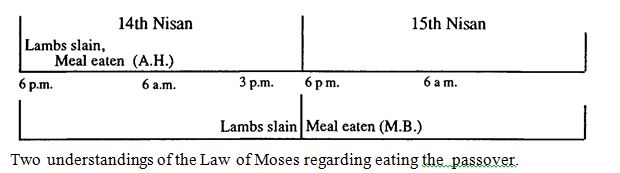
The first passage tells us that the seven-day feast of unleavened bread began on 15th Nisan. The second tells us that it began on the 14th of Nisan at even. There is no inconsistency if we understand the phrase, “14th day of the month at even” to mean, “the interval during which the 14th ends and the 15th begins.” In that case, it becomes clear that the sentence in Leviticus 23:5 (“In the fourteenth day of the first month at even is the LORD’S passover”) means that the passover was properly slain at the end of Abib 14th (i.e. our 3-6 p.m. time period) and not the beginning as Bro. Hayward implies. I can therefore find little fault with the Jews of Jesus’ day for following this timetable.
Last supper not Jewish passover
Apart from one passage in Luke, which we’ll consider below, all the allusions in Matthew, Mark and Luke (the synoptic gospels) are to preparation for the passover — a process which took place in the late afternoon of the 13th Nisan and early opening hours of the 14th. This was the time when Jesus sent the disciples to prepare for passover (Matt. 26:17-19; Mk. 14:12ff; Lk. 22:7ff).
The KJV of Matthew 26:17 says they were sent “on the first day of the feast of unleavened bread” but this is impossible, for the passover had not yet been held and the feast of unleavened bread began after passover. “The feast of” is not in the Greek. “The day of preparation” (Nisan 14) was, by Jewish practice, the “first day of unleavened bread” as well as the day on which the passover was slain (Mk. 14:12). Early on the 14th, preparation for passover consisted in sweeping the house and gathering all leaven to one place, to be disposed of later. (It is probable that Zephaniah 1:12 alludes to this, or a similar practice.)
In each synoptic, the account of the sending of the disciples to prepare the passover is followed by the record of the last supper — as though the last supper was the passover for which they were preparing. We feel, however, that the foregoing makes it clear that all they did was to prepare the room for the passover meal which was to be eaten the next evening. The last supper, although held in the prepared chamber, was not a passover. It was just their ordinary evening meal at the end of the day. (Of course, it became very special because the memorial supper was included with it)
The language of Luke 22:15
What, then, are we to make of Luke 22:15? “And he said unto them, With desire I have desired to eat this passover with you before I suffer” (Lk. 22:15).
It must have been obvious to the disciples that this was not really a passover. Clearly, Jesus was making a different point. The last supper was to be for these believers, and all who would follow, what passover had been for the Jewish nation. It would mark the last meal before the slaying of the firstborn which would make possible deliverance from bondage. Indeed, it was to be a new passover, styled by Jesus as “this passover.” While the last supper was to have much the same significance as passover, it was to be separate from it, for “We have an altar, whereof they have no right to eat which serve the tabernacle” (Heb. 13:10).
Summary of the point
Thus while agreeing with Bro. Hayward that there is no confusion between the gospel records, I suggest a different solution to the problem. The synoptics speak of the disciples going to prepare for passover in the ritual way of the Jews; they then speak of the last supper in such a way as might suggest that the last supper was that passover. I think, however, the clear evidence of the law shows the last supper preceded the passover feast by about 24 hours and Jesus therefore died on the cross (while the lambs were being killed) at the exact moment decreed by the law: “between the evening” or “at even” on the 14th of Nisan just before the feast of unleavened bread began on the 15th with the eating of the passover meal.
 Strong’s Concordance