
Psalms 111-118 are known as the “Hallelujah” Psalms because of their emphasis on praising God and because the phrase, “Praise the LORD” (or Hallelujah) occurs eight times in this section. In the Jewish community, they are Psalms that are used to praise God at Passover time and at other major feasts during the year. As we take a few moments to consider some of their content, we find powerful exhortation and encouragement for ourselves.
Psalms 111 and 112
These two Psalms fit together in a most instructive manner. While one praises God and the other speaks of the godly man, their content is remarkably parallel. Consider the following table:
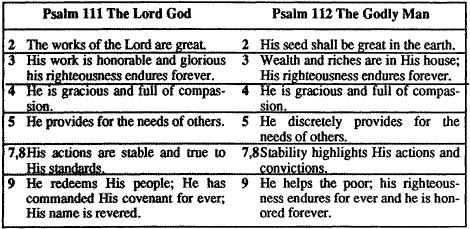
This comparison highlights a very important point — the godly man manifests the characteristics of his Heavenly Father and is therefore blessed in sharing God’s eternity.
Psalm 113
This Psalm examines an amazing paradox. The Lord is far above us in power and might. He looks down to see not only the earth but also the heavens. Yet He has taken a great interest in exalting the “poor from the dust, and…the needy from the ash heap to make them sit with princes…He gives the barren woman a home, making her the joyous mother of children” (vs. 7-9 RSV).
Even mere men, who have positions above others, rarely take time to consider the needs of the less fortunate. But our Heavenly Father, who holds the position of ultimate power, considers the poor and contrite of heart to exalt them in His grace.
Psalm 114
Here is a recounting of the deeds performed by the Lord in bringing the children out of Egypt and into the promised land. The powers of nature were totally at God’s command as He paved the way for the children of Israel to enter Palestine.
Psalm 115
Psalm 114 is really continued here as Psalm 115 is a song of praise offered by the nation in gratitude for God’s involvement in their lives.
The Psalm begins with a declaration by His people that the exaltation of God’s name is their great concern (vs. 1-3). This, of course, is exactly the opposite idea from the materialistic humanism which dominates much of today’s educational curriculum. We pray for the coming kingdom that God’s name be vindicated in all the earth.
There follows a biting exposure of the futility of worshiping the gods that men devise (vs. 4-8). We see it around us in the frustration and turmoil of those who have the wealth and notoriety that most people worship -what foolishness to devote our lives to the pursuit of that which has already proven to be vain and unsatisfying. In the words of the Psalm, those who devote themselves to idol worship become like their idols, worthless and foolish (v. 8).
We, on the other hand, should put our trust in the Lord (vs. 9-13). At times, we may feel that He has forgotten us. But as proven by His past actions, if we remain faithful, the help and blessings of God are sure.
Verses 14-18 are magnificent first-principle verses declaring in no uncertain terms that man’s place of reward is not in heaven but upon earth. There is no reward upon death for “the dead praise not the LORD, neither any that go down into silence” (v. 17 RSV). But the godly look forward to being raised to eternal life and the certain fulfillment of God’s covenant.
Psalm 116
While Psalm 115 is a congregational praise, Psalm 116 is an individual thanksgiving for deliverance from the imminent danger of death and is thus similar to Hezekiah’s thanksgiving in Isaiah 38.
Answered prayer evokes love and lifelong praise on the part of the godly man (vs. 1-4). It is a very natural tendency to pray in times of trouble. We should do this and it is honoring to God that we rely upon Him. But when things are going well, we should remember His help in times past and continue to render abundant praise.
The character of God was realized by the Psalmist during his trial (vs. 59). The fundamental qualities of our God’s character are that He is gracious, righteous and merciful (v. 5). In trial, we also recognize that we are “simple,” greatly in need of instruction and wholly reliant upon God. We realize, too, that we should abandon anxiety and put our trust in the only One who can deliver us.
Faith’s triumph must be followed by grateful thanksgiving (vs. 10-14). While the Psalmist never lost faith, he had to wait on God’s timetable for alleviation of his struggle (v. 10). Now that deliverance has been granted, what can man do for God? Nothing but to further rely upon God’s saving power and publicly express his commitment to the only God who can save (vs. 12-14).
The closing words of Psalm 116 are particularly fitting for those who have just risen from the waters of baptism or for those who renew their vows in partaking of the memorial emblems: “I will take the cup of salvation…O LORD, truly I am thy servant…thou has loosed my bonds. I will offer to thee, the sacrifice of thanksgiving, and will call upon the name of the LORD” (vs. 13,16,17).
 The Origin of the Organic World – Part One