
“I appeal to you, brethren, by the name of our Lord Jesus Christ, that all of you agree and that there be no dissensions among you, but that you be united in the same mind and the same judgment” (I Cor 1:10).
In light of this verse, it is a good thing to minimize and eliminate any dissension or disunity that hampers the spiritual well-being of our Christadelphian community. To that end, the following topics are submitted for consideration:
A unique teaching position – Christadelphians have a unique belief and teaching position in Christendom. There is a wide chasm between our theology and that of even the nearest-matching Christian church.
What “Truth” is – The Truth of Scripture is an integrated whole centered in the being of God and the person of the Lord Jesus Christ. Doctrine entails both belief and behavior. “First principles” are a convenient label to describe fundamental Bible teaching which is clearly supported by both the Old Testament and New Testament.
A unique teaching position
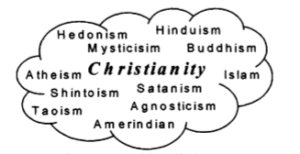
Some world religions
Christianity is one of many world religions. The person who believes that Jesus is the Christ, and that there is salvation in no one else, has taken a stand for Christianity. This basic Christian belief is uniquely different and is, therefore, at odds with all of the world’s “isms.” When details are examined, the adherents of Christianity usually find themselves far removed from all these other “man-made” religions. Christadelphians ought to be grateful for the buffer provided by those who profess Christ as their Savior.
However, Christadelphian beliefs are clearly unique in the spectrum of Christianity.
The Christadelphians take a stand for Bible Christianity. As a result, our understanding of Scripture has put us at odds with most of Christendom. For the gospel we preach and teach is unique, and is repudiated by both mainstream and sectarian churches. Fundamental differences in key doctrines have effected a “great chasm” like that mentioned in Luke 16:26, where theologically, “none may cross from there to us.” Bottom line: there is a huge gap between Christadelphian “first principles” and those held by the rest of Christendom. The following diagram illustrates:
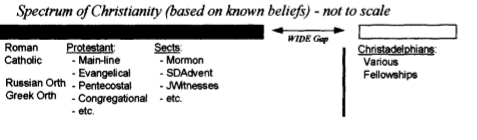
What makes the Christadelphian theology unique? And how does it conflict with the general teaching of Christendom? Consider these seven areas:
The nature of man: mortal vs. immortal soul (don’t really die).
The devil: serpentine human nature vs. fallen angel rebel (root cause of evil).
The nature of Jesus: Son of Man, Son of God, vs. God the Son (the trinity).
The atonement: representative sacrifice vs. substitution (appeasement).
The gospel of God: entails the Abrahamic and Davidic promises fulfilled by Jesus’ first coming, and to be established by Christ’s second coming vs. limited to the life and sacrifice of Christ, and salvation guaranteed by belief in Jesus.
The reward of the faithful: eternal life in God’s Kingdom on earth vs. immortal soul goes to heaven upon death (no waiting for the reward).
The attitude toward Scripture: individual belief and behavior is shaped by God’s word vs. unwillingness to investigate and be taught by the text (selective obedience).
Taken together, these representative areas make the Christadelphians a community apart. While there is not disagreement on every point with every church, we cannot join with other Christian groups who do not share the same thinking in these ‘first principle’ areas. Sooner or later a “first principle” issue would arise, and one or both of us would be compelled to break off from the other.[note: This was the writer’s experience as a college student with the Inter-varsity Christian Fellowship, as a counselor at an Anglican church youth camp, as a participant in a Catholic “renew” class and most recently, as a member of a non-denominational Bible study at work./note]
As long as we maintain our unique set of “first principles,” there is an unbridgeable doctrinal chasm between us and the rest of Christendom.
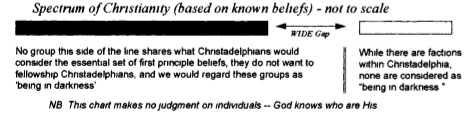
Given the validity of this conclusion, a very interesting point becomes apparent. Because we are in a unique theological arena, doctrinal disputes within Christadelphia differ obviously and markedly from those we have in the rest of Christianity. Differences among us typically arise from our unique views and are rarely of a “first principle” nature. Instead, we wrangle about issues on a different level and of a different kind.
Conclusion
Let us be keen to maintain our unique teaching position and contend for the indisputable truths of scripture. But let’s recognize that when we are arguing among ourselves on our own side of the chasm, we risk creating schism in the household of faith.
 The Origin of the Organic World – Part One