
We make decisions and they have consequences We can’t always control the consequences, but God can It is important for us to make good decisions and to learn the God-given lessons that come from the consequences.
The following activity is what I like to call a decision tree activity It can be a lot of fun to carry out with a group of almost any size Each decision called for m the activity leads to two or more consequences and the need to make more decisions There is a branching effect, and it can be instructive to follow several different branches, one at a time, to see where the decisions may lead.
“A Story with 24 Endings” starts off by describing a situation, and a problem, that many young people can relate to Then it offers four decisions or choices a young person might make After this, each decision leads to consequences and the need to make another decision, until the branching effect has led to 24 different endings to the story.
With 24 avenues or decision paths to explore, there is a lot of room for thought and discussion For example, can a good decision lead to bad results? Can a bad decision seem to work out okay and deceive us into thinking the ends justified the means? Does God always have to reward our faithful actions with immediate blessings? The mechanics of decision making are brought into sharp relief in the process.
It is possible to read the following story and think about it on your own If, you decide to use it for a group activity, here’s how I like to carry it out.
Show the group the overall structure of the decision tree Explain how it can be followed, step by step, to 24 different outcomes.
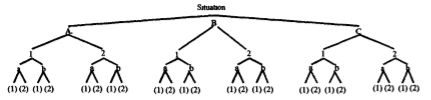
To begin the process, read the situation to the group It poses an initial problem Advise them there are three immediate choices they may make A, B or C They are to select one of these Part of the fun is that they do not know what any of the choices are or where they may lead After choosing one of the three, they are committed to the chain of events that follows from it At each succeeding level, they again select the letter or number to follow With each new selection, the group leader reads the decision/outcome that goes with it and identifies the new problem which results There are lots of surprises along the way, and the activity can often draw some interesting reactions as it unfolds.
Here are the details of the story the group leader relates.
Situation
You deliver the morning newspaper in your neighborhood. It is Saturday morning and you have just finished collecting from your customers. You have $75 in your pocket. Of course, you owe most of the money to the newspaper company. Only $20 is actually yours. You’ve been wanting a new bike, and a kid in the neighborhood comes along and says he will sell you his mountain bike for $70. You know the bike would cost a lot more in the store. What will you do? You have enough money in your pocket to pay the kid $70.
[Choose A,B or C]
A. You buy the bike. Now you have only $5 left and you can’t pay your newspaper bill this week. You don’t pay the bill. What happens?
[Choose 1 or 2]
- The newspaper company calls your home. Your mom answers. She asks you why you haven’t paid your bill. What will you say?
[Choose a or b]- You tell her you forgot to pay it. She says, “Okay, let’s get in the car and go pay it now.” What will you do?
[Choose 1) or 2)]- You tell her you lost the money. What will she say to you? What is going to happen next?
- You slip into her bedroom and take $50 from her purse. You go pay the bill. Is the problem solved? What will happen?
- You tell her you lost the money. She is upset, but she believes you. She pays the bill and requires you pay her back over the next three weeks. Is the problem solved?
[Choose 1) or 2)]- She discovers the new bike. Now what?
- The kid comes by and asks you how you like the new bike. Your mom hears this. Now what?
- You tell her you forgot to pay it. She says, “Okay, let’s get in the car and go pay it now.” What will you do?
- The newspaper company calls your home on Monday. You answer and they tell you your bill is overdue. It must be paid or you could lose the route. What will you do?
[Choose a or b]- You say you will be right over to pay the bill, and they believe you. Of course, you don’t have enough money. What are you going to do?
[Choose 1) or 2)]- You do nothing. The next Saturday you owe for two weeks but still don’t have enough money. You avoid paying the bill again. What will happen?
- You go around to your customers and try to collect next week’s money in advance. You tell them you are going to be away next Saturday and can’t collect then. What’s going to happen?
- You tell them your money was stolen last Saturday, and you can’t pay right now. What’s going to happen next?
[Choose 1) or 2)]- They ask if your mom knows about the stolen money, and you say, “No” They ask to speak with your mom Now what?
- They tell you they will send the manager over to talk with you and your mom about the stolen money Now what are you going to do?
- You say you will be right over to pay the bill, and they believe you. Of course, you don’t have enough money. What are you going to do?
B. You buy the bike You convince yourself you will do some odd jobs next week and catch up on your newspaper bill You can probably get away without paying the bill for a few days Will everything work out okay?
[Choose 1 or 2]
- Your mom sees the new bike and asks you how you got it What are you going to tell her?
[Choose a or b]- You tell her you paid for it out of your paper route money After all, that’s true, isn’t it Are you off the hook?
[Choose 1) or 2)]- The newspaper company calls and tells your mom your bill is not paid What now?
- The police show up at your front door and tell your mom you have a stolen bike Will anyone believe anything you say now?
- You tell her it belongs to the kid next door and he is letting you ride it Will you get away with this?
[Choose 1) or 2)]- She tells you to return it right away What will you do?
- Just then the kid next door comes over and asks if you have gotten a new bike How do you get out of this jam?
- You tell her you paid for it out of your paper route money After all, that’s true, isn’t it Are you off the hook?
- A police cruiser comes around the neighborhood They stop you as you are riding the bike They tell you the bike is stolen (No wonder the kid was willing to sell it so cheaply!) What are you going to tell them?
[Choose a or b]- You insist the bike is yours You bought it with your paper route money What are the police going to do?
[Choose 1) or 2)]- The police ask where you live and take you home to have a talk with your mom What now?
- The police ask where you got it, how much you paid for it, and when you got it What will you tell them?
- You tell them the bike belongs to the kid you bought it from and you are only borrowing it What will happen next?
[Choose 1) or 2)]- The police question the kid you bought the bike from and he denies knowing about the bike What kind of trouble are you in now?
- The police take your name and address They also take the bike They inform you they will be back to question you and the other kid Now you are out money and bike What will you do?
- You insist the bike is yours You bought it with your paper route money What are the police going to do?
C. You don’t buy the bike. Somehow you don’t trust the kid. Of course, you still have enough to pay your newspaper bill, and you are doing the right thing. Will everything work out okay?
[Choose 1 or 2]
- Your old bike breaks down, and now you have to walk on your paper route. Should you have bought the new bike after all?
[Choose a or b]- Without a bike, it takes much longer to do your paper route. Some customers start to complain they are getting their papers late. Should you have bought the new bike after all?
[Choose 1) or 2)]- Following up on customer complaints, the newspaper company takes away some of your customers. Should you have bought the new bike?
- Some customers stop giving you tips when you collect, and your income starts to fall off. Should you have bought the new bike?
- You twist your ankle while walking the route. You know this wouldn’t have happened if you were on a bike. Should you have bought the new bike after all?
[Choose 1) or 2)]- You end up paying the kid to do your route for you while your ankle heals. Should you have bought the new bike after all?
- Your ankle is so slow to heal, you have to give up the paper route. There goes your income! Should you have bought the new bike?
- Without a bike, it takes much longer to do your paper route. Some customers start to complain they are getting their papers late. Should you have bought the new bike after all?
- The kid comes around to your house a little later and offers the bike for $50. You still have your paper route money. Will you give in to such a terrific offer? How can you go wrong?
[Choose a or b]- You don’t buy it, and the kid really begins to give you a sales pitch. He is moving and has to sell the bike. You can set your own price! Are you ready to buy it now?
[Choose 1) or 2)]- You don’t buy it. Later you learn that it was a stolen bike. How do you feel now?
- You give in and buy it. Later you find out the bike was stolen. How do you feel now?
- You don’t buy it. On Monday the kid gets some of his friends to start picking on you at school. You suspect they are trying to force you to buy a stolen bike. What will you do?
[Choose 1) or 2)]- You still don’t buy the bike and they beat you up. Should you have bought the bike after all?
- You tell your mom. Both of you pray about it. Then she calls the school to tell them what is going on. Wouldn’t it have been easier to buy the bike in the first place?
- You don’t buy it, and the kid really begins to give you a sales pitch. He is moving and has to sell the bike. You can set your own price! Are you ready to buy it now?
Follow-up Questions
1 When you do something wrong, what is the one way to clear yourself?
2 Can you think of a biblical person who sinned and afterward was cleared (justified)? How did it happen? A classic case is in II Samuel 111-12,14 if you can’t think of others
3 Identify one of the 24 decision paths m the story in which
- One he led to another serious crime
- A he seemed to work What is not okay when a he seems to work?
- The person tried to solve the problem by ignoring it What happened?
- The person tried to do the right thing and it backfired Is this fair? What’s the lesson?
- The person tried to do the right thing but eventually gave m to pressure How can this mistake be avoided in life?
- The wrong course of action cost the person everything
- The best course of action was taken Explain why you think it was best
4 When you do something wrong and afterward own up to ft, does this entirely free you from the consequences of your actions?
 The Origin of the Organic World – Part One