It seems Incredible that the president of the most powerful nation in the world is currently unable to achieve peace in the Middle East. Despite continued talks over the past months between Israelis and Palestinians, President Bill Clinton was unable to achieve a peaceful resolution. Clinton’s mantra throughout the talks was, “It’s very, very hard.” Clinton was referring to the negotiations that related directly to the issues surrounding the ancient city of Jerusalem. The city, wholly revered by both Jews and Arabs, has become a “burdensome stone” to the peace process.

History

Will peace ever be achieved when so many obstacles are in the way of this goal? For their part, the Palestinians justify their intransigence by insisting that they are the blameless vic­tims of the Middle East conflict and that the burden of concessions rests entirely on the aggressor, Israel. Pal­estinian leaders insist that they cannot compromise on the 1967 borders be­cause they have already conceded the three-quarters of historic Palestine that became Israel after the 1948 war.

The Palestinian leadership rejected the United Nations partition plan in 1947 and then joined the Arab world’s attempt to destroy Israel. Not until a half century later did the Palestine Lib­eration Organization finally accept the fact of Israel’s existence.

Ironically, the uncritical sympathy the Palestinian cause has enjoyed in the international community has only encouraged Palestinian self-righteousness, making compromise that much more elusive. And compromise on behalf of both parties is exactly what is required in order to achieve peace.

Current agreement nearly up

The clock is ticking. In order to achieve peace it must be accomplished by September 13, 2000. Both the Israelis and Palestinians have pledged to have the interim peace agreement expire on this date. For their part, the PLO leadership has pledged to unilat­erally declare a state if a permanent peace has not been achieved by that date. Unfortunately for the Palestin­ians, in order to achieve peace, the issue of the city of Jerusalem must be resolved. This is by far the most dif­ficult obstacle to overcome. The primary reason is that God has decreed it to be a virtually insurmountable ob­struction to the path to peaceful agree­ment. In addition, the Israeli parlia­ment has declared to President Ehud Barak that Jerusalem is off limits to negotiation.

Foreign minister resigns

The internal war over Jerusalem became public on August 2, 2000, when, in the wake of the Camp David summit meeting, Barak’s foreign min­ister (and acting prime minister while Mr. Barak was at Camp David) resigned over Barak’s willingness to even consider compromising with the Palestinians on Jerusalem. The foreign minister, David Levy, promptly moved his loyalty to the opposition party, the Likud, which is the leader in declaring war over the matter of Jerusalem.

Levy claimed he resigned due to the “grave situation that had developed because of the introduction of the once-taboo subject of Jerusalem at Camp David” The New York Times quoted Levy as saying “These things touch upon the soul of the people It turns out that we are talking about the very heart of ancient Jerusalem We are talking about things that the vast majority of the people are connected in their soul, their past, present and future I can say that the fact of an announcement that we would get ac­cess [implying Israel would no longer control access but would have to be granted it] to the Western Wall takes us backward to the time before the establishment of the Jewish State” Levy continued, “Regarding the Temple Mount, the Holy of Holies, they refused to understand the con­nection of the Jewish people to the Holy of Holies That is a denial of our past in this land “

The “Jerusalem coalition”

Levy’s new boss, Likud leader Ariel Sharon, was adamant about his concern over the capital of the State of Israel Mr Sharon warned that, on this issue, what he called his “Jerusalem Coalition” would “stand on guard,” ready to call Parliament back into session if any agreement threat­ening Israeli sovereignty over all of Jerusalem appeared likely Sharon added in remarking to journalists that Jerusalem was the rightful possession of the Jewish people and must never be divided in any way “Jerusalem is a symbol that kept the Jews together for thousands of years,” he thundered at one point, hammering his hand on the lectern “Jerusalem is a symbol You don’t touch it”

In order to ensure support for their stand that Jerusalem was off limits, the Likud party threatened other Israeli coalition members The New York Times reported “The five ultra-orthodox members from the United Torah Judaism party were clumped in the back of the chamber not taking part in the vote, saying they were under orders from their spiritual leader, Rabbi Shalom Yosef Elyashiv, to abstain Shouting Likud members descended on them and threatened that if they did abstain, Likud would vote against a bill they have sponsored granting additional government benefits to large families The five votes were duly cast against Mr Barak”

The stumbling block

Clinton confirmed in an interview after the Camp David meetings that Jerusalem is indeed the key stumbling block in achieving peace Clinton was quoted as saying “Jerusalem was the sticking point that prevented agree­ment at last month’s Camp David summit meeting Jerusalem is the most difficult issue They did not agree on everything else But they’re close enough that I think that we can still get an agreement”

The topic of Jerusalem is indeed a thorny issue because God has mandated Jerusalem will always be a bur­den, particularly during the latter days Scripture states, “It shall happen in that day that I shall make Jerusalem a burdensome stone for all peoples, all who would heave it away will surely be cut in pieces, though all nations of the earth are gathered against it” (Zech 12 3 NKJV)

Throughout the centuries, Jerusalem has been a burdensome stone God’s prophetic word is faithful and true Today we are witness to another period in history when the prophecy is dramatically true.

Clinton wishes above all to leave the presidency with the peace of Jerusalem as his crowning achievement. The resolution of the problem of the sovereignty of Jerusalem, how­ever, will not come from man’s strength. God alone will work out His purpose, culminating in the return of his Son to this very city. We look forward to that day when Jesus Christ will stand on the Mount of Olives to bring Jerusalem to a time of peace when she will no more be threatened by her enemies.

Vladimir Putin, he Russian president, paid a nostalgic return visit to Germany last month, having spent many happy years there as a Russian spy. After a cordial summit meeting with Chancellor Gerhard Schroeder, he referred to his host in passing as the German “Fuehrer.” Although the comment caused a slight embarrassment, it helped emphasize the developing respect that Russia has for the new Germany. While “fuehrer” is not often used in modern German politics because of its associations with Hitler, it is a term indicating great respect for the authority of one in high office. This month’s article will look at the developing relationship between these two nations and conclude that yet again Germany and Russia are working to­gether in harmony towards common goals and initiatives.

June conference

In June, 2000, a conference be­tween the new Russian leader and Schroeder was held in Germany. Schroeder opened the discussions by hailing a start of “a new strategic part­nership between the two nations.” In turn, Putin described Germany as “Russia’s leading partner in Europe and the world.” Although one might contend that bilateral political discus­sions tend to be full of rhetorical and exaggerated discussion between the parties, since the June conference both countries have worked towards put­ting these words into practice. Of particular note is the fact they have agreed to jointly pursue plans for a missile early-warning system run from Moscow and a “regional” anti­missile defense system covering Eu­rope. Most significantly, Europe is defined as covering territory from the Atlantic to the Urals, and from the Arctic to the southern Mediterranean.

This is by no means the first at­tempt to try and organize a join part­nership between these two nations. At the end of the cold war, the Kremlin under Mikhail Gorbachev stepped up its efforts to woo the Germans away from the North Atlantic Treaty Orga­nization alliance with the United States and into a new strategic partnership with Moscow. Mr. Gorbachev called the relationship “Our common Euro­pean Home.” However, in a timely turn of events, the Soviet Union col­lapsed before it could join forces with Germany. Today, we have a renais­sance of the program first envisioned by Mr. Gorbachev, a program that foresees the need for a strong rela­tionship between these two nations.

Could this program be extrapolated to include the rest of Europe or is this proposal merely limited to Germany and Russia? The Toronto National Post reported, June 21, 2000: “With the Cold War over, the Soviet threat evaporated and Russia at least a nomi­nally democratic country, Europeans suddenly are finding the idea of a ‘Common European Home’ a rather attractive prospect.” One might ar­gue that the European Economic Community and the common EU currency already meet the objective of a “Com­mon European Home (CEH).” The European home as defined by both Gorbachev and Putin, however, in­cludes an arms treaty, not merely a common market.

If the CEH is to succeed in the full sense of the proposal, it must first overcome some very significant hurdles, the least of which is obtaining NATO’s buy in. As one might expect, NATO would be reluctant to agree to a European arms treaty. Therefore in order to succeed, the CEH has to place all armaments on soil that belongs to a non-NATO mem­ber nation, such as Russia.

A new superpower?

The Post article indicated there is a push on by some Europeans to have the European Union become an independent superpower. And the key link to this new superpower is a Euro-­Russian and more particularly a German-Russian partnership. For this partnership to succeed, Chancellor Schroeder need not look far to observe a precedent. There are two German traditions in foreign policy: the Western tradition of Helmut Kohl, who based security on a U.S. alliance and the tradition of Willy Brandt, which sought rapprochement with Russia to achieve German security.

The last time Russia and Germany decided to join forces was in 1922. These two nations signed that year what is referred to as the Rapallo treaty. Under the terms of this agree­ment, the Soviets agreed to help Germany secretly rearm itself outside the limits of the Versailles treaty. In re­turn, the Soviets would receive economic aid. Both Schroeder and Putin may be tempted to arrange a second Rapallo treaty. Under the terms of the North Atlantic Treaty Organization, Germany cannot bear arms that can be used for offensive purposes. However, they are permitted to bear arms that can be used for defensive purposes. Therefore, if any relationship between Germany and Russia were to succeed, Russia would become the bearer of the armaments, not Germany.

One need not look far to determine the current situation in Russia. Putin described the situation himself in the July 8, 2000, State of the Nation ad­dress. The New York Times reported July 9, that President Putin declared: “After ten years of independence, Russians have built only the carcass of a civic society and have yet to shoulder such basic obligations as obeying laws. A falling birthrate and aging population threaten to make Russia a senile nation.” Now imagine this same senile nation with armaments capable of “protecting” the enlarged European area, which includes Medi­terranean countries. With Russia and Germany pressing ahead for an early warning missile system one wonders if it will remain a system merely to protect the immediate vicinity or one that will be used in an offensive fash­ion.

Whatever the outcome of these new developments, let us pray that God’s Son may return to the earth shortly.

The Death of Syrian President Hafez al-Assad once again draws our attention to the Middle East, While U.S. President Bill Clinton is attempting to leave the presi­dency with a peace legacy in his port­folio, the peace process seesaws back and forth. Israel has withdrawn from a five-mile wide section of land in Lebanon while across the Jordan, the leadership in Syria must struggle to stabilize itself. This months article will look at the changes that have taken place in Syria, Lebanon and Israel with particular emphasis being placed on the peace process.

Lebanon

For the past 22 years, Israel has occupied a five-mile wide section of their northern neighbor, Lebanon. This was a security buffer as Lebanon ex­perienced both a civil war during these years and general unrest. During May 2000, Israel unilaterally retreated from the “security buffer” and currently all is quiet along the front. In June, the United Nations said that it is close to setting its seal on the proceedings by certifying Israel’s full withdrawal.

Teams of soldiers, cartographers and mine-sweepers have worked their way along the front line, trying to chart the old international frontier. The Israeli army, eager to earn the inspec­tors’ approval, has been demolishing fortifications that straddle the border. It blew up a communications mast which stood a few meters inside Leba­non on May 29, and other minor structures are to receive similar treatment.

The Economist Magazine reported on June 5, 2000 : “Israel, too, is cel­ebrating the fact that the withdrawal, however hasty and sloppy, was car­ried out without any Israeli casualties at all. The approval rating of the Prime Minister, Ehud Barak, has soared, and he is now turning his attention to the Palestinians in talks with Bill Clinton. Even the embarrassment of the army’s unsentimental abandonment of its Lebanese allies is quickly dissipating as the government offers cash hand­outs and resettlement promises to the mercenaries and their families who straggled in as refugees.”

The Economist continued to re­port, “The Lebanese army has now reimposed restrictions on travel to the former occupied zone, making it dif­ficult for trouble-makers to get near the border. Although the government, in deference to its ally Syria, refuses to send troops to ‘guarantee Israel’s security,’ it has filled the border area with policemen. And Hizbullah, the guerrilla group that spearheaded resistance to the Israeli occupation, is also behaving responsibly. The gun­men who swarmed through the area in the first days after liberation have disappeared. Instead, bulldozers bear­ing Hizbullah banners are building earth barricades to keep cars away from the most sensitive spots along the fron­tier.”

One irony of the situation is that the Israeli government handed out machine-guns to residents of border villages. The peace is being maintained by humble villagers carrying high-powered weapons for which training has not been provided.

Syria

On June 10, 2000, the peace pro­cess may have taken one step back­wards with the death of Syrian leader Hafez al-Assad. Although the ruling Bath party moved quickly to appoint a new President, Assad’s son Bashar, it may be several months if not years before the new leader places his stamp on a peace mission. Although Mr. Assad insisted that Israel would have to return all land, including the Golan Heights, if peace were to be achieved, the peace process has moved forward significantly. Upon assuming the Presidency, Bashar Assad will have to first and foremost assume control of his rulership. It is questionable that peace with neighboring Israel will be at the top of his list of priorities.

Former President Assad ruled Syria with an iron fist for 30 years, it is unlikely his son will command the same level of respect as his father without some form of bloodshed. The son, a 34-year-old eye doctor by training, has been received into the annals of Syrian power rather hurriedly. The New York Times, June 12, 2000, wrote that Bashar “cemented his claim to his father’s job as Mr. Assad secured a number of new titles and positions today. Abdel-Halim Khaddam, one of Syria’s two vice presidents who are nominally running the country, named him the com­mander of Syria’s armed forces at the same time promoting him from the rank of colonel to lieutenant-general.”

In addition, the regional command or governing body of the ruling Bath Party unanimously nominated him for the presidency. Parliament must also endorse the nomination and set a date for a referendum to confirm the choice. The Parliament has already amended the country’s constitution to reduce the minimum age for a presi­dent to 34 from 40, briskly eliminat­ing a legal obstacle to Mr. Assad’s ascension.

However swift Bashar Assad’s ascension to the Presidency may be, he faces an uphill battle for ruling the nation in the style of his father. The New York Times reported: “The young Mr. Assad, a relative neophyte who held no official position in the gov­ernment or the party while his father was alive, is unlikely to command any­thing close to the independence and absolute authority of the deceased ruler. The uncertainty caused by the sudden death of his father rippled be­neath statements of support for Mr. Assad issued by Mideast leaders to­day.”

God’s hand at work

Whether or not the peace process will be impacted remains to be seen. God works in the lives of men to ensure that His will is fulfilled. Former President Assad ruled and controlled his nation with absolute dominance so that peace was only an option if it was Assad’s desire. By all accounts his desire was to hold fast on his claim to the Golan Heights. This resulted in a breakdown in mid January of the peace process. Despite a meeting between President Clinton and the late President Assad in Geneva in March this logjam was never resolved.

The younger Mr. Assad inherits the foreign policy issues that occupied his father, but may not have the same freedom to strike a deal with Israel. He has also been left an unsettled situation in Lebanon where the abrupt Is­raeli withdrawal put pressure on Syria to rein in the militias that it had supported in the formerly occupied zone in the south. How the Lord will or­chestrate the next steps toward a political climate ripe for the Savior’s return is of the keenest interest to His people.

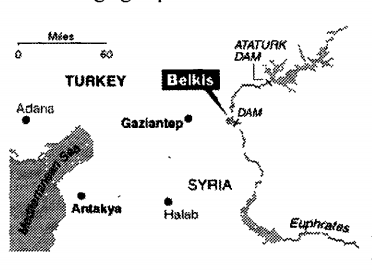
In order to help irrigate land, create jobs and provide electricity for a growing populace, Turkey has built the second of two dams along the Euphrates River. The Belkis Dam was completed April 29, 2000, and in its wake, nine villages and an entire town were flooded. Further downstream, Syria is now the recipient of a decreased water flow and an already parched land is becoming water starved. This month’s article will look at the problems plaguing Syria and the Euphrates River, with emphasis being placed on the political and geographical matters that have recently come to light.

A new dam

Approximately three years ago, the Turkish government started work on this second dam in what is referred to as the Southeast Anatolia Project, which is a centerpiece of Turkey’s massive water and hydroelectric development plans. The Ataturk Dam was completed in 1996 and helped turn the once raging Euphrates River into a mild stream. The Belkis Dam, completed in April, 2000, will further deny Turkey’s downstream neighbors of water and help to literally dry up the Euphrates. Revelation 16:12 speaks about the sixth angel pouring his bowl on the great river Euphrates and having its water dry up to prepare the way for the kings from the east.

This verse is usually interpreted to reflect the political drying up of the region in and around the Euphrates River. However, a strong argument can be made that the prophecy refers to both a political and literal drying up of the river. The literal drying up of the river will be particularly emphasized over the next several years while the area behind the dam is flooding, creating a new man-made lake. Filling the lake will reduce by 40% the downstream water flow into Syria. As one might expect, Syria has voiced concern over the “water theft” as they call it. According to Syria, Turkey is breaking international law by controlling the water flow and drying up the river.

Hafez Assad

According to the London, England-based Sunday Telegraph, the ailing president of Syria, Hafez Assad, suffered a cerebral hemorrhage. The newspaper reported, April 29, 2000: “Mr. Assad suffered the stroke at the beginning of April, leaving him incapacitated and with double vision. His public appearances are extremely limited and only possible with heavy medication. He received heavy doses of steroids before a meeting with Bill Clinton, the U.S. president.” The 69 year-old dictator, already seriously ill with a history of heart problems, failed to deliver his traditional address to the nation on April 7, the anniversary of the founding of the Baath party. For the first time during his presidency, he also missed the Independence Day celebration on April 17.

Mr. Assad’s failing health has and will set the Middle East peace clock back several years. The threat of a destabilizing succession battle in one of the most powerful and secretive Arab states has prompted Ehud Barak, the Israeli Prime Minister, and Mr. Clinton to back Mr. Assad as the best hope for peace in the region, despite his record as a sworn enemy of Israel. Unfortunately, Mr. Assad’s health has been deteriorating so quickly that American intelligence experts now believe he has only months to live.

Leadership vacuum feared

The death of Mr. Assad would create both a leadership vacuum and a power struggle to replace him at the presidential helm. Although it may be too early to speculate, it is assumed that Syria will face a vicious power struggle for the presidency between Mr. Assad’s younger brother, Rifaat, and his son and chosen heir, Bashar. Whatever the outcome, a post-Assad Syria is likely to take a tougher stand toward the peace process because any new government will have to consolidate competing political forces in Damascus.

Access to Galilee

Currently, the major stumblingblock to a peace settlement between Israel and Syria centers around one of the most pristine natural resources in the Middle East — water. Mr. Assad has refused to budge over his demand that Syria should gain access to the Sea of Galilee and the fresh water that the lake contains.

Israel has offered to withdraw from the Golan, which it has occupied since the 1967 war, but has insisted on keeping control of a 100 meter strip of land next to the lake, as well as the lake itself. The demand for Syria to have unfettered access to the Sea of Galilee and its fresh water supply is all the more pressing now that the Euphrates water had been cut by 40%. Hopes that Mr. Assad might be persuaded to back down from his demands of access to the Sea of Galilee diminish daily as the ever-reliable water supply from the north becomes increasingly unreliable and unpredictable. As a result, Syria must hunker down and find resources elsewhere – even at the cost of peace in the Middle East.

God’s plan and purpose is clear. During the kingdom age, the land will be refreshed and renewed and water will flow abundantly (Ezekiel 47). Until that day, however, water shall remain more precious than oil and wars will be fought over this precious commodity. Let us pray that a renewed land and people may be established on this earth shortly.

The Current on again off again Israeli – Syrian peace talks are off again and the principal sponsor of the peace negotiations, the United States, is currently upset with Israel. America is also attempting to block Israel’s sale of military hardware to China.

Weapons to China

During the past several months, Israel has decided to boost her economy at the expense of the peace process. In particular, Israel has recently announced plans to sell high-tech armaments to China, going di­rectly against the wishes of the United States’ government. The April 4, 2000, New York Times reported that during a meeting between U.S. Defense Secretary, William Cohen, and Israeli Prime Minister, Ehud Barak: “Mr. Barak did not give Washington the assurances it wanted for Israel to cancel plans to sell conventional and high-technology weapons to China including early-warning AWACS planes. Israel has been selling weap­ons to China for more than a decade. But it has come under increasing pres­sure from the United States to cancel the deals.”

The United States has been pressuring Israel to abandon the weapon sales to China “because of the potential of changing the strategic balance in that region, with the tensions run­ning high as they are between China and Taiwan.”

Mr. Barak responded that Israel would “take into account” American concerns. But he indicated that Israel expects to proceed with the promised sale of at least the first radar-equipped aircraft.

“We are aware of the sensitivity in the United States with regard to China,” he said. Then he quickly added, “We are, of course, aware of our commitments in the contracts that we signed.”

China’s president to Israel

During April, Chinese President Jiang Zemin broke new ground by becoming the first Chinese leader ever to visit Israel. The visit was planned to help ensure Israel would deliver the weapons that had been ordered by China.

According to Israeli military officials, Israel notified the United States four years ago of its intent to offer airborne radar surveillance systems to China. It was reported in the New York Times that the “Pentagon offi­cials reviewing the proposed contract determined then that Israel would not be providing China with proprietary American military technology.” However, since then, there has been a new government installed in Taiwan that has strained relationships with China, resulting in the U.S. changing its tune.

For their part, the Americans have indicated that, should the sale be con­cluded, the support for the huge $17 billion military-aid package Israel is seeking in connection with an even­tual peace treaty with Syria will be jeopardized.

It will be difficult at best, however, for Israel to back down on the China deal. The sale of the radar system will provide Israel with a much needed $230 million, but more impor­tantly, it will set the groundwork for future military sales. In addition to this sale, Israel has been laying the groundwork for the past ten years to bring in additional revenue through the sale of four AWACS-type planes. This sale, if realized, will be its largest sale to China yet, estimated as a several billion-dollar order.

Since the 1990’s, China has em­barked on a major program to mod­ernize its military. By far its biggest arms supplier has been Russia, which sold it MIG fighter jets, warships, submarines and missiles. Since 1997, when Israel first established diplo­matic ties with China, it has quickly become China’s second largest sup­plier and is looking to move into the number-one position.

Many peaceful advances

Not all is negative on the peace front. Since the right-wing govern­ment was replaced last summer by a broad coalition including several left­ists and human-rights advocates, cru­cial policy changes have been made helping facilitate the peace process.

The torture of Palestinian suspects has been banned. The practice of stripping Palestinians of their resi­dency rights in East Jerusalem has all but ended. The equal right of Arabs to land allocated by the state has been affirmed. And for the first time in Israel’s history, land long considered part of a Jewish town was taken away and returned to the Arab village from which it was expropriated decades ago. The number of Palestinian administrative detainees, those impris­oned without charges, has plummeted to 9 from 66 last April and hundreds in previous years. In April, Israel re­leased one of 16 remaining Lebanese who are being held, in contravention of international law, as “bargaining chips” for captured Israelis.

Other changes, even unofficial ones, reflect a fundamental relaxation of Israel’s security-conscious attitudes toward territory and the use of force. The demolition of illegal Arab homes in East Jerusalem and the West Bank, for instance, has declined sharply since Barak took office in July, according to statistics kept by the Btselem human-rights organization. In East Jerusalem, all the demolitions since November were done by the municipality, which is run by a right-wing mayor, and none by the national government.

More land exchanged

In March, Israel and the Palestin­ians agreed on the next area of West Bank territory to be handed over to Palestinian control. This agreement removed a persistent stumbling block to resuming negotiations on a perma­nent peace. The latest handover will put another 6.1 percent of the West Bank under full Palestinian control. In March negotiators for Israel and the Palestinians agreed on maps delineat­ing the areas to be handed over, and the transfer is expected to take place shortly, leaving the Palestinians in full or partial control of 42.9 percent of the West Bank.

It’s difficult at best to ascertain whether or not this government will be successful in negotiating a broader peace. Although steps are being taken to move toward peace, we realize that lasting peace will only come with the return of our Lord Jesus Christ to set up his kingdom on earth when Jews and Arabs will dwell peacefully under his righteous rule.