
God brought the flood because “the earth also was corrupt before God, and the earth was filled with violence.” Deeply grieved by this situation, God destroyed the disobedient and encouraged righteous Noah and his family to replenish the earth (Gen. 6:6,13; 9:1). Although only Noah and his family were left, God knew the human tendency to quarrel would still be present. He therefore issued this command: “Whoso sheddeth man’s blood, by man shall his blood be shed: for in the image of God made he man” (Gen. 9:6). Thus God condemned murder and initiated the death penalty.
Life is a gift from God and anyone taking a life with intent must forfeit his life. Strong measures were needed then as now to prevent violence from getting the upper hand, thus the death penalty was imposed both as a deterrent and to rid the world of murderers.
Provision for murder without intent
Those committing first degree murder were to be executed. The avenger of blood, the nearest kinsman of the victim, assumed the role of implementing the penalty (Num. 35:19). Yet if a death was accidental, God provided a way to escape the avenger’s sword. This protection took effect once the slayer reached a city of refuge. These were six cities, appointed by Mose as a sanctuary for any citizen who might “kill his neighbor unawares” (Deut. 4:42).
Jewish tradition records that the road to the cities had to be level, 32 cubits broad and marked by finger posts bearing the words “Refuge, Refuge.” Tradition also says magistrates sent out surveyors every 15th of Adar to repair the roads by removing every obstacle and bridging every stream.
Protection was not afforded for any cases where previous hatred existed, or when the murderer used a weapon or lay in wait for the victim (Num. 35:16-20). Christ does not provide refuge for the willful sinner. Thus, with an obvious allusion to those denied entry to the cities of refuge, scripture says: “For if we sin willfully after that we have received the knowledge of the truth, there remaineth no more sacrifice for sins, but a certain fearful looking for of judgment and fiery indignation, which shall devour the adversaries” (Heb. 10:26,27).
The six cities
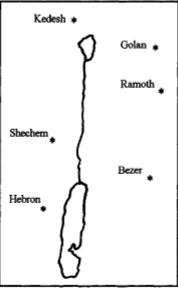
The cities were in the shape of a U around the sea of Galilee and the Dead Sea They were strategically spaced so that the vast majority of Israelites were within a day’s journey – 50 km – from refuge After accidentally killing someone, a man could flee to the nearest city Once inside the gate, he could await his trial in safety If the outcome were favorable, the slayer could remain in the city secure from the avenger Then, upon the death of the High Priest, he was free to leave (Num 35 25) If he ventured outside prematurely, his life was m danger (I Kg 2 36-46).
The northernmost city, Kedesh, was in the mountains of Galilee m the territory given to Naphtali Before Israel could use it, Joshua had to slay its king (Jos 12 22) Later in the time of the judges, Barak resided there (Jdg 4 6).
Shechem, the second city, was between two mountains m the territory given to Ephraim Here on Mounts Gerizim and Ebal blessings and cursings had been pronounced Two of the curses were against intentional violence (Deut 27 24,25).
On the way to Shechem (Sichem, Sychar) a refugee might recall many echoes of Israel’s early past It was here that Abraham first came when he entered Canaan and built an altar unto the Lord Here the land was promised to his seed as an inheritance (Gen 12 6) One event that took place here thousands of years later is also significant Here Jesus met the Samaritan woman at Jacob’s well and revealed to her that he was the Christ, Savior of the world (John 4 5, 42).
The third city, Hebron (Kirjatharba,), was in territory given to Judah At an elevation of 927 meters, Hebron is the highest town in southern Israel. This sanctuary would be visible to the slayer from a great distance as he strove to reach it before the avenger could overtake him David and his men hid here m the caves, perhaps taking advantage of the elevation to avoid Saul Innocent of any sin against Saul, God protected David When circumstance improved, David reigned from Hebron for more than seven years (II Sam 2 11).
The fourth city, Bezer, is only mentioned four times and then only concerning the Levitical cities It was a walled city, the southernmost refuge on the east side of the Jordan “Bezer” means “fortress,” although ma wilderness, Bezer offered protection to those inside.
The fifth city was Ramoth (Ramoth Gilead, the heights of Gilead) Ironically, when Jehu was here anointed king of Israel, he was instructed to avenge the blood of God’s servants murdered at the hand of Jezebel (II Kgs 9 1-8) Being near the Syrian border, it was frequently conquered by the Syrians for varying periods of time.
Golan is the last of the cities of refuge It is m Manasseh’s territory east of the sea of Galilee This area is frequently in the news as the Golan Heights, much disputed between Syria and Israel Ironically, the mean-mg of “Golan” is “rejoicing”
Use not recorded in scripture
Curiously, there are no clear references to the use of these cities as places of refuge Was Abner, who had killed Joab’s brother Asahel, actually taking refuge m Hebron when Joab killed him? (II Sam 3 27) If so, this may be the only biblical account of the use of the city for its designated purpose.
 The Origin of the Organic World – Part One