
Conflicts in teens
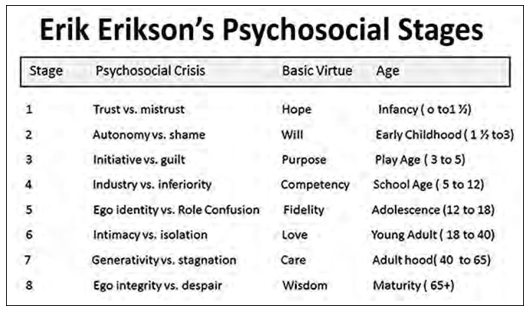
Over the summer, I had the pleasure of teaching, and learning from, a co-ed teen class of 13-19 year olds, at Bible School. The purpose of my class was to introduce the teens to Erik Erikson’s human development concept1which proposes that each specifically defined age group has a psychosocial crisis between two conflicting forces that needs to be resolved. Teens need to resolve the conflict between a sense of identity or of role confusion. If they are successful in achieving a sense of identity they are rewarded with the virtue of ‘fidelity’. Fidelity is defined as both a commitment to oneself and the acceptance of others, even when there are ideological differences. It is the ability to live by society’s standards and expectations and still be true to oneself.
We started the week reading Psalm 139 with special emphasis on the following verses, and particularly the bolded phrase which struck a chord with many of the teens.
“For you created my inmost being; you knit me together in my mother’s womb. I praise you because I am fearfully and wonderfully made; your works are wonderful, I know that full well. My frame was not hidden from you when I was made in the secret place, when I was woven together in the depths of the earth. Your eyes saw my unformed body; all the days ordainedfor me were written in your book before one of them came to be” (Psa 139:13-16 NIV).
God’s definition of fidelity could be reworded as ‘believing that we are all fearfully and wonderfully made, as each of us reflects the image of God in our unique way’.
Social media
Throughout the week we focused on specific societies or communities in which we live. One of the classes addressed social media and the role it plays in these young people’s lives, and we talked about their struggle to find their true identity amidst the pressures and expectations of Snapchat, Twitter, Instagram, Facebook, etc. By the way, Facebook, I learned from one of the teens, is “for older people” (emphasis on older!).
To be honest, I came to this conversation with the expectation that adults are generally out of the loop and believe myths about how social media negatively impacts our youth. For example, I recently read in NASW News (National Association of Social Workers, June 2016), “While technology like social media may help students who would otherwise be isolated stay in contact with friends outside of school, it can also isolate people.” The article concluded that teens perceive that they are interacting when in fact they are not. It is my understanding that this is a widely held view by many adults who did not grow up with technology and have not adapted as well to this new way of interacting. I went into this class discussion on social media with the expectation that this myth would be busted.
During the conversational class on social media with the teens — which ran through break and into the next session (thanks to the interest and understanding of the third period teacher) — I was both amazed and, quite frankly saddened, to realize that the isolation, peer pressure, anxiety, depression, sense of unworthiness, low self-esteem (their words), and identify confusion experienced by this group of young people was real and more serious than I had realized. And that they are fully aware of these issues. Intellectually, they knew how “insincere” and “false” social media can be, and at the same time are emotionally vulnerable and feel the pressure to compete and gain validation from their peers; who probably feel the same. Rather than busted, the myth seemed to have more depth than anticipated.
There is an expectation that high school students have a Facebook account in order to keep in touch with school activities. One teen shared about her drama class, and how one student who is not on Facebook misses out on after-school events that are solely posted on social media.
The addiction of teens
I learned that teens appear to be addicted to “being liked”. As one girl explained, she did not experience any social pressure from celebrities because she would never meet these people, and knew that their photos have been airbrushed. However, the pressure from pretty girls at school, whom she personally knows, who post almost perfect photos of themselves, which are instantly liked by many people, is intense. Again, intellectually, this group of teens knows that being liked is almost a scam. I learned that the best time to post on social media sites is between 4pm and 5pm, and again from 10pm to midnight. These are the peak times, and the likelihood of being ‘liked’ is high. And, of course, if one doesn’t receive the required amount of likes, then the posting is immediately removed. This gives the impression that popular, good-looking people are always liked. So, even knowing that these are well-used tricks by those who post on social media, it does not stop the emotional fallout of feeling less-than in comparison.
The concept of echo chambers that reinforce negative opinions, views and perspectives was also explained to me. Echo chambers are places where extremely negative political, religious, racially disparaging views are not counteracted with either facts or positive opposites. As one teen explained, “People’s views are just echoed back at them” by others who share the opinions. Many of these teens are aware of this sub-group of social media sites where you can be validated and negatively encouraged with eating disorders, self-harm behaviors and suicidal ideation. For example, those suffering from bulimia are encouraged with “Way to go!” type of sentiments when they report new weight loss, rather than with support and resources for help to overcome this eating disorder.
One theme that was repeated throughout this discussion was “the waste of time” that these teens experience as a result of spending too much time on social media. This was true even for those who use social media to learn about what is going on in the world and to keep up with political issues. Reddit was the most commonly used source, and the few teens who use this site shared that they believe it is an unbiased news source, as posts will receive comments that either agree with the original viewpoint or comments that provide an alternative angle. (Reddit is, therefore, a great example of a site that is not an echo chamber.) Although this site is used for current events and generally more productive online time, they still acknowledged that time online seemed wasted. So, why are they still using it?
Addiction
We had already spent a class on addiction issues and, working with the abbreviated definition of addiction, “using more than intended, despite the negative consequences” we began to look at the use of social media through this lens. Towards the end of the class teens were expressing a curiosity about how life would be: if they didn’t use social media as a validation tool; if they had fewer but more authentic friendships; and whether this could be done on an individual basis or whether “we’d all have to get off at the same time”. One teen shared that she felt she had missed so much of her friend’s lives just while being at the bible school (this was on the 4th day), but at the same time realized that by next week when she was back at home, those friends’ lives would have moved on to something new and she would be back feeling connected. Going without social media for a week would not actually affect her friendships, rather it was the habit/addiction to using social media that was making her feel left out.
I challenged this group of teens to go one week without social media; only one accepted this challenge. However, I heard later on that day that another teen had stopped checking her Instagram and Snapchat accounts because “it was a waste of time” and she “didn’t need to know what was going on.” A few weeks after the Bible School, I checked on the teen who had decided to go a week without Facebook and was informed that his account has now been closed and he feels that he “is much more productive” with his time.
Part of the discussion time was used to create a cost/benefit analysis on social media and the following is the result. These are the exact words used by the teens:
Pros of using social mediaStore photos Stay in touch with friends “Meet” new people Help to organize events Get jobs Find interest groups Have a perception of validation Find old friends Expand mind/view Entertainment value Community news |
Cons of using social mediaEcho chambers reinforce negative views Opinions are treated like facts Warped sense of beauty, worldview, life Lack of privacy Provides venue for infamy Reinforces unauthentic life Desensitized Belief against your morals Victimization — pity party Titillating stories/gossip Some sites are pro-eating disorders, self-harm, and suicidal ideation Over exaggerate problems Makes life impersonal Waste of time |
Cons of not using social mediaFeel that they don’t know what’s going on in the world Feel out of the loop Miss event announcements at school Miss unbiased sources of news/ politics Miss discussions about the news Can’t talk to Canadian friends |
Pros of not using social mediaCan cut ties with people you don’t really care about = be more authentic Seek validation from credible people, and people you respect Less dramatic/exaggerated Life is more truthful/sincere |
What can we do about it?
A few weeks after the Bible School, I was telling a 21 year old about my class and the incredible discussions that had ensued. She shared her perspective on social media and shared that most of the younger people she knows in her ecclesia typically end their day on social media between 10pm and midnight, and the “negativity is huge”. Again, I felt saddened that teens are ending their day on sites that either provide a false sense of validation or reinforce a negative self-esteem. She offered advice to parents: “parents need to spend time complimenting their kids”, and “making them feel appreciated”, and “pointing out their good qualities and skills”.
These suggestions are not to be taken lightly or used whenever, but daily. Every day. According to Erikson, this age group looks to its peers for support and validation; this teen class demonstrated that social media exemplifies Erikson’s concept that the struggle between defining one’s identity and experiencing role confusion is real. The danger is that if social media is the only ‘mirror’ that teens use to see themselves, they will believe a warped sense of self and experience role confusion without knowing that this view is not reality.
Naturally, according to Erik Erikson, the main source of information and influence for this age group comes from their peers, and now exponentially via social media. This means that the rest of us – parents, older siblings, ecclesial ‘uncles’ and ‘aunts’ – have a great responsibility to shore up this vulnerable age group by providing validation, encouragement, positive recognition, and compliments because we are the “credible people” and the ones our teens “respect” (see pros on not using social media in the table). We, as adults, need to recognize that social media is not going away, and in fact offers many positive benefits in life. However, we all play an important role in helping these teens find their sense of identity which will help them feel valued, fearfully and wonderfully made, and with provide a sense of purpose in life as one of God’s children.
 The Origin of the Organic World – Part One