
Old Testament men of faith
With the five books of Moses in print, many Old Testament men of faith had recourse to the divine record for times of adversity and prosperity. We would like to consider a few of these faithful ones who through patience and comfort of the Scriptures had un-wavering hope.
Ezra in around 450 BC led a second group of post-Babylon Jews to rebuild Jerusalem and soon found out that there was an unexpected transgression: “Then were assembled unto me every one that trembled at the words of the God of Israel, because of the transgression of those that had been carried away; and I sat astonied until the evening sacrifice” (Ezra 9:4). In his penitent prayer he made reference to the forsaking of God’s commandments: “And now, O our God, what shall we say after this? for we have forsaken thy commandments Which thou hast commanded by thy servants the prophets” (Ezra 9:10-11). So the scribe Ezra would have been familiar with his Bible to have such resolute faith in dealing with the crisis in the camp.
Likewise, Daniel with the captives in Babylon and before a prayer similar to Ezra’s in the first year of Darius says this:
“I, Daniel understood by books the number of the years whereof the word of the Lord came to Jeremiah…” (Dan 9:2).
Here is another excellent Bible student! In his prayer that followed, there are expressions which highlight his familiarity with scriptures, such as
“neither have we hearkened unto thy servants the prophets… Neither have we obeyed the voice of the Lord our God, to walk in His laws, which he set before us by His servants the prophets; …the curse… and the oath… written in the Law of Moses” (Dan 9:6,10-13).
Daniel and Ezra lived in critical times of Jewish history. Daniel was with the captives, approx. 550 BC. With the 70 years not yet complete, his impatience was perhaps eating away his endurance. Ezra was with the second batch of patriots, 450 BC, clearing the ruins of the city walls and temple in preparation for reconstruction. Both men needed fortitude which undoubtedly came from their love of the word embedded in their souls.
We move to another pair of Bible students, Gideon and Jephthah. With the passing of Moses and Joshua, the developing nation faced grave challenges. It was the time when “In those days there was no king in Israel, but every man did that which was right in his own eyes” (Jdgs 17:6). Canaanite tribes unsettled the demoralized Israelites. Occasionally, “the Lord raised up judges who delivered them…” (Jdgs 2:16,18). Two of such judges were Gideon and Jephthah.
The oppressors were the Midianites, 1250 BC; and Israel was in dire trouble, because food resources were destroyed. Gideon was approached by the angel, “the Lord is with thee…” (Jdgs 6:12). His rejoinder was, “Oh my Lord, if the Lord be with us, why then is all this befallen us? and where be all his miracles which our fathers told us of, saying, Did not the Lord bring us up from Egypt? but now the Lord hath forsaken us, and delivered us into the hands of the Midianites” (Jdgs 6:13-14). So, Gideon had Bible instruction, orally, and a written record would probably have been available. His familiarity with Scripture, then, enabled him to have a meaningful dialogue with the angel, even as Habakkuk did:
“Art thou not from everlasting, O Lord my God, mine Holy One? we shall not die. O Lord, thou hast ordained them for judgment; and, O mighty God, thou hast established them for correction. Thou art of purer eyes than to behold evil, and canst not look on iniquity: wherefore lookest thou upon them that deal treacherously, and holdest thy tongue when the wicked devoureth the man that is more righteous than he?” (Hab 1:12-13).
During the time of another famous judge, Jephthah, the Ammonites were now the aggressors, and their king made this claim, “because Israel took away my land, from Arnon even to Jabbok, and unto Jordan, now therefore restore those lands again peaceably” (Jdgs 11:13). Jephthah, in an amazing display of Jewish history, rebutted thus: “Israel took not away the land of Moab, nor of Arnon” (Jdgs 11:15), and then went on to state how Israel, in their wilderness journey, negotiated unsuccessfully with the Edomites and Moabites; the same approach failed with the Amorites, who declared war! The result? “…The LoRD God of Israel disposed the Amorites” (Jdgs 11:16-23). Jephthah’s case was finally summed up thus, “while Israel dwelt in Heshbon…Aroer…Arnon for 300 years, why therefore did ye not recover them [the disputed territories]?” (Jdgs 11.26). Jephthah’s Bible knowledge was truly a defense against the enemy of Israel.
David
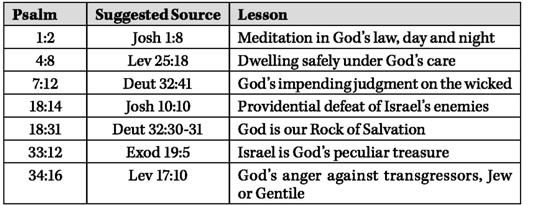
One cannot complete this “Living by Faith…” study without reference to Israel’s greatest Old Testament king, David! The kings were to make a personal copy of the law upon their coronation. This must have fostered a unique sense of devotion to the divine cause. David, in addition, showed himself an excellent Bible student as the following outline (by no means complete) illustrates:

Deborah
One woman of faith, whose words in Judges 5, bear remarkable echoes to incidents recorded in the Pentateuch.
For all these examples of Old Testament faithful, Bible study was not just an academic exercise, but a vital arsenal in their defense of the Truth and a convincing activity for edification of the Ecclesia.
David, in a most famous Psalm writes thus, “How love I thy law! It is my MEDITATION all the day. Thou, through thy commandments, hast made me wiser than my enemies; for they are ever with me. I have more understanding tan all my teachers; for thy testimonies are my MEDITATION” (Psa 119:97-99).
Meditation is defined thus, “deep, deliberate thought; contemplation” (Webster)
Spiritual wisdom
So our Bible study should have as its goal spiritual wisdom. Did this meditative spirit pervade in any of the notable Old Testament faithful covered in this brief analysis, or in any others, so that their lives were well directed?
We will begin this consideration of Bible study and meditation with Deborah. A commission was given to Joshua which has an interesting sequence:
“This book of the law shall not depart out of thy mouth; But thou shalt meditate therein day and night,
That thou mayest observe to do all that is written therein;
For then thou shalt make thy way prosperous, And then thou shalt have good success” (Josh 1:8)
A succession of judges replaced Joshua as leaders. Deborah, with Barak, is on the scene against Jabin, Sisera and 900 iron chariots. Victory is miraculously achieved, as “the hand of the children of Israel prospered…” (Jdgs 4:24). A victory song ensued, “then sang Deborah and Barak…” (Jdgs 5:1). The words of this song show deep deliberate contemplation on the written record of the day, referencing Exodus and Deuteronomy. Likewise, when we sing as we should, “speaking to yourselves in Psalms, hymns and spiritual songs…” (Eph 5:19). We have the wonderful opportunity of to MEDITATE on the Scriptural source of the words we are singing.
Prayer
Prayer is another medium of meditation. Ezra and David, keen Bible students, are excellent examples of how Bible study can inform our public (Ezra’s) and private (Daniel’s) prayer.
Ezra 9:7 “since the days of our fathers…” what depth of thought is deliberately shown by this faithful servant!
Dan 9:4 “…keeping the covenant…” verse 11 “…the oath that is written in the Law of Moses.”
Again, meditation based on familiarity with the written record of the day! We are now left to examine the meditative spirit of Gideon and Jephthah. Gideon requested a sign to verify that the angel spoke to him (Jdgs 6:7). Was he contemplating Moses (Exod 4:1)? As the drama unfolded into another encounter, Gideon “perceived that it was an angel of the Lord” (Jdgs 6:22) and thought he would die! Why? As he was meditating, he was remembering the words written by Moses: “And he [the Lord] said, Thou canst not see my face: for there shall no man see me, and live” (Exod 33:20).
Jephthah was falsely told by the king of the Ammonites:
“And the king of the children of Ammon answered unto the messengers of Jephthah, Because Israel took away my land, when they came up out of Egypt, from Arnon even unto Jabbok, and unto Jordan: now therefore restore those lands again peaceably” (Jdgs 11:13).
In reply, Jephthah made several references to the accounts of what happened after the Exodus, each time emphasizing what God had done to forge a nation: “the Lord God of Israel delivered… The Lord God of Israel hath dispossessed… So, whomsoever the Lord our God shall drive out” (Jdgs 11:21-24). These events, implanted in Jephthah’s mind come to bear fruits at a crucial time. Likewise, the words of Scripture must inform our response to challenges.
What do we take away from this brief analysis of Old Testament Bible students?
- A written record was available: “The law and the prophets”
- It was studied by men and women of faith: Joshua, Deborah, Gideon, Jephthah, David, Ezra, Daniel.
- For them, it was a sobering source of meditation, leading to prosperity and success.
- It strengthened FAITH, “Faith cometh… by the word of the Lord”
- Can we say with David, “O how love I thy law!” (Psa 119:97).
 The Origin of the Organic World – Part One