
A standard mythology
Have you ever heard of the hero’s journey? Perhaps you recall your middle school English class going over it at some point or perhaps you are a bit of a literature nerd like me.
The hero’s journey is often referred to as the mono myth, mono meaning one, and myth being short for mythology. One mythology. The idea is that most, if not all stories follow a similar path or structure from the beginning to the end. This has been a topic of some discussion by many a mythology enthusiast or student of popular culture. Opinions vary as to which parts count and which parts need to be revised but on a whole, the hero’s journey is a fairly fascinating study.
Chances are you have heard it before. Let’s see if you can tell what story I am referring to:
A character is told that he or she has been chosen by some force to go on an adventure to save their world. At first, the hero doesn’t want to, but bad stuff happens that forces them to go on the adventure. Along the way they find friends who help them on their quest while they overcome various obstacles and temptations.
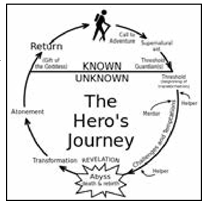
Towards the end of the journey, the hero is defeated by their nemesis and must give up on everything they love. They are left to die. When all hope is lost though, they find the strength within themselves and rise to face their conflict. This time, they succeed and embody the hero they were told they would be. Then, villain defeated, they return to their home, with knowledge or wealth or whatever force they needed to save their world from disaster.
Now, what story did I just tell you? That was The Lego Movie. Wait what?
Let’s look at it again and I will replace the words with Indiana and other appropriate locations or events:
Emmit is told that he or she has been chosen by the “piece of resistance” to go on an adventure to save their world from Lord Business by stopping the Kraggle (crazy glue). At first, the Emmit doesn’t want to, but bad Cop and Lord Business chase him which forces him to go on the adventure. Along the way he finds Wild Style (love interest), Princess Unikitty, Benny the Spaceman, Metal beard, and Batman (friends) who help them on their quest while he fights Lord Business and Bad Cop.
Towards the end of the journey, the Emmit is defeated by his foes and must sacrifice himself so that his friends will live. He falls out of reality and thus is dead to all his friends. When all hope is lost though, he returns with new confidence in himself and understanding of what makes him special. He uses this knowledge to convince the bad guys that they too can be special and unites his world in peace. Or piece.
But of course, I could have also been talking about lord of the Rings. Or Harry Potter. Or Star Wars, Star Trek, Mad Max, The King’s Speech, Guardians Of The Galaxy, The Hunger Games, any Disney film or any number of popular stories with this same structure. I basically copied and pasted names and places and events in the correct spots and outlined a popular kid’s movie. It’s like a giant game of Mad lib. Now, obviously not every single story follows this exact formula. Parts, as I said before, are often replaced or left out altogether. And obviously this doesn’t work on other genres, such as horror or comedy. This works mainly on adventure stories or quests.
The memo
But this is a formula and it is one that works. Seriously. Look at the list a couple paragraphs above this. Star wars is one of the, if not the highest grossing film series of all time. Harry potter also made millions in books and in film as did the hunger games. Mad max and Kings Speech are some of the most popular Pest picture nominees/recipients. And Disney simply cannot be matched as far as number of quality films that were also insanely popular. Seriously, there’s an actual formula they use, sent in a Memo in 1975.
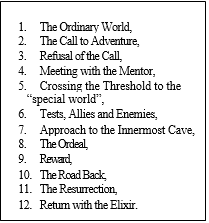
Why does it work? Numerous studies have been done on this question and the closest answer people have come up with is how relatable these stories are. Most have been asked to do something they didn’t want to only to be forced into the quest of some sort. Many of us have been in situations where we were tempted or tried and had to rely on our close friends for support. Some, if not most have felt despair or hit rock bottom, facing death or loss in ways we never thought possible. And many have risen from those challenges, or we hope we will at some point. In a way, the hero’s journey is a beacon of hope. A message that all challenges can be overcome and we respond to it. We love to see that others made it, even if those others are fictional characters.
Now there are arguments that this formula is not really applicable to all adventures. For many stories, such as Beowulf, The Epic of Gilgamesh, and many other stories from various cultures feature unlikable heroes, or stories that end poorly for the heroes. Opponents of the Mono myth point out that not all personalities are represented, not all lifestyles shown.
While this may be somewhat true, it is important to look at the numbers as evidence of the hero’s Journey’s effectiveness as a narrative tool: the epic of Gilgemesh has never seen a film adaptation (and is likely unfilmable due to its nonlinear nature and lack of protagonist) and most adaptions of Beowulf have not been commercial successes. Even the 2007 animated version was only moderately successful, but nowhere near the success of say, Star Wars. So yes, while the hero’s journey model is not perfect, nor does it represent all factions of life, one cannot argue it is, at the very least, the most popular model of storytelling.
The words of the Preacher
So, what’s my point? Well, I’d like to turn to an interesting verse that applies directly to all that we’ve written so far:
“The words of the Preacher, the son of David, king in Jerusalem. Vanity of vanities, saith the Preacher, vanity of vanities; all is vanity. What profit hath a man of all his labour which he taketh under the sun? One generation passeth away, and another generation cometh: but the earth abideth for ever. The sun also ariseth, and the sun goeth down, and hasteth to his place where he arose. The wind goeth toward the south, and turneth about unto the north; it whirleth about continually, and the wind returneth again according to his circuits. All the rivers run into the sea; yet the sea is not full; unto the place from whence the rivers come, thither they return again. All things are full of labour; man cannot utter it: the eye is not satisfied with seeing, nor the ear filled with hearing. The thing that hath been, it is that which shall be; and that which is done is that which shall be done: and there is no new thing under the sun. Is there any thing whereof it may be said, See, this is new? it hath been already of old time, which was before us. There is no remembrance of former things; neither shall there be any remembrance of things that are to come with those that shall come after” (Eccl 1:1-11).
I’ve always loved these verses because they display a futility of human achievement. Don’t get me wrong: I am a huge fan of ingenuity and creativity. I watch expos every year, learning what I can about upcoming software and gaming advances. But these verses always remind me that all the things that mankind makes are merely repeats of old creations, or perhaps expansions or evolutions of the original concept.
And when it comes to storytelling, the same is true. These stories have been passed down from generation to generation, with details getting adjusted or tweaked to fit various morals or ideals. Yet despite, or perhaps in spite of that, the basic story telling structure has remained the same. And there is not better proof than in scripture itself. Take, for example, the story of Joseph.
“And Joseph dreamed a dream, and he told it his brethren: and they hated him yet the more. And he said unto them, Hear, I pray you, this dream which I have dreamed: For, behold, we were binding sheaves in the field, and, lo, my sheaf arose, and also stood upright; and, behold, your sheaves stood round about, and made obeisance to my sheaf. And his brethren said to him, Shalt thou indeed reign over us? or shalt thou indeed have dominion over us? And they hated him yet the more for his dreams, and for his words. And he dreamed yet another dream, and told it his brethren, and said, Behold, I have dreamed a dream more; and, behold, the sun and the moon and the eleven stars made obeisance to me. And he told it to his father, and to his brethren: and his father rebuked him, and said unto him, What is this dream that thou hast dreamed? Shall I and thy mother and thy brethren indeed come to bow down ourselves to thee to the earth? And his brethren envied him; but his father observed the saying” (Gen 37:7-11).
Hero’s in the Bible
Now here we have the hero’s calling, these dreams that would tell Joseph of the things that were to come, that he would rule over his brothers and sisters and parents. And while we do not have recorded the “refusal to be called,” we do see events forcing Joseph along a rather unpleasant journey.
“And they took him, and cast him into a pit: and the pit was empty, there was no water in it. And they sat down to eat bread: and they lifted up their eyes and looked, and, behold, a company of Ishmeelites came from Gilead with their camels bearing spicery and balm and myrrh, going to carry it down to Egypt. And Judah said unto his brethren, What profit is it if we slay our brother, and conceal his blood? 7 Come, and let us sell him to the Ishmeelites, and let not our hand be upon him; for he is our brother and our flesh. And his brethren were content. Then there passed by Midianites merchantmen; and they drew and lifted up Joseph out of the pit, and sold Joseph to the Ishmeelites for twenty pieces of silver: and they brought Joseph into Egypt” (Gen 37:24-28).
Here our hero is taken away from his home, forced on his journey. He leaves everything behind. Along the way he makes friends, in the form of Potiphar, the jailer, the baker, and the butler. He resists temptation by getting away from Potiphar’s wife. This is where he is cast into prison, a form of death. He is buried and forgotten, until one day, when the Pharaoh is plagued by relentless nightmares. These remind the butler of the man who understood dreams and Joseph is resurrected. He, is brought before the Pharaoh and upon interpreting the dreams, he is raised to a position of ultimate authority.
He uses this authority, or boon, to deliver the land out of turmoil and rescue his brothers, the same ones who had abandoned him so many years prior. Through this, his hero’s journey is complete.
Now, here the fascinating part: this journey is used repeatedly throughout scripture. We can trace this journey through the life of Moses (he outright refuses the call at one point), David, Elijah, Daniel, Samson, and many others. Beat for beat, each of these characters go through the stages of the Hero’s Journey.
Growing up, we think of these individuals as characters in grand stories, complete with epic battles and dynamic choices. It’s only as we grow up that it begins to dawn on us that these were real people with real lives that went through these real problems and grew through them. That being the case, one must ask, why did God make them go through such similar situations, failing or feeling like they had failed at similar points in their spiritual journey? Why follow such a structure that repeated itself so many times?
I think it was for us. True accounts
First, think about the human brain: for the most part, we like to predict things, and we like to be correct. When we hear a story, we like to know where it is heading. We like to guess at the end results, and when we guess correctly, our brain rewards us. It sends a message that basically says “you are smart, good job.” The same is true in film: of the 10 most successful films in history, adjusted for gross income, at least six feature some form of the Hero’s Journey within their stories. That’s likely due to the fact that our brains enjoy predicting the outcomes of these films. As we said, the structure works, and our brains like it.
And back to scripture, we must realize that as God made us the way we are, he knows what our brains like. He knows how to reach us, and telling us stories in a predictable way, a way our brains will latch onto and feel good about makes sense. And why must they make sense? Because we are to learn from these stories. The stories are relatable, especially for those seeking redemption through Christ.
(Perhaps we should call them accounts, because even the word “story” might implie an element of fiction, although the dictionary definition is “a narrative, either true or fictitious, in prose or verse, designed to interest, amuse, or instruct the hearer or reader”.)
Our own spiritual story
We are called: “For many are called, but few are chosen” (Matt 22:14). And many refuse the call. But our lives often force us to reconsider and take up the journey towards God. We make that choice, in this case, baptism, and our journey truly begins. Along the way we meet friends and allies:
“For where two or three are gathered together in my name, there am I in the midst of them” (Matt 18:20).
We face trials and tribulations, and many of us will die, literal deaths.
“Wherefore, as by one man sin entered into the world, and death by sin; and so death passed upon all men,for that all have sinned: But we wait that coming day that we will be literally resurrected. We will enter into the kingdom of God and bring with us treasures stored up in heaven, incomparable to the things of the world” (Rom 5:12-13).
Our lives were meant to follow the hero’s journey. That is a huge part of God’s plan for us. If you need further proof, look no further than Jesus Christ. Christ was called by God to serve him, to be a fulfillment of the law. He was tempted in the wilderness, a refusal to answer his calling. But through his trial he made a conscious decision to follow his Father’s will and begin his journey. Along the way, he gained followers, but none closer than his 12 disciples, who strengthened him in the times he needed them. But he faced his death alone, save for the angels God sent to comfort him. He laid down his life, literally dying. But it would not be the end, for in three days he was resurrected and brought to his disciples both then and now, a perfect example of how a true hero returns, not for their own honor or glory but so that their people, their friends and family may thrive.
Christ is the reason the hero’s journey exists. God wasn’t just creating a rhetoric that could be easily followed, he was tracing his plan and purpose for us to see throughout the ages. HE was painting an image that we could follow, a map that would lead us to the kingdom. God has called us, arguably he has called everyone in the world to him, and he knows we may indeed refuse that call. But he knows also that we must be the ones to make the choice to begin the journey, just as it was Christ’s choice to answer his father’s call. He wants us to make friends and family that will support us on our journey, just as Christ had his closest friends to strengthen him. And God wants us to know that we will face downfall, and that we must do so willingly. God wants us to know that this is part of the journey, that most of us will face such hardships that we may feel as though there is no recovery. But at the end of our journey, there is hope.
“These all died in faith, not having received the promises, but having seen them afar off, and were persuaded of them, and embraced them, and confessed that they were strangers and pilgrims on the earth. For they that say such things declare plainly that they seek a country. And truly, if they had been mindful of that country from whence they came out, they might have had opportunity to have returned. But now they desire a better country, that is, an heavenly: wherefore God is not ashamed to be called their God: for he hath prepared for them a city” (Heb 11:13-16).
This story, old as human history, is one of hope and deliverance. It is told in a way that we can enjoy, grasp and share. Told by a God that knows his creation through the actions of the faithful of old. Told so that we might follow and pattern our lives after them, that we might seek that country, one better than anything under this sun.
 The Origin of the Organic World – Part One