
Public lectures, Etc.
For the past few years, my ecclesia has, every month or so, put on public lectures at various venues in the area, in order to present the Gospel message to the local region. We have selected a variety of public locations in the nearby towns, mostly libraries or community centers, and promoted them by various means, but lately relying on both direct mail and notifying all our contacts.
Looking back on these efforts, and other public activities over the decades, some themes are fairly clear:
- Overall, the public’s response is quite limited.
- A topic like “Learn to Read the Bible” still has some appeal.
- Basic topics like “Does God still exist” etc. call forth almost no response.
- Significant interest has been shown in two areas
- Prophecy – what does the Bible say about the current turmoil?
- How archeology demonstrates the truth of the Bible.
However, even then the response has been limited — although we are spreading the true gospel message, this does not appear to resonate.
We have looked at preaching before, specifically in the Special Issue in 2011, and an editorial in May, 2013. It was clear some ecclesias and some individuals have seen quite a few who respond, but it is also obvious that many ecclesias see little response, even those that engage in major outreaches.
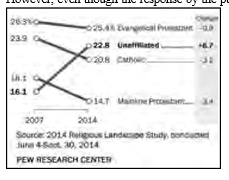
However, even though the response by the public to our message is not strong, our community in North America appears to be growing, if only very slowly. In this it differs from the situation in the UK, where the Christadelphian community is shrinking by about 100 (over 1%) per year. This is also true of most Christian denominations, in the USA, as shown alongside. So the question to us is to why this is happening, and what can we do to improve the situation?
Positive factors — our young
There is no doubt, at least to my mind, that the major reason for any growth of our community is our success in retaining our young, who grow up in our Sunday schools. We, as a community, have had little success in retaining those who attend Sunday school simply because they are in the neighborhood, as can be seen by the limited success of several ecclesias who have made this outreach. The retention of our own young people is, I believe, due to several factors (in no particular order):
- We are fortunate, in that in most areas of North America, around 70% claim some sort of Christian affiliation. So, our communities are often generally supportive of Christianity, even though they might think some of our beliefs are unconventional and our lifestyles are too restrictive.
- The normal tendency of children to follow in the footsteps of their parents
- The proliferation of Bible Schools throughout the continent.
- Likewise, weekends and special events for the youth of our community.
- The modern age with its ease of transportation, smart phones, video communication etc. has made the maintenance and development of relationships much easier.
- The strong message we promote to marry within our community.
- The emphasis on teaching our children from the Bible in our Sunday schools. Whether this is strong enough is another question.
- Very rarely do our young people seriously question their (or our community’s) fundamental doctrines. Although it is perhaps inevitable for sometimes difficult questions to be asked, rarely do our basic beliefs get seriously challenged.
Negative factors
This retention is also negatively impacted by several factors. Some of these are drawn from a recent survey on reasons for leaving our community, which was dominated by responses from Australia and the UK.
- Our internal doctrinal and fellowship disputes.
- Unfortunately, many in North America belong to fairly small ecclesias, which are often dominated by extended families. So, somewhat naturally, apparent cliques form, which are perhaps unknowingly off-putting to other members.
- Some ecclesias are positively hostile when our young form a relationship with anyone outside our community.
- We all acknowledge marriage within our community is the best prescription for a stable, Christ-filled relationship. But how we handle what happens when this ideal is not followed can lead to the individuals affected leaving our community.
- Sometimes our community can appear to be narrow, judgmental, self-centered and not at all Christ-like, at least to our young people.
- I was somewhat surprised, but the survey reported that over half of those who felt dissatisfied by our community believed we harbored racist attitudes.
- There is a tendency for some speakers to address areas outside their competence (e.g., physics, biology, and archeology) seemingly without recognizing the limitations of their background. If the young hearing them have knowledge in these areas, this can lead to the questioning of other areas of our teachings.
Potential improvements
In order to improve our retention, perhaps we can focus on several areas
- We should be careful, in all our activities, to ensure we are inclusive in all our activities. Nothing is worse to the young than a feeling of being an outsider.
- All ecclesias should do their level best to ensure their young people get the opportunity to attend at least one Bible School and Youth Gathering. Cost or transportation problems should not be an impediment: there is generally someone else going in that direction, and ecclesias etc. should be happy to reasonably assist with costs involved.
- Even if we have internal disputes, we must all acknowledge the gulf between our beliefs and those of the larger communities around us. To expose or affect our young people, and especially their gatherings, to our problems should be unacceptable.
- We should be careful in our conversations and correspondence to reflect the spirit of Christ: we might disagree, but should always strive to reflect that spirit, especially when the young are involved or might hear us.
- Our attitude to everyone should reflect the universal appeal of the gospel to all races and socioeconomic classes, and we should be mindful to convey a message of inclusivity of all groups in our addresses, lectures, and activities (e.g., PowerPoint presentations can have pictures of people from different backgrounds).
- We should be aware of the complexities and temptations of youth and nurture an atmosphere where young people who are genuinely seeking to follow the example of the Lord Jesus Christ can receive support and help with their struggles without fear of condemnation and rejection.
- In all things we should reflect the love and forgiveness or our Lord Jesus Christ, who healed the sick, comforted the poor, and dealt kindly with people like the Samaritan woman, who was of a race ostracized by the Jews, and also of an uncertain moral status.
So, until our Lord returns to cure the world of all its problems, we should ensure that our young people indeed grow up in our nurture and are encouraged to continue to seek after our Lord Jesus Christ with us.
“… put on the new self, which is being renewed in knowledge in the image of its Creator. Here there is no Gentile or Jew, circumcised or uncircumcised, barbarian, Scythian, slave or free, but Christ is all, and is in all. Therefore, as God’s chosen people, holy and dearly loved, clothe yourselves with compassion, kindness, humility, gentleness and patience… Forgive as the Lord forgave you. And over all these virtues put on love, which binds them all together in perfect unity” (Col 3:10-14 NIV).
 The Origin of the Organic World – Part One