
Development of a chronology
Like the timelines developed to support the belief in evolution, archeology has not been immune to similar pressures to support anti-Biblical biases. In an earlier time, archeologist routinely used the Bible as the basis of their explorations. In the early 19th century when Napoleon brought the treasures of ancient Egypt to the attention of the world, fascination with Egypt grew enormously. This ultimately led to the development of a chronology that relied (to a large extent) on a list of pharaohs compiled by the Egyptian priest Manetho in the 3rd century BC. Carbon-14 dating, especially for the Middle and Old Egyptian Kingdoms, and the alleged pre-dynastic period, has been used to provide some support for this dating. The Egyptian chronology, though, put the beginning of Egypt’s Old Kingdom to be around 3000 BC, or some 700 years before Noah’s flood. Hence the problem.
It is not just the Biblical account of the flood that has been called into question by this new chronology. All the history from Abraham, to Joseph, to Moses, to Joshua down through the end of the Northern kingdom of Israel and the southern kingdom of Judah has also been called into question. The Dec. 18, 1995 cover of Time magazine asked the question, “Is The Bible Fact or Fiction?” Here are some of their answers: “(Years) of searching have convinced all but the most conservative experts that Abraham, and the rest of the Patriarchs, were inventions of the Bible’s authors.” “Apart from the Bible, there is no evidence that (Moses) ever lived.” “The walls of (Jericho) did come tumbling down, say most historians, but centuries before Moses’ protégé could have arrived.” (“Are the Bible’s Stories True?” — sidebar to featured article.) Here are the critical problems when following the Egyptian Chronology:
Problems of Egyptian chronology The Exodus Problem
The Exodus from Egypt was not only the most significant event in the history of the Jewish people; it was also an unprecedented and unequaled catastrophe for Egypt. In the course of the pharaoh’s stubborn refusal to let the Israelites leave and the resultant plagues sent by God, Egypt was devastated. Hail, disease and infestations obliterated Egypt’s produce and livestock, while the plague of the first-born stripped the land of its elite, leaving inexperienced second sons to cope with the economic disaster. The drowning of the ruling pharaoh and the Egyptian army in the Red Sea left Egypt open and vulnerable to foreign invasions.
Such a momentous series of events must find a reflection somewhere in the archeological record, but, according to the currently accepted chronology, in the year of the Exodus, the greatest warlord Egypt ever knew, Thutmose III, embarked on a series of conquests, extending the Egyptian sphere of influence and tribute over Palestine, Syria and crossing the Euphrates into Mesopotamia itself. No archeological evidence exists from this time supporting any of the Biblical claims.
The Wilderness Problem
Forty years is a very long time for 2 million people to live in the wilderness. The considerable time they would have spent in various locations should have left evidence. Archeologists, using the standard chronology, have not found any such evidence.
The Canaan Problem
The problem only gets worse in trying to find evidence for the major devastation of cities recorded in the book of Joshua. Archeological evidence bears little resemblance to the Biblical account of the conquest of Canaan. Archaeologists say Israel “emerged” from among the Canaanite peoples without a conquest. In other
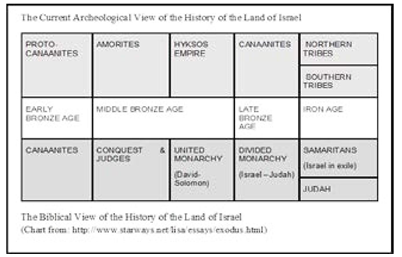
words, there is virtually no evidence for the mighty overthrow of the Canaanites as recorded in the Bible.
The Iron Age Problem
There were invasions, but they were from the north, from Syria and Mesopotamia, and they came in several waves, unlike the lightning conquest under Joshua. The people who settled the land after the invasions also came from the north, and seemed to settle an empty land after it had been destroyed by others. The south remained in the hands of the Bronze Age inhabitants, albeit on a lower material level. (See chart above.)
The conclusions drawn from this evidence? The people in the south, who supposedly constituted the kingdom of Judah, have been determined to be of Canaanite descent, if not biologically, then culturally. And the people in the north, supposedly the ten tribes of Israel, have been determined to have no relation to the tribes of the south. The idea of twelve tribes descended from the sons of Jacob has been removed from the history books and re-catalogued under “Mythology, Jewish.”
The Real problem
The acceptance of the Conventional Egyptian Chronology has not been universal, but the use of it in evaluating and dating archeological evidence is so common and dominant that Bible dictionaries and popular archeology books and magazine all reflect the same belief: Little, if any, evidence exists to support the plain reading of the Old Testament. As the Time article put it: “…parts of the Old Testament where the evidence is contradictory or still absent, (include) slavery in Egypt, the existence of Moses, the Exodus and Joshua’s military conquest of the Holy Land…
Kathleen Kenyon, who excavated at Jericho for six years, found no evidence of destruction at that time” (p. 54).
However, the real problem turns out to be the Conventional Egyptian Chronology (CEC) itself, not the Bible. The flaws in this chronology have produced continuing problems in trying to correlate finds throughout the eastern Mediterranean world. A number of archeologists have begun calling for its revision. In Centuries of Darkness, Peter James (British historian and author specializing in the ancient history and archaeology of the Eastern Mediterranean region) calls traditional chronology a “gigantic academic blunder.” David M Rohl writes, “The only real solution to the archaeological problems which have been created is to pull down the whole structure and start again, reconstructing from the foundations upward.”1
An illustration of the mismatch can be seen from an article in Biblical Archeology Review of Sep/Oct 1987. The authors looked at the cities that Joshua attacked and destroyed. According to the current dating of these sites, there is no evidence for any destruction at all by Joshua (Late Bronze Age). When the authors examined these cities during an earlier period (Middle Bronze Age), suddenly there was significant evidence of destruction or abandonment consistent with the Biblical account.
The authors’ conclusion: “In summary, the chart reveals a basic inconsistency between the situation at the end of the Late Bronze Age and the Biblical account of the conquest of Canaan, while the situation at the end of Middle Bronze II is consistent with the Biblical account.”2
One possible correction
David Down (field archaeologist; editor of Archeological Diggings.com.au), in Unwrapping the Pharaohs, synthesized the work of many experts to produce what he feels is a cohesive narrative consistent with the Bible. He points out many synchronisms between the histories of Israel and Egypt, providing a plausible identification for many of the characters found in the Old Testament. His work also seems consistent with the history of surrounding nations. (Short article here: http://creation.com/searching-for-moses.)
When the Egyptian chronology is corrected, the missing evidence for Joseph, Israel as slaves in Egypt, Moses as potential heir-apparent to the throne, the Exodus and its devastating effects on Egypt, the wilderness wanderings, Joshua’s dramatic conquest of Canaan, Israel under David and Solomon as the super power of the Middle East, through the destruction of Israel and Judah — all these missing pieces now find reflections in the archeological record. The alignment is a powerful confirmation that God’s Word really can be trusted.
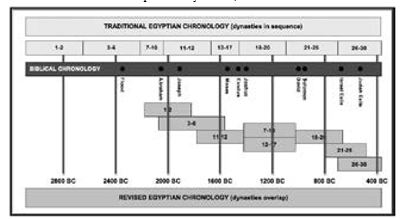
The chart below, based on the proposed revision by archeologist David Down, illustrates the contrast between the Conventional Egyptian Chronology and Down’s revised chronology.
Another researcher, Patrick Clarke (specializes in pharaonic tombs in the Valley of the Kings; their architecture, artwork and afterlife texts), has a series of research articles arguing for a slightly different lineup. (His conclusion places Joseph nearer to 1750 BC and would have Mentohotep II as the pharaoh in Joseph’s day, which would alter the overlaps in the dynasties.)
Why should I care?
Archeological discoveries once were seen as confirming evidence of the validity and truthfulness of the historical narratives of the Bible. Archeologists with Bible in hand searched out ancient ruins to discover this evidence. Not all archeologists were happy with this approach; some had little respect for the Bible, much less a desire to authenticate it. When archeologists began put together a timeline of the ancient Middle East based on the Egyptian king lists in the early 1900’s, the pressure to expel the Bible as a legitimate historical text began. Today, as the Times article mentioned earlier demonstrates, the Bible has been completely dismissed.
So why should you care? Because each of us ultimately has to make a decision: Did God speak through the Bible or is the Bible just another ancient text with lots of myths? The first choice acknowledges there is a God and that He has something to say to me. The second choice is to jettison God altogether and live in a meaningless, directionless, and sterile world.
Resources:
For helpful discussions of the dating problems behind the traditional chronology, see the suggested references below. These are all from researchers and scientists that accept the Bible to actually be God’s inspired word.
- Gary Bates, Egyptian chronology and the Bible—framing the issues. creation. com/egypt-chronology. 2 Nov 2014.
- David Down & Dr. John Ashton, Unwrapping The Pharaohs, Ch. 28, “A Correct Chronology”.
- Elizabeth Mitchell, The New Answers Book 2, Ch. 24, “Doesn’t Egyptian Chronology Prove That the Bible Is Unreliable?”
- Patrick Clarke, Joseph’s Zaphenath Paaneah—a chronological key. Journal Of Creation 27(3) 2013
- An interesting new video: “Patterns of Evidence: The Exodus”. This video explores the striking archaeological evidence that Hebrews once existed in Egypt. It also demonstrates some of the difficulty behind establishing an exact Egyptian chronology.
 The Origin of the Organic World – Part One