
Atheists
Among the world’s population, there are various views about the existence of God. Many people, perhaps the majority of people, do not believe that there is a God. They believe he is just an imagined concept invented to provide hope and comfort in a power bigger than themselves. They believe that God is simply a wish, a hope, an illusion. They do not believe in any god; they worship no divine being. Life for them is what they personally experience with no expectation of plan or purpose beyond the steady, relentless unfolding of random, uncontrolled events. People in this group are called atheists.
God-Worshippers
In contrast to the position that there is no God or Higher Power, there is a second group of people who believe in a God, or perhaps many gods. The religious perspectives of this group of people range from a simple belief in one God to all sorts of variations. They include belief in two or more gods that are thought to influence various parts of life and the world. With people in most cultures today, and dating back to antiquity, evidence can be found of belief in a god or gods that should be worshipped. Among this group there is no common thread of belief or practice that in any way could be regarded as universal. These groups are disparate and often in serious opposition to each other. For purposes of this article this group will be referred to as god-worshippers.
Agnostics
There is a third classification of people who fall between the atheists and god-worshippers. People in this group simply declare: “I don’t know if there is a god or not. There may be but I cannot find sufficient evidence to prove it with enough certainty for me to believe in god.” This group is not critical of atheists for their lack of belief, nor are they disdainful of god-worshippers for their commitment to a god or gods they believe to be real. They simply confess that they do not know for sure if god exists and therefore remain unaligned with any religious system. This group are called agnostics.
Common features
It is very interesting to look at a common feature of each of these three groups. Atheists either
- Do not believe in God because they are not aware of any compelling evidence to believe. As they observe life, the world and the universe around them they see no proof of God, no reason to alter their completely independent mindset and lifestyle to conform to any religious system. They want proof of God’s existence.
- Or choose to be so because they do not wish to accept the responsibility this belief entails. Hence, no amount of evidence can change their adherence to atheism.
The god-worshippers approach belief in god through many faith systems. From all over the world, over long periods of time, many religious systems have developed and today have large committed communities of adherents. They are widely disparate in belief and practice. They have no common authoritative information about the god they claim to worship.
The agnostics, by their own admission, do not know what to believe or why they should believe any of the numerous and conflicting claims about God. They are not convinced on matters related to God because they lack an authoritative source, if for them one even exists.
All three groups (except the second type of atheists) need information. They need trustworthy, reliable, verifiable information to support their conclusions about the existence of God, who He is and why He is important to them.
What is God’s purpose?
Once the question is settled about the existence of God there remains another major issue. What communication is there from God? What is His purpose in creation and more specifically what is His purpose with humankind? How can a person understand their relationship with an all-powerful God who created the earth?
There is a continuing search for information about God. There is certainly beauty, complexity and design in everything around us which testifies to a higher, purposeful intelligence. But who is this God and what can a person know about Him?
In the vast literature of human history there have been many attempts to describe the creator God, and what He plans to accomplish with the creation. But in all this compendium of literature there is no voice of authority. There is reason and speculation. There are observations and conjecture. Science is co-mingled with philosophy to project views about God, purpose, the meaning of life, and the future of all things. There remains, however, the essential missing ingredient — where is the voice of authority? Where can we learn about the nature of God, the meaning of life, and the future of the world we inhabit?
The book we call the Bible claims to be this authority. It claims to document the actions, the words, the expectations of the creator God. In this respect it is unique among books. To claim to be the inspired Word of God does not make it true. There needs to be sound reasons for believing this claim. The next section of this article will show why we can have complete confidence in the Bible’s claim of Divine inspiration. It will cover the claims of the Old Testament and why it can be trusted as a record of God’s purposes and His oversight of His creation.
Reasons for believing the Bible
There are sound fundamental reasons for believing in God and that the Bible is the inspired Word of God. This introductory section deals with only one of these factors — the record of the Old Testament to show evidence of God speaking, hearing and acting. There are at least five additional factors of great significance.
Historical Accuracy: The historical accuracy of the Old Testament is the subject of extensive, careful scholarship in universities around the world. Historical records of ancient cultures and nations provide abundant confirmation of interchange with people and events documented in the Old Testament.
Archaeological Evidence: Hundreds of archaeological excavations in Israel and throughout the Mediterranean basin have verified the existence of people and places described in the Old Testament. Thousands of artifacts, excavation of ancient cities, examination of ancient buildings, seaports and trade routes all help confirm the accuracy of the Bible record. Examination of thousands of ancient documents and manuscripts provide abundant evidence of the veracity of the Hebrew Scriptures.
Fulfilled Prophecy: Fulfillment of Old Testament prophecies related to Israel, Egypt, Phoenicia, Assyria, Babylon, Philistia and other nations in the ancient world have come true with remarkable accuracy. Prophecies related to the families of Abraham, Isaac and Jacob, David and Solomon have unfolded exactly as outlined in the Bible record.
Witness of the people of Israel: The descendants of Abraham who later became the people of the ancient nation of Israel are the subject of most of the Old Testament record. What God said to them, how He instructed them, how He treated them are all primary themes of the Books of the Old Testament. Within this context are many specific prophecies that predict important events that affected the Nation of Israel. These prophecies were fulfilled with amazing accuracy, thus supporting their Divine source.
The Bible’s accurate assessment of human nature: Analysis of human nature is a subject of extensive study and observation. Countless books have been written to explain human behavior, to analyze the normal and abnormal behavioral patterns, and attempt to predict future attitudes and conduct. While not seeming to be a psychology book, the Bible is outstanding in its analysis of human behavior and the consequences of the full range of human conduct. Human mortality, with its limitations and potential, are described in surprisingly accurate detail throughout the Bible.
The Bible’s claim of Divine Authority
One of the most important claims in the Old Testament is that the record clearly claims to be God speaking, God hearing and God acting. Here are some examples of statements taken directly from the Bible that claim to be God speaking or acting.
“Now the LORD said to Abram, Go forth from your country, and from your relatives and from your father’s house, to the land which I will shew you; and I will make you a great nation, and I will bless you and make your name great; and so you will shall be a blessing; and I will bless those who bless you, and the one ho curses you I will curse. And in you all the families of the earth will be blessed” (Gen 12:1-3).
“Then the Lord said to Moses, ‘Go to Pharaoh and speak to him, “Thus says the LoRD, the God of the Hebrews. ‘Let my people go that they may serve me’ ” (Exod 9:1).
“The Lord said to Joshua, See, I have given Jericho into your hand, with its king and the valiant warriors” (Josh 6:2).
“I, the Lord, search the heart, I test the mind, Even to give to each man according to his ways, According to the results of his deeds” (Jer 17:10).
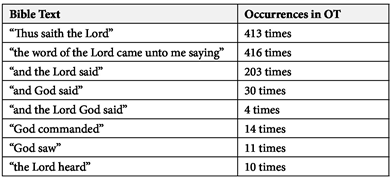
These are unusual statements. They cannot be the words of men. They speak of things far beyond the scope of normal human perception and ability. The Bible is full of such words that claim to be the voice of God speaking. Consider the words or actions directly attributed to God in the Old Testament
The above chart shows that there are over 1000 direct references in the Old Testament that claim to be God’s words or God’s actions. What are we to make of this? If this is a true and accurate documentation of God speaking, responding, or acting then the Bible is a unique record that demands our careful attention. If these claims are not to be trusted the Bible should be regarded as a work of fiction, or even worse, a record of dishonest claims of a fictitious God.
Another fact is clear. It is reasonable to conclude that the Bible stands or falls as a complete document. Either it is a divinely inspired record of God’s actions, His words, interventions and guidance in human affairs or it is fictitious and cannot be trusted. It stands or falls together. We cannot highly regard the 10 Commandments that claim to be given by an all-powerful and all-knowing God, if we do not believe in that God. If God did not give the 10 Commandments to Moses, as is documented in the Book of Exodus, then the record is fraudulent and dishonest.
Putting it all together
Let’s now put the parts of this consideration together. There are those who do not believe in the existence of god — any god at all. There are those who declare that they don’t know if a god exists. And there are people who worship god in many diverse ways. Accurate, reliable information is what each of the groups need to confirm their position. There is no single source of information on this matter that is universally trusted. The Bible stands out among world literature as a document that claims to record information about God. Its claims are unique and require us to satisfy our minds about its reliability
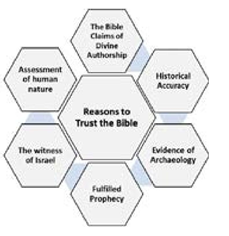
The chart to the right identifies factors that validate the truth and reliability of the Bible.
Any one of these witnesses would strongly support belief in God and the Bible. Taken together they provide a comprehensive and reliable bases for belief that the Bible is the inspired Word of God.
This study is not an intellectual exercise. The conclusions we reach on this subject will affect our whole outlook on the meaning and purpose of life. More specifically, our conclusions will affect our personal view of life, and the standards and values we will live by. Will God be a part of our living? The following quote from John Carter’s book The Oracles of God provides a valuable challenge to our thinking on these matters.
“The authority of the Bible is in itself, because it is God’s word. There is no satisfactory middle ground between full acceptance and complete rejection. If it is God’s word its witness concerning itself is of primary importance: that witness we have seen to be consistent and uncompromising. We decide our attitude to it, and so doing determine whether we will accept infallible divine guidance, or set up a standard of our own by which to guide our lives”.
 The Origin of the Organic World – Part One