
“And he said to them, Well did Isaiah prophesy of you hypocrites, as it is written, ‘This people honors me with their lips, but their heart is far from me; in vain do they worship me, teaching as doctrines the commandments of men.’ You leave the commandment of God and hold to the tradition of men” (Mark 7:6-8).
“What then, brothers? When you come together, each one has a hymn, a lesson, a revelation, a tongue, or an interpretation. Let all things be done for building up” (1 Cor 14:26).
Introduction
I was recently looking at the original “Ecclesial Guide” by Robert Roberts, issued in 1883. I noticed many differences between that guide and the one currently in print, including not only some differences in the Statement of Faith but also in the instructions for the conduct of our meetings. Some of the differences, particularly to the “Doctrines to be Rejected”, are considered elsewhere in this issue, God willing, but it was the directions for meetings that caught my attention. Indeed, Bro. Frank Shuttle worth penned quite a section for the correct mode of conduct for prayers, exhortations, etc. This disappeared from subsequent editions1.
However, this made me decide to compare the prescriptions in the Ecclesial Guide with the models as given in the New Testament, often by Paul in particular.
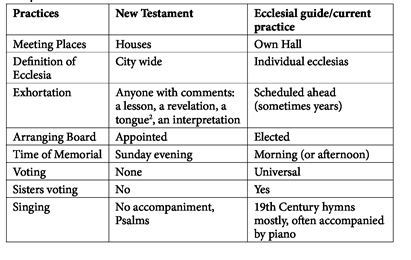
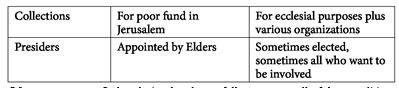
Of course, you can find ecclesias that do not follow some or all of these traditions in the last column, but I believe that our current practices are fully appropriate for the purposes of ensuring the “all things should be done decently and in order” (1 Cor 14:40). My point is not to disparage the way we conduct our meetings, but to point out they are based, not on Biblical precepts and examples, but mainly on those that were common in Robert Roberts’ time among the churches he was familiar with. So our practices are not “cast in stone”: in following them we follow the precepts of man, neither of God or Christ, nor by inspiration, or the apostles.
Change
How many times have we seen attempts to change even minor details of the way we do things produce dissension, troubles, and the use of the “I will join another ecclesia if you do…”. In apostolic times, there was of course largely adherence to the guidance of the apostles and the overseers that they had appointed: with their death, unfortunately it was not long before a paid hierarchy developed, with all the problems that involved, and which our forebears universally rejected. So we are left with our current procedures, in which each ecclesia is in practice governed by the collective will of all members — or rather the will of those who vote! It might be helpful to examine some areas that have caused such intense disagreement that brethren and sisters have left their own ecclesias over the topic.
Attitude for Prayer
It is customary in most ecclesias to stand for prayers: some sit for prayers for the emblems. But even a change such as this, duly voted and approved a large majority of the ecclesia, has been known to result in some members “voting with their feet”. Which is strange, because the Bible is full of examples of different postures (which is quite a little study in itself).
- 1 Sam 1:26 – Hannah stood
- 1 Chron 17:16 – David sat
- Ezra 9:5 – Ezra fell on his knees and spread his hands
- 2 Chron 6:13 – Solomon kneeled down upon his knees and spread forth his hands
- Matt 26:39, Luke 22:41 – Jesus knelt down/fell on face
- Mark 11:25 – Stand praying
- Acts 20:36 – Paul kneeled down and prayed
The custom of kneeling for prayer is common in private prayer, and of course the custom in many churches, but I have not come across it much in our Christadelphian services. But lacking any specific guidance, the whole point of prayer is to show a listening, reverent humility. Robert Roberts indeed counsels against having prayers where you stand immediately adjoining hymns where we also stand, in case of fatigue: but I think this reflects the Victorian trait of long prayers more than anything else.
Owning Your Meeting Places
At least in the UK, when I was much younger it was the normal practice for most “Central” ecclesias to meet in rented halls, perhaps reflecting the expectation for the soon coming of Jesus. But when the reunion with the “Suffolk Street” ecclesias took place, it was noted that most of the latter owned their own halls. This was a pattern that soon spread to all those ecclesias in a position to do so. But this very topic has been known to cause divisions and dissension: it is quite rare for an ecclesia to decide to buy their own hall (or a new one) without some internal dissension and animosity. This over a topic which would seem quite innocuous. And I can find no guidance on this topic in the Bible. It is interesting that this subject of owning halls is rarely to be found in the pages of The Christadelphian prior to 1956, but is quite common afterwards.
Times of Meetings
Apart from the fact that the early church met on a Sunday, and most likely in the evening, a time when most could attend, the New Testament is silent on this. And many ecclesias in the early days met on Sunday afternoons, mainly because public transport was more available then. In the UK, like North America, the majority now meet in the mornings, but unlike in North America, quite a few in the UK still have afternoon meetings. (Afternoon meeting in North America are very rare.)
But, once again, any change has often provoked dissension and trouble. The times used are quite variable, from 9:30 to 11 am, and some have Sunday school before, some after, and a very few during. There seems no Biblical guidance for this: surely it is the wish of the majority that should rule in this, following the advice of Robert Roberts.
Conclusion
The mode of conduct of our meetings, their times, their places, and many other aspects of our worship reflect our situations, and we should remember the purpose of such arrangements: to let all worship our Lord with reverence and humility. There is no “traditions of men” that should bind us to any particular form of worship, other than the directions of Paul to remember our Lord regularly when we meet: and even though we customarily do that on a Sunday, there is no direction to make that the only day, or that day especially. After all, our statement of faith says that “That the observance of Sunday is a matter of duty” is a doctrine to be rejected.
 The Origin of the Organic World – Part One