
One of the more important events in the fight for the recognition of the right for conscientious objection by our community was a hearing in England which took place in 1916, usually known as the test case. It has often been inadequately covered in our literature: this is primarily because the young brother selected by the authorities was in fact, not a member of the larger “Temperance Hall” (now usually known as Amended or Central), or even the smaller Suffolk St group. Instead, he was a member of those Christadelphians aligned with the Advocate group in America, although known as the “up and be doing” movement in England. These ecclesias were strongly represented in London, and so the young brother chosen was Bro. Charles Gordon Ramsden, usually known as Gordon Ramsden. Baptized in 1914, he was a member of the London Camberwell meeting. When Bro. Frank Jannaway recounts this episode in his “Without the Camp”, he does mention Bro. Ramsden’s name, but The Christadelphian does not do so.
A full account to be found is in the magazine “The Fellow Labourer”, now almost totally forgotten. The magazine was folded into the Advocate as of July 1917: however, the group associated with the magazine joined with the Suffolk Street group in 1921, which in turn rejoined the Central community in 1956.
Report of the test case from Fellow Labourer1
Readers of the Fellow-Labourer have followed with deep interest and concern the reports of proceedings before the various Tribunals under the Military Service Act on applications for exemption for our young brethren on conscientious grounds. As will have been observed, the results have usually taken the form of exemption from combatant service only. In all such cases, it is believed, an appeal has been lodged to the Appeal Tribunal.
The first case before the County of London Appeal Tribunal, which was held on Mondays, 13th March [1916], at the House of Commons, was that of Bro. Charles Gordon Ramsden, of the Camberwell Ecclesia. Mr. Donald Maclean, M.P., presided over the whole body of 25 members, and at the outset made a short statement on the subject of procedure, in the course of which he said that appeals by conscientious objectors would be heard by the tribunal as a whole, so as to secure uniformity of treatment. Mr. Maclean, as the Times report states, dealt in a shrewd but wholly sympathetic way with the applicants, and in this respect Bro. Ramsden had certainly nothing to complain of.
As, no doubt, it will be of interest to all our readers to know of the form in which Bro. Ramsden made his appeal, the following is the statement which he read to the Tribunal :
To the members of the Appeal Tribunal. Gentlemen,
In obedience to the requirements of the Government, I come before you to state the grounds of my conscientious objection to Military Service.
By Military Service I mean Military Service in the widest sense of the term; that is to say, every form of service involving the taking of the oath, or affirmation, or attestation, or its equivalent, under the military authorities in connection with war or war work.
My conscientious objection to military service is the result of a deep religious conviction that wars, fightings, and fleshly strivings are contrary to the letter and the Spirit of the laws of Christ, as expressed in the sermon on the mount, and amplified in the writings of the apostles, by which I, as a Christadelphian, or brother of Christ, am bound.
To me, war is opposed to every principle of the doctrine of Christ. Under. no circumstances therefore could I join the ranks of those who make war — be the consequences what they may — not even as a so-called noncombatant; because I agree with your law, which holds a man responsible who helps another man to strike, he is an accessory to the deed. The combatant and non-combatant are both alike integral parts of an organisation which is kept for the special purpose of fighting. They are essential to one another; in fact one is the complement of the other. They belong to the same body, are subject to the same law, and are under the same oath, which involves a solemn undertaking to fight for king and country.
My conscientious objection to combatant service therefore, equally holds good in regard to the so-called non-combatant service.
On these grounds and under these special and exceptional circumstances, I respectfully beg to claim a complete and unconditional certificate of exemption from Military Service, which you have the power to grant, and which is my right under the provisions of the Act relating to conscientious objectors, as interpreted and explained by Mr. Walter Long in the Local Government Board instructions issued on Feb. 4th, 1916, explaining the application and effect of the Act, where it expressly states that in exceptional cases in which the genuine convictions and circumstances of the man are such that neither exemption from combatant service, nor a conditional exemption will adequately meet the case, absolute exemption may be granted in these cases if the Tribunal are fully satisfied of the facts.
This provision gives effect to the assurance of Mr. Asquith in a speech reported on Jan. 6th : That the Government had taken every care to secure that no one shall come under the obligation created by this Bill unless it is manifest he has no reasonable ground for not responding to his country’s call. Gentlemen, believing as I do that the return of Jesus Christ to the earth, to establish His kingdom, will soon be a literal fact and wishing to be ‘ found of Him in peace, without spot, and blameless,’ I affirm that I cannot—I dare not— I will not—take any part in the war.”
The statement was read by Bro. Gordon Ramsden with marked effect. The Tribunal were evidently impressed by it, and after a few questions had been asked and answered, the Chairman intimated that he would be exempted from military service on condition that he is engaged in some work of national importance. Although in a certified occupation, Bro. Ramsden had, of course, refused to claim exemption on this ground, basing his appeal wholly on grounds of conscience. He, therefore, courteously but firmly, declined to accept the finding, and asked for leave to appeal. to the Central Tribunal. After the committee-room had been cleared for a private conference, Bro. Ramsden was re-called, and it is satisfactory to be able to report that leave to appeal was granted.
This further appeal was carefully prepared, and was accompanied by a covering letter intimating that if the claim of the Christadelphian body to absolute exemption from Military Service were allowed, those concerned would no doubt voluntarily agree to help the country in any civil work which would leave them freedom of conscience. Just as this number goes to press, a letter has been received from the Central Tribunal inviting us to state what civil work we are prepared to undertake. Three days only have been allowed in which to submit our suggestion, and it is hoped it will be possible to discuss the matter with the authorities in conference.
The above is the position up to the time of writing, and we are very grateful that we have succeeded so far. No doubt a good deal of ridicule, scorn, and contumely will be levelled at our young brethren, but they are making a strenuous fight for the liberty of conscience, and everything that can possibly be done to strengthen their hands is imperative. In this connection it has been made abundantly evident at the various Local Tribunals and also at the House of Commons that the Ecclesias throughout the country will require to take very strict lines in order to preserve our neutrality to the world’s affairs. On many occasions evidence has been called for to show our sincere and determined attitude in this matter, and the crisis is such as will try us in every way to see if we can stand the test and come out purified.
It is only right that acknowledgment should be made of the assistance we have received from a member of the Standing Committee of the Brixton and Morning-ton Hall Ecclesias who has very kindly placed at our disposal copies of suggested answers to the questions on the forms of application for exemption; particulars of the statement of the Christadelphian position and copies of the evidence in support of it. Mention must also be made of some very helpful letters and leaflets issued by a brother in Birmingham, extracts from which have been embodied in Bro. Ramsden’s statement as given above2
Other contemporary records3
Bro. Gordon, at the time of his appearance, was employed as a Boiler Stoker in a laundry (another vanished profession!), which was reportedly a reserved profession, although Bro. Gordon did not claim as such when he appeared before the tribunal. The result of the appeal mentioned above was communicated as shown below on April 10, 1916:
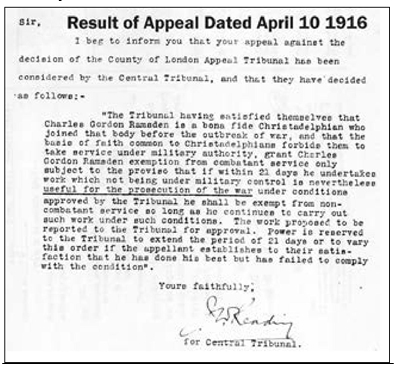
Bro. Gordon, like several other brethren, subsequently worked on a farm near Sevenoaks, Kent. He was quite a prominent brother after the war: his passing is recorded in The Christadelphian for 1983, his service for the magazine Glad Tidings being particularly mentioned.
It might also be mentioned that he was one of 1,716 British Christadelphians given alternative service under the “Pelham Committee”, almost half the total so treated in WW1.
Conclusion
I believe the above account is an interesting demonstration of the power of sincerity in presenting our position on Conscientious Objection, and demonstrates how this tenant of our faith is consistent over all the various divisions within our community. Although there was no official joint committee at the time, by the inception of WWII both the amended and unamended communities presented a united front to the authorities in the USA.
In addition, the statement by Bro. Rams den clearly and succinctly sets forth the basis of our objection to non-combatant as well as combatant service. This is
- The whole idea of war is quite contrary to the spirit of Christ
- The combatant and non-combatant are both alike integral parts of an organization … They belong to the same body, are subject to the same law, and are under the same oath, which involves a solemn undertaking to fight for king and country.
- As seen in The Fellow Labourer, April 1916, p. 283
- In “Conscription and Conscience” by John Botten, it is claimed the statement was as drafted by Bro. Viner Hall, presumably the “London Brother” referred to above. This is what was claimed by Bro. Viner, but is probably somewhat of an exaggeration.
- I must thank Bro. John Ramsden, a nephew of Bro. Gordon, for supplying the illustrations.
 The Origin of the Organic World – Part One