
Introduction
This special issue is designed to strengthen the commitment of all of us to behaving like an apostle – one who is sent with a vitally important message, which is of riches in the Kingdom beyond any present day valuation.
What is an Apostle?
Although the word is quite common in our language, it is not really an English one, but a Greek word — apostolos — in an English dress. It was not a term of frequent occurrence in Greek literature, but it has some interesting associations in terms of classical Greek. Herodotus used it in his record of an incident when the king of Sardis sent a herald to Miletus, so that an apostle in this sense may be a herald, one who takes a message from someone to a particular individual or people. The word is best defined in classical Greek as a messenger, but more than a messenger, an ambassador, or an envoy. It is related to apostoleus, a magistrate who had to fit out a squadron for service, while a kindred word is apostolē, a sending off, or away, a mission, a dispatching. In the Greek Septuagint version of the Old Testament, we find only one example, where it is usually translated “sent”:
“And it was so, when Ahijah heard the sound of her feet, as she came in at the door, that he said, Come in, thou wife of Jeroboam; why feignest thou thyself to be another? for I am sent to thee with heavy tidings” (1 Kgs 14:6).
Thus the Greek apostolos is composed of apo, from, or away from; and stolos, an equipment, an expedition, whether by land or sea, but generally used for sending or going on a journey, or for whosoever goes, or is sent, on a journey. It also carries with it the idea that an important message is associated with the sending: as in an ambassador, who is one charged with representing the authority of the person who sends. The word was therefore a very suitable one to apply to men who were given the commission to make in turn disciples of all the nations, to go into all the world and preach the gospel to the whole creation (Matt 28:19; Mark 16:15). It is also the term that is used for those who are charged with carrying the message of Jesus, as they changed from those who are taught (disciples) to those who teach (apostles). To say an apostle simply means “one who is sent” is incorrect in how the New Testament uses it, as we shall see. It is an example of the way the authors of the New Testament, through inspiration, took classical Greek words and used them in a way quite different to their prior use.
The application of the term “apostles” varies in different parts of the New Testament. In the Gospels, it generally refers to the twelve disciples (except probably in Luke 11:49, where it seems to be prophetic). Note the term is not used in the Gospel of John, except as noted below. In the earlier chapters of the Acts it refers to the Twelve who were personally chosen by Jesus of Nazareth to be his special companions, substituting Matthias for Judas Iscariot. They were the leaders of the church during its earliest days. Later, the term was applied to Paul and Barnabas, and, by implication, to James, the Lord’s brother (Gal 1:19). Besides these, the term is applied to Andronicus and Juniua, fellow prisoners with Paul, who he says were of note among the apostles (Rom 16:7). In another connection it is applied to certain officers in the early church, being placed before pastors and teachers (1 Cor 12:28; Eph 4:11). The term is therefore somewhat elastic in use, In addition, in three cases the Greek word is used, but most translations use other terms:
“Truly, truly, I say to you, a servant is not greater than his master; nor is he who is sent greater than he who sent him” (John 13:16).
“As for Titus, he is my partner and fellow worker in your service; and as for our brethren, they are messengers of the churches, the glory of Christ” (2 Cor 8:23).
“I have thought it necessary to send to you Epaphroditus my brother and fellow worker and fellow soldier, and your messenger and minister to my need” (Phil 2:25).
Only Young’s Literal Translation uses “Apostle” in all these cases, but it is difficult to see why Titus in particular, as well as Epaphroditus, cannot be considered to be Apostles, so they will here be so treated.
Apostle — the various meanings1
- In the New Testament, “Apostle” always denotes a man who is sent, and sent with full authority. Thus the Greek gives us only the form of the NT concept. We can say this quite exclusively because throughout the NT the word is used only of men, although according to the course of things women might also have been called apostles. Yet this would have been a self-contradiction, since women had very restricted legal competence in Judaism. Above all, they could not appear as witnesses.
- In John 3:16 “Apostle” is simply a rendering of the legal term in its sense of one who is lawfully charged to represent the person and cause of another. “Verily, verily, I say unto you, The servant is not greater than his lord; neither he that is sent [apostle] greater than he that sent him” (John 13:16).
- Apostle — commissioned representative of a congregation. “Whether any do enquire of Titus, he is my partner and fellowhelper concerning you: or our brethren be enquired of, they are the messengers [apostles] of the churches, and the glory of Christ” (2Cor 8:23).
- Finally, apostle is a comprehensive term for “bearers of the NT message.” The name is first borne by the circle of the twelve, i.e., the original apostles (including Matthias brought in as a replacement in Acts 1:26). Their sending by Jesus is presupposed.
This last use dominates the presentation of Luke, in his Gospel and especially Acts. The twelve are here almost a closed college alongside that of the other disciples. Among them the figure of Peter is pre-eminent (2:37; 5:29). In all these cases the term is absolute and self-explanatory; and it is always plural.
Yet the name is also applied to the first Christian missionaries or their most prominent representatives, including some who did not belong even to the wider groups of disciples. Even in Acts we find this usage at least in 14:4, 14, where Paul and Barnabas are called apostles without any sense of impropriety on the part of the author. Thus, although the twelve are apostles for Luke, they are not the only apostles. Paul especially is an apostle, in this sense, and be constantly uses the word of himself, especially in the salutations to his epistles. James, the Lord’s brother, may also be mentioned: like Paul he joined the community only after the death of Jesus.
e) In Heb 3:1 Jesus himself is called apostle. “Wherefore, holy brethren, partakers of the heavenly calling, consider the Apostle and High Priest of our profession, Christ Jesus.” Here the only possible meaning of apostle is that in Jesus there has taken place the definitive revelation of God by Jesus.
The twelve Apostles – an introduction
Below is a table of the twelve, together with their names in the various gospels.
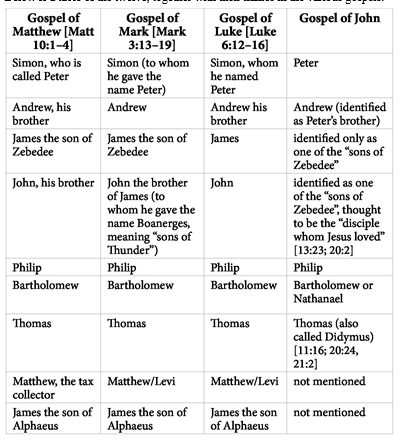
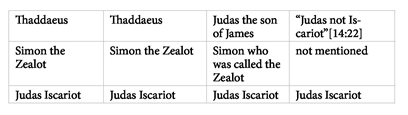
Others mentioned as Apostles are as follows:
Person called apostle Where in Scripture
Paul Numerous Places
Barnabas Acts 14:14
Andronicus and Junia Rom 16:7
Silas or Silvanus 1 Thess 1:1, 2:6
Timothy 1 Thess 1:1, 2:6
Epaphroditus Phil 2:25
Apollos 1 Cor 4:9
Titus 2 Cor 8:23
Many of these individuals, along with some of the twelve apostles/disciples of Jesus, have almost nothing recorded other than their name, but we can be sure the very fact they are mentioned as apostles says a great deal for their zeal and mission. Many, also, of these individuals are subject to separate articles in this special issue, so we will not introduce them here. However, we cannot ignore the contributions of the apostles not elsewhere dealt with, so we will cover them, somewhat briefly, in one later article. Timothy, although on our list, is being currently dealt with in a series of articles by Bro. Ryan Mutter, so we will defer to those articles.
Other sources
The literature of our community is rather scant in its consideration of the apostles as a group. Some years ago, Bro. Arthur Hall wrote a little book entitled “The Twelve — The Lord’s Men”. There is also a little book called “His Twelve Disciples” by Bro. M.D. Southgate. These two hard to find books, together with scattered articles in the various magazines, represent all I can find. It is therefore partially to fill this void this special issue was put together. It is important to remind ourselves, in these turbulent times, of the lives of the apostles, and their commitment to both spreading the gospel and giving guidance to the nascent ecclesias.
 The Origin of the Organic World – Part One