
“And ye shall hear of wars and rumours of wars: see that ye be not troubled: for all these things must come to pass, but the end is not yet. For nation shall rise against nation, and kingdom against kingdom: and there shall be famines, and pestilences, and earthquakes, in divers places. All these are the beginning of sorrows” ( Matt 24:6-8).
The accepted view
Earthquakes, volcanic eruptions and random violence have filled the news lately. We all probably know of someone who experienced travel problems due to the eruption in Iceland, and many marveled at the way our brother in Haiti survived the catastrophic earthquake there. The Japanese tsunami produced by the shift in the earth’s crust early in 2011 in Japan still have ramifications that are being felt today, both economically (car production is still restricted in Japan) and environmentally (the nuclear reactor complex there is not yet totally under control). And the slaughter of the youth in Norway made headlines, coming as it did from a famously peaceful society. Probably these events have all been all been used in Christadelphian lectures and exhortations, some based on the words of Jesus above. The expectation of the imminent return of our Lord is emphasized, and merged with the words that follow on in verse 37: “But as the days of Noah were, so shall also the coming of the Son of man be.” So it is common to point out the moral decay in North America and around the world as confirmation of the imminent return of our Lord. But it must also be pointed out that this type of exhortation, or this type of public address, is much less prevalent than it once was. A quick glance at the magazines from around a hundred years ago shows a much keener awareness of the “Signs of the Times” than is common today. Accounts of earthquakes, of famines, of outbreaks of disease, of moral decay, were all discussed in terms of their significance in demonstrating the imminent return of the Lord. This is not to deny such connections are made today, but their prevalence is not nearly so noticeable.
Even the armed conflicts of recent years, although they make headlines in our newspapers, pail into insignificance compared to the great conflicts of the twentieth century. WWII holds the distinction of destroying more lives, it is estimated, than any of the conflicts before and since. But, as a proportion of the world population, as we turn to pestilence, the black death of 1348 killed perhaps 50% of the population of Europe. The rise of HIV/AIDS is serious, but compared to this the number of deaths is quite negligible. If we remember all the concern about SARS in 1996, its actual toll was almost insignificant, with around 900 fatal cases. (I would like to acknowledge, however, that to the affected, even one death is a deep tragedy.) As to famine, millions are at risk in these times in Africa, at least partially due to regional armed conflict. But history records perhaps 30 million died from famine in China in the 1950’s, an episode which made little impact in the Americas. The great Irish potato famine of the 1850’s resulted in a population decline of perhaps 50%, much of it attributed to the emigration of those affected to America. .
Are Violence and Earthquakes Signs of the Return of Christ?
Let us first consider violence, a topic of particular concern in the USA. We read of terrible episodes of random violence: the shooting of congresswoman Giffords in Arizona, the Columbine High School massacre, and the seemingly constant litany of similar events, and we worry. We say they are signs of increasing violence in the world, and relate them to events which will surround the return of Christ.
So is this, in fact, true? Let us consider the USA. It has a murder rate of around 5 per 100,000 at present, which is much higher than that in Canada (about 1.6) and England (1.2). So we have had about a 1% chance of dying by violence in the USA, from both domestic violence and wars combined in the 20th Century. But is this high by historical standards? Well, the best estimates show, for example, that 20% of the population perished by violence in what can be termed tribal times — a situation that can perhaps be seen to this day in parts of Africa. And the murder rate is recorded as being around 200 per 100,000 in Oxford in the UK in the 14th century, much higher even than in current day border towns in Mexico, an area most of my readers would not willingly travel to1. Even in recent years, a quick look shows the incidence of violence has decreased considerably of late. In the USA the murder rate has fallen from 9.8 in 1991 to 4.8 in 2010 (last year.) In fact, all rates of crime have fallen in the last ten years, despite the economic struggles of many. Thus, despite the many terrible crimes reported in the news, we in the USA are currently safer than at any time in the past forty years.
To turn to another area, the topic of the increase in Earthquakes has been subject to much discussion in our literature, with a seeming consensus that yes, such an increase is real and a sign that we are in the end times. But is there unequivocal evidence of this? Well, I am not an earthquake specialist — a profession that, incidentally, is perhaps subject to the major problem that earthquakes are almost impossible to predict in any meaningful way. It is often claimed that there has been a recent increase in earthquakes, and indeed we have detected many more in recent years, and the trend is increasing. (Much of this is undoubtedly due to the proliferation of seismographs.) But are severe earthquakes increasing? I cannot myself detect a significant increase over
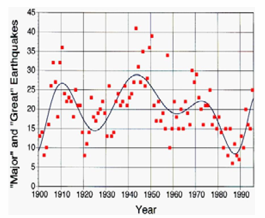
the last century from the count of earthquakes over magnitude 7.0 over the last 100 years, as shown alongside2.
What is the Current Situation?
Well, to claim the recent episodes of violence or natural disasters, both in the Americas and the world, is a sure sign of the imminent return of our Lord is, at least in my opinion, doing damage to the available information. But what of the political earthquakes? As we customarily interpret the Book of Revelation, when we come across the term “earthquake”, we traditionally assign such episodes to certain events in history. For example, of the four earthquakes mentioned in Revelation, the first, in Chapter 6, is usually related to the political changes surrounding the reign of Constantine. In Rev 11:13, we read “And the same hour was there a great earthquake, and the tenth part of the city fell, and in the earthquake were slain of men seven thousand: and the remnant were frighted, and gave glory to the God of heaven.” This is normally taken to refer to the French revolution of the late 18th century, to which is ascribed the liberty the Western World is said to enjoy — although how much enjoyment such liberty affords might be debated. On the other hand, the earthquake of Rev 16:18 is usually taken to be yet future, when Christ will return in his glory to overthrow all the nations of this world. Whether it also refers to the great earthquake foretold by the prophet Zechariah is quite likely. “And his feet shall stand in that day upon the mount of Olives, which is before Jerusalem on the east, and the mount of Olives shall cleave in the midst thereof toward the east and toward the west, and there shall be a very great valley; and half of the mountain shall remove toward the north, and half of it toward the south. And ye shall flee to the valley of the mountains; for the valley of the mountains shall reach unto Azal: yea, ye shall flee, like as ye fled from before the earthquake in the days of Uzziah king of Judah: and the LORD my God shall come, and all the saints with thee…” (Zech 14:4-5).
Thus the great earthquakes foretold in the book of Revelation refer to events in the political earth, at least most probably. And even the Olivet prophecy in the passage from Matthew above clearly refers primarily to the fall of Jerusalem, which certainly greatly shook the Jews, but not by any recorded physical earthquakes.
So what of ourselves? Are we to read about literal earthquakes, and violent episodes, and proclaim them as sure and certain signs of the long hoped for return of our Lord? Or are to look for signs in the Political Earth, such as the turmoil in the Middle East? Perhaps I am wrong, but I believe that it is the latter events that are the surer sign of the coming of Christ. There have been many violent earthquakes over the centuries, and countless wars, but for the current changes in the Middle East there is no true precedent. Even the withdrawal of Turkey “The Drying up of the River Euphrates”, was of a small impact compared to the simultaneous upheavals in Syria, Jordan, Libya and Egypt. How much further these effects will spread, and the impact on Israel and its land, is hard to predict, but certainly the Jews of the land are facing a changed world — as we are. So are physical earthquakes increasing? Is violence on the rise? I am not sure of this — but I am sure there are political earthquakes all around Israel at present.
The exhortation is real, that we are to look for signs of the sure return of our lord Jesus. But we ought not to do so using anecdotal evidence of “natural” or human disasters pulled from the headlines. I am personally inclined to put more respect in peace as a sign of the coming: “And thou shalt say, I will go up to the land of unwalled villages; I will go to them that are at rest, that dwell safely, all of them dwelling without walls, and having neither bars nor gates,” (Ezek 38:11). The world might be getting safer, but the nations around about Jerusalem are arming themselves with nuclear weapons. Safety in the short term might cause us to relax our guard, but “For yourselves know perfectly that the day of the Lord so cometh as a thief in the night” (1Thess 5:2).
 The Origin of the Organic World – Part One