
John Stuart Mill began learning Greek at the age of three, Latin at the age of eight, and had read through most of the Greek and Roman classics on politics and philosophy (as well as history — Gibbons ‘Decline and Fall of the Roman Empire’ being his favorite at 13). When I was still getting in trouble for pulling chairs out from people in Elementary School, John Stuart Mill’s father had made this child write dissertations and précis on most of these classical works, to make sure that the child developed his mind. His father was demanding, often to the limit of impossible, pushing the limits of John Stuart Mill to unheard of discipline and understanding in such a young boy. This is like the Bible and in particular, the first epistle of John and the concept of love.
Brief overview and analysis of 1 John
The book is full of “If” and “Then” statements — very logical and simple. These simple statements are indicators with which we can examine ourselves to see whether we are walking in the light. They are small but profound statements that reach deep into our minds and cut open our hearts, and lay them out in full view of the light that comes from God’s Word. For example:
“If we say that we have fellowship with Him, and walk in darkness, we lie and do not practice the truth. If we walk in the light as He is in the light, we have fellowship with one another, and the blood of Jesus Christ His Son cleanses us from all sin. If we say that we have no sin, we deceive ourselves, and the truth is not in us. If we confess our sins, He is faithful and just to forgive us our sins and to cleanse us from all unrighteousness”(1John1:6-9).
1 John is all about ideals, like Jesus was. It reaches for the unreachable. It tells us what to reach for, and how to grasp perfection, how to love perfectly, how to live perfectly, how to not sin, how to obtain perfection. And, without faith, we would read 1 John with despair and frustration. How can I possibly carry out 1 John 3:6? And in 1 John 5:14, why would I even pray if all that will be accomplished is God’s will anyways? How can I even come close to the impossible standard of 1 John 3:24? Well, the answer to these questions is answered by John in 1 John 5:3-6. THAT’S US! We have to reach for the impossible in order to do our best! Then 1 John 2:1 tells us that when we reach for this standard, God will take care of the rest.
Introduction to Love
Love (#25, 26 — agape, agapeo) is used intensely in this short epistle — #25 is used 17 times, and #26 is used 14 times for a total of 31. This is more intense than anywhere else in the Bible! John is obviously making a point that we are meant to take notice of! So, spare me some time that I may do this.
“… it is remarkable that there have been only three supposed instances of its use in ‘profane’ Greek, two of which are now read otherwise and the third is doubtful… The fact that its use was very restricted made it easier to annex for a special purpose…” [James Hope Moulton, George Milligan. The Vocabulary of the Greek Testament. (USA: Eerdmens Publishing Company, 1980), pg.2.]
Agape love is full, total, no-compromise love. It is the kind of love that we are to have in Mark 12:33 — it’s all encompassing. In fact, Jesus tells us this —
“A new commandment I give unto you, That ye love <25> one another; as I have loved <25> you, that ye also love <25> one another”( John 13:34).
What’s so new about this commandment of Jesus? Well, I can assure you that the first part certainly isn’t new. (Leviticus 19:18[your neighbor], 34[strangers and one another]). But the second part makes all the difference in the world. In fact a two letter word (in English) makes all the difference — ‘AS’… as Jesus loved us. What does ‘as’ mean? The word is ‘kathos’ #2531 and is translated ‘as’, ‘even as’, ‘according as’, ‘according to’. It gives the idea in our language of ‘equal to’, ‘in proportion to’, ‘in the degree that’… Let’s take a look at a few other passages where this word is used:
John 15:9 — “As <2531> the Father hath loved me, so have I loved you: continue ye in my love.”
2 Cor. 9:7 — “Every man according as <2531> he purposeth in his heart, so let him give; not grudgingly, or of necessity: for God loveth a cheerful giver.”
Eph. 5:25 — “Husbands, love your wives, even as <2531> Christ also loved the church, and gave himself for it…”
This ‘equal to’ love is the most fulfilling, perfect form possible. And it is this love that John, in his first epistle is capitalizing on. He tells us what this love is all about.
Agape stands in contrast to ‘eros’ (fleshly, erotic love) which is never mentioned in the New Testament, and ‘phileo’, which is affection, friendship (the word for friend in the Greek is philos), attraction, based on something that you like in the object towards which you feel phileo. But how can you possibly phileo your enemies? They do not attract you! It is based on emotion and therefore it is impossible to phileo them. Agape is not based on emotions but on a firm foundation of spiritual enlightenment through God’s Word and looking to Jesus. Then and ONLY THEN can we love God and then naturally love one another, whether it’s our brothers and sisters, our friends, our enemies, etc. (Matt. 5:44-48).
Love — the look from 1 John
Agape love is the glue that sticks together EVERYTHING! Our faith, our confidence, our relationships with others, our attitude, our knowledge, our actions, etc.
Summary
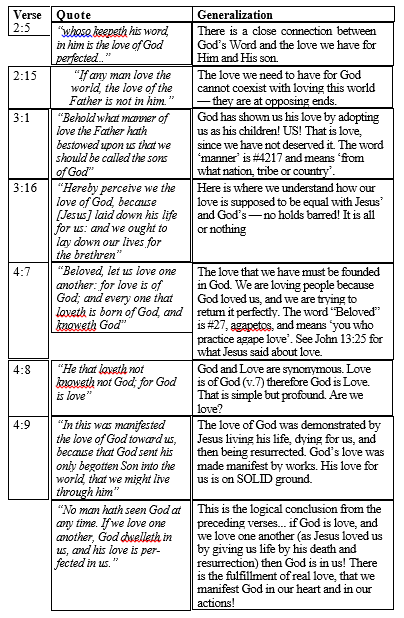
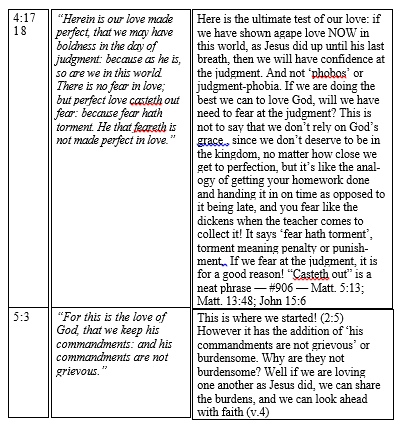
We cannot understand agape or practice agapeo without reading and knowing our Bibles. This love that we have to God cannot live in us alongside our love for the world — one of them must go. This love, which is from another country (this world does not understand or care to understand this kind of love that compels you to love those who don’t attract you) is manifested by God making us his adopted children, his sons and daughters. God’s love is not only manifested in calling us his children, but in purposing his only Son to be killed and raised again to atone for our sins that must be blotted out. The logical conclusion? We must do the same — lay down our lives for each other — CONSTANTLY! Not just to die for someone, but to do something simple like v.17. We must love one another or else our love cannot possibly be agape! It is of necessity brimming with ACTION — God’s was, Jesus’ was, and so should ours. Are we synonymous with love? Are we walking manifestations of God’s most amazing character? No one will know unless we act! God’s love is SOLIDLY founded on what he did for us, helping us out by putting away our sins so that we could be close to him. What’s our driving force for loving? The logical conclusion to us having and DOING agape love is that God dwells in us, just as he did PERFECTLY in Jesus. Finally, agape is what will sustain us at the judgement. We throw out fear, we fill our hearts with agape, and then when Christ returns, we will have confidence.
Conclusion
Love is the driving force in our lives. It is the ability to drop what we are doing and help someone, to listen to problems in someone’s life, to clean our rooms when our mothers tell us to (ahem…), to not care if we miss lunch because we are talking to a co-worker about the Bible and God’s plan, to exert ourself past our perceived limits… to reach perfection by God’s grace.
In our lives, our busy priorities have a way of getting out of hand… pick up the kids at this time, got test at this time, must be home for supper at this time… where does love fit into all this? IT DOESN”T… it is above it… LOVE IS OUR PRIORITY! It is what defines our priorities. It certainly defined God’s.
 The Origin of the Organic World – Part One