
Phase 1. Creation is very good
“In the beginning God created the heavens and the earth. And the earth was without form, and void; and darkness was upon the face of the deep” (Gen 1:1-2): in other words, the earth was an uninhabitable wasteland (Deut 32:10; Isa 24:10; 45:18; Jer 4:23-27) and it was covered by darkness and by water. In Genesis 1, God prepares a dwelling place appropriate for his creatures. He does this by creating light, the firmament above, the seas below, and the dry land; then He populates them. After inspection, He declares everything to be “very good”. Once finished, God rests from His work. The seven days follow a 3/3/1 pattern:
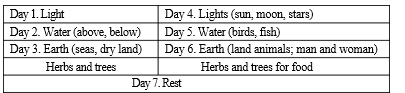
Genesis 2 provides more details about the formation of man and his wife, and their placement in the Garden of Eden. They could eat of any tree except the tree of knowledge.
Phase 2. Sin endangers creation
- The serpent contradicts God. In promising “Ye shall not surely die”, the serpent contradicts God.
- Eyes opened, but now ashamed. After the eating of the fruit, Adam and Eve transitioned from being naked and unashamed to having their eyes opened and being shamed.
- Return to the dust. Created out of dust, after the fall Adam was told he would return to the dust.
- Out of the garden of Eden. God put him in the garden, but after the fall drives him out.
- Sin escalates: Cain murders Abel, and Lamech threatens violent revenge (Gen 4).
- The wickedness of man causes God to repent. The wickedness that caused God to send the flood (Gen 6:5-7) contrasts with the sense of accomplishment in Genesis 1-2.
- God saw and behold. God’s assessment of the earth, “God saw and, behold, it was corrupt” (Gen 6:12), directly contrasts his original assessment of creation, “God saw… and, behold, it was very good” (Gen 1:31).
- Windows of heaven opened. “And the windows of heaven were opened” (Gen 7:11) reverses the division of waters above and below on day two (Gen 1:6-8).
- Fountains of the deep broken up. The breaking up of the fountains in Genesis 7 reverses the gathering of waters and formation of dry land on the third day (Gen 1:9-10).
- All flesh died. The death of all flesh (Gen 7:21-22) reverses the creative acts of days five and six (Gen 1:20-31; cf. 2:7).
Phase 3. Creation restored and the covenant established
- Windows of heaven stopped. “And the windows of heaven were stopped, and the rain from heaven was restrained” (Gen 8:2), reverses their opening to cause the flood (Gen 7:11) and reestablishes the division of waters from day two (Gen 1:6-8).
- Fountains of the deep stopped. “The fountains also of the deep… were stopped…” (Gen 8:2-13) restores the dry land from the third day (ct. Gen 7:11, 18-20, 24; 8:9; cf. 1:9-10).
- Animals to be fruitful and multiply. “Bring…every living thing… that they may breed abundantly in the earth” (Gen 8:17) replays days five and six (esp. Gen 1:22).
- No more curse. “And the Lord said… I will not again curse the ground” (Gen 8:21b) reverses “Cursed is the ground for thy sake” (Gen 3:17).
- No more smiting of all living things. “And the Lord said… neither will I again smite any more every living thing” (Gen 8:21d) reverses “And the Lord said, I will destroy… both man and beast” (Gen 6:6-7).
- Imagination of man’s heart remains evil. The reason God gives for these reversals, “for the imagination of man’s heart is evil from his youth” (Gen 8:21), is exactly the same reason He gave for causing the flood, “And God saw that… every imagination of the thoughts of his heart was only evil continually” (Gen 6:5). Man has not changed: it is by God’s mercy that creation continues.
- Seasons shall not cease. “While the earth remaineth, seedtime and harvest… and summer and winter… shall not cease” (Gen 8:22) reestablishes the purpose of the sun, moon, and stars from day four, (Gen 1:14). This promise is applied to Israel (Jer 31:35-36; 33:19-21, 25-26), probably because the annual calendar of feasts was so essential to the nation’s identity.
- God renews His blessing to be fruitful and multiply. “And God… said unto them, Be fruitful, and multiply, and replenish the earth” (Gen 9:1; cf. 9:7) renews the original blessing of Adam and Eve, “And God said unto them, Be fruitful, and multiply, and replenish the earth” (Gen 1:28). God is starting over with Noah and his family.
- Mankind has dominion over the rest of creation. “The fear of you and the dread of you shall be upon every beast of the earth” (Gen 9:2) recalls “Let them have dominion over the… earth… and over every living thing that moveth upon the earth” (Gen 1:26, 28), but with the idea of “dread” indicating a need for further reform (see, for example, Psa 8:3-8 and Heb 2:5-9).
- Mankind’s diet extended. “I have given you all things” (Gen 9:3) echoes “I have given you every herb… and every tree… to you it shall be for meat” (Gen 1:29; cf. Mark 7:15-19; Rom 14:6; 1Cor 10:25-31; 1Tim 4:3-5).
- Murder is a capital offense because God made man in His image. “At the hand of every man’s brother will I require the life of man” (Gen 9:5-6) recalls Cain’s murdering of Abel (Gen 4:8, 10-11). The reason God gives, “for in the image of God made he man” (Gen 9:6), repeats “And God said, Let us make man in our image, after our likeness” (Gen 1:26).
- God’s covenant with Noah and all of creation. When God announced His intention to destroy all flesh (Gen 6:5-7), He promised Noah, “with thee will I establish my covenant; and thou shalt come into the ark,” (Gen 6:18; 7:1; cf. 6:8). God’s directive to “come into the ark” indicates that God was in the ark already, implying that God was with Noah and his family in the ark. The details of this covenant are formalized after the flood,
“And God spake unto Noah, and to his sons with him, saying, And I, behold, I establish my covenant with you, and with your seed after you; And with every living creature that is with you… neither shall all flesh be cut off any more by the waters of a flood; neither shall there any more be a flood to destroy the earth” (Gen 9:8-11).
- God remembers His covenant. In the midst of the flood, “God remembered Noah, and every living thing, and all the cattle that was with him in the ark” (Gen 8:1). This remembering of Noah points forward to the token of the perpetual covenant:
“And God said, This is the token of the covenant which I make between me and you and every living creature that is with you, for perpetual generations. I do set my bow in the cloud, and it shall be for a token of a covenant between me and the earth…and I will look upon it, that I may remember the everlasting covenant” (Gen 9:12-17).
 The Origin of the Organic World – Part One