
Bethlehem, a small town about four or five miles south of Jerusalem, along with its immediately surrounding area, has been the scene of some very significant births in Bible times:
- Rachel (whose name in Hebrew means “ewe”, or female sheep) gave birth to her second son just before she died very near to “Ephrath (that is, Bethlehem)” (Gen 35:19) and “Migdal Eder” (v 21). (Rabbinical tradition states that the single pillar which Jacob erected over her tomb, mentioned in verse 20, was modified and added to over many years to become what was later called “Migdal Eder”, the “Tower of the Flock”.) As she was dying, Rachel named her son “Ben-Oni” (“son of my sorrow”), but his father Jacob renamed him “Ben-Jamin” (“son of my right hand”) (v 18).
- The great King David, the shepherd boy elevated to the throne of Israel, was almost certainly born in or near Bethlehem, the home of Jesse his father (1Sam 16:1,18; 17:12), as well as the home of his ancestors Boaz and Ruth (Ruth 4:11).
- The prophet Micah, in predicting the advent of Israel’s Messiah, names the “watchtower of the flock” (Hebrew “Migdal Eder”) as the place to which the “kingship” will “be restored” (or “come”, KJV) to the “daughter of Zion”, or Jerusalem (Mic 4:8). In other words, one born at Migdal Eder or Bethlehem would rule from Jerusalem over the Kingdom of God. There is no mistaking that, by “restoring” or “coming”, he means the birth of the Messiah — since he speaks of the “woman in labor” in verses 9 and 10. This prophecy is clarified further in Micah 5:2-3: “ ‘But you, Bethlehem Ephrathah, though you are small among the clans of Judah, out of you will come for me one who will be ruler over Israel, whose origins are from of old, from ancient times.’ Therefore Israel will be abandoned until the time when she who is in labor gives birth and the rest of his brothers return to join the Israelites.”1The ruler to be born there would become the great Shepherd “in the majesty of the name of the LORD his God”, and “his greatness will reach to the ends of the earth” (v 4).
- Later, in Jeremiah 31, the prophet sees a time when, after great trials, the LORD will save a remnant of Israel out of their captivity, including “expectant mothers and women in labor” (v 8). Meanwhile, “the voice of Rachel” will have been heard, in Bethlehem, “weeping for her children… because they are no more” (v 15). Nevertheless, the LORD says to those mothers who weep: “Restrain your voice from weeping and your eyes from tears, for your work will be rewarded… They will return from the land of the enemy. So there is hope for your future… Your children will return to their own land” (vv 16-17).
- Finally, of course, Jesus Christ was born in Bethlehem the town of David (Matt 2:1; Luke 2:4), as Micah had predicted (Matt 2:5-6). Luke records succinctly that he was laid in a “manger”, a corn crib or feeding trough there (Luke 2:7).
- Upon hearing of the birth of the Messiah at Bethlehem, the old King Herod the Great, evidently insane and delusional, tried to track him down. When he could not find him, he ordered the slaughter of all the male babies in or near Bethlehem. Not knowing exactly when the child was born, or exactly where, he decided to err on the side of ‘safety’: “He gave orders to kill all the boys in Bethlehem and its vicinity who were two years old and under” (Matt 2:16). Matthew himself adds, quoting Jeremiah, “Then what was said through the prophet Jeremiah was fulfilled: A‘ voice is heard in Ramah, weeping and great mourning, Rachel weeping for her children and refusing to be comforted, because they are no more’ ” (vv 17-18; Jer 31:15).
This brief survey yields the following chart:
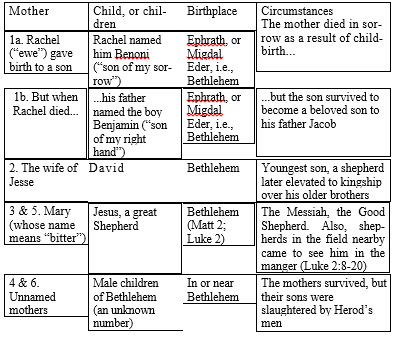
Parts of this summary we know very well, but other parts perhaps less. We notice particularly the emphasis on sheep and shepherds, as well as that somewhat mysterious place, “Migdal Eder”, “the tower, or watchtower, of the flock”. Naturally, we might ask: does this refer to a “flock” of “sheep”, watched over by shepherds?
Watchtowers in the Bible
In Bible times, “watchtowers” were built on city walls or on borders, from which watchmen might sound a trumpet, or send messengers, to warn of imminent danger, such as attack or invasion (Jdgs 8:9, 17; 9:46,49-52; 2Kgs 9:17; 17:9; 18:8; 1 Chron 27:25; 2Chron 26:9, 15; 32:5; Neh 3:1; Psa 61:3; Isa 21:8; 32:14; 62:6,7; etc).
Other towers, probably less elaborate, were erected to guard vineyards or orchards from thieves (Isa 5:2; Matt 21:33; Mark 12:1). King Uzziah also had towers built for shepherds to watch over his extensive flocks (2Chron 26:10).
“Migdal Eder”, the “tower of the flock”, may have been a military watchtower in the first instance, so named because of flocks that already pastured in the area (1Sam 16:4, 11; Luke 2:8). Later, the same tower may have been taken over by shepherds, who used it as a lookout post from which they watched over their scattered flocks.
The location of Migdal Eder
The Anchor Bible Dictionary says that Migdal Eder’s “exact location is not known”, but that “it has been associated with Khirbet Siyar el-Ganam, approximately 2.5 kilometers (1.5 miles) east of Bethlehem on a ridge overlooking the modern village of Beit Sahur.” (Other sources, mentioned below, say that this site is one kilometer, i.e., about 5/8 of a mile, east of Bethlehem.)
This site is described as a favorite tourist destination. One website2 states that Eusebius (265-340 AD) called it “Tower Ader”, the place where shepherds received the announcement of Christ’s birth. The website also states: “Since 1859 the site of Siyar el-Ganam (the Sheepfold) has been preferred as the traditional site… This area, in the care of the Franciscans, was partially excavated in 1859… and extensively excavated… in 1951-52. These excavations revealed a vast monastic agricultural establishment, with presses, cisterns, silos and grottoes [natural caves].”
Later, this site seems to have passed under the control of the Greek Orthodox Church. On its website (www.greekorthodoxsf.com), the Greek Orthodox Partriarchate of Jerusalem shows photographs and describes the Monastery at the Shepherd’s Field there.
Edersheim and the Tower of the Flock
To all this the noted rabbinical authority Alfred Edersheim3adds other intriguing information.
Following is what he had to say about Migdal Eder. The references cited are from the Mishnah. Additional explanatory references and notes have been supplied by the present writer, and are set apart in brackets.
There is one passage in the Mishnah which throws… light on the Gospel narrative [meaning, in this case, Luke 2]… We know that, on the night in which our Savior was born, the angels’ message came to those who probably alone of all in or near Bethlehem were “keeping watch”. For, close by Bethlehem, on the road to Jerusalem, was a tower, known as Migdal Eder, the “watch-tower of the flock” [see Gen 35:21; also see Mic 4:8-10; 5:2-4]. For here was the station where shepherds watched their flocks destined for sacrifices in the Temple. So well known was this, that if animals were found as far from Jerusalem as Migdal Eder, and within that circuit on every side, the males were offered as burnt-offerings, the females as peace-offerings.
R. Jehudah adds: “If suited for Paschal [i.e., Passover] sacrifices, then they are Paschal sacrifices, provided it be not more than thirty days before the feast” (Shekal. vii 4; compare also Jer. Kid. ii. 9). It seems of deepest significance, almost like the fulfillment of type, that those shepherds who first heard tidings of the Savior’s birth, who first listened to angels’ praises, were watching flocks destined to be offered as sacrifices in the Temple. There was the type, and here the reality… The small village-inn was over-crowded, and the guests from Nazareth found shelter only in the stable, whose manger became the cradle of the King of Israel.
“It was here [by which Edersheim seems to mean some shelter or stable for sheep, close by Migdal Eder] that those who tended the sacrificial flocks, heaven-directed, found the Divine Babe [the baby Jesus] — significantly the first to see him, to believe, and to adore. But this is not all. It is when we remember that presently these shepherds would be in the Temple, and meet those who came thither to worship and to sacrifice, that we perceive the full significance of what otherwise would have seemed scarcely worthwhile noticing in connection with humble shepherds: “And when they had seen it, they made known abroad the saying which was told them concerning this child. And all they that heard it wondered at those things which were told them by the shepherds” (Luke 2:17,18)…”
We can understand the wonderful impression made on those in the courts of the Temple, as, while they selected their sacrifices, the shepherds told the devout of the speedy fulfillment of all these types in what they had themselves seen and heard in that night of wonders; how eager, curious crowds might gather around to discuss, to wonder, perhaps to mock; how the heart of “just and devout” old Simeon would be gladdened within him, in expectation of the near realization of a life’s hopes and prayers [Luke 2:25-35]; and how aged Anna, and they who like her “looked for redemption in Israel”, would lift up their heads, since their salvation was drawing nigh [Luke 2:36-38]. Thus the shepherds would be the most effectual heralds of the Messiah in the Temple, and both Simeon and Anna be prepared for the time when the infant Savior would be presented in the sanctuary.
But there is yet another verse which, as we may suggest, would find a fuller explanation in the fact that these shepherds tended the Temple flocks. When in Luke 2:20 we read that “the shepherds returned, glorifying and praising God”, the meaning in that connection seems somewhat difficult till we realize that, after bringing their flocks to the Temple, they would return to their own homes, and carry with them, joyfully and gratefully, tidings of the great salvation. Compare here Luke 2:17,18, which in point of time precede verse 20. The term “diagnorizo”, rendered in the KJV “make known abroad”… does not seem exhausted by the idea of conversation with the party in the “stable”, or with any whom they might meet in “the field”.
Note that we cannot be positive about the place; in fact, we can be absolutely certain about the exact location of very few events in the Bible. Having said that, though, the circumstantial evidence and the relevant Bible passages surely point toward Migdal Eder, the Tower of the Flock, as the birthplace of Jesus.
The shepherds and the Tower of the Flock
It is stated that Migdal Eder was about one mile east of Bethlehem. It should be easy to accept small discrepancies in the reported distance between the village itself and the tower (sometimes said to be 5/8 of a mile, and at other times 1.5 miles) — given that, as time passed, it would have been difficult to determine exactly where the village stopped and the countryside began. Migdal Eder may have been considered as standing on the outskirts of the town, or more simply as part of the town because situated in its environs.
Sometimes the distinction between a village and a region seems unclear in the Bible. We may note that the village Bethlehem and the region Ephrath (or Ephrathah) occur as parallel place names in certain passages (Gen 35:19; 48:7; Ruth 4:11; 1Sam 17:12; Mic 5:2). But Ephrath and Ephrathah are names for a portion of land much greater than the size of one village, inhabited by a clan (Mic 5:2) or family of Judah, the “Ephrathites” (Ruth 1:2; 4:11; 1Sam 17:12; Psa 132:6). The Ephrathites kept sheep and raises crops in the fields. The Ephrathites seem to take their name from their matriarch, Ephrath, who married Caleb (1Chron 2:19); this family settled in and around Bethlehem, but in a somewhat larger area — perhaps as far north as Jerusalem. What we now think of as the royal family of Judah (Boaz, Jesse and David) were members of the Ephrathites, but presumably also lived very near the village of Bethlehem. As L.M. Luker puts it, “Bethlehem was a village locale within the greater expanse of the clan Ephrathah”4This leads us to conclude, then, that a tower one or two miles away from a village might be considered part of the village.
Various Jewish commentaries actually discuss the work of the shepherds in and around Migdal Eder and Bethlehem. The shepherds were most likely Levites selected and trained for their special tasks, who reported to the highest Jewish officials connected with the Temple in Jerusalem. In addition to the duties of watchmen, the shepherds supervised the birthing of the lambs that were destined for Temple sacrifice, and provided their care afterward.
The tower itself would be the place where the shepherds kept watch for predators and thieves who threatened their flocks. Underneath, in the lower level of the tower, or perhaps in a cave or grotto beneath it, there was a warm, dry area where ewes about to give birth were taken. Clean straw was provided, the shelter would be cleaned regularly and meticulously, and good fodder would be provided for the mother sheep, probably in cribs, troughs or mangers.
There, if everything went right, was where the Passover lambs were actually born. We are also told that, after they were cleaned up and checked for defects, the male lambs were wrapped in cloths to protect them from injury and contamination as much as possible. Only those with no flaw, defect or blemish would be suitable for sacrifice, and for the Passover meal (Exod 12:5). (This wrapping of newborns is sometimes done even today for valuable lambs, but not for religious reasons at all.) There, in the stables, they were sheltered and watched until they were old enough, and strong enough, to be allowed out into the pastures.
For up to one year after birth, the newborn males destined to become Passover lambs would be cared for, according to the Law of Moses (verse 5 again), until the time came for them to be delivered to the Temple.
Joseph and Mary at the Tower of the Flock
Here we start with what we know for certain, and go on to consider carefully how to fill in the gaps, recognizing that the results can be no more than educated guesses.
When there was no room at the inn in the town, then Joseph and Mary may have been directed the short distance to Migdal Eder, and its clean, comfortable stable, near the mothers with their newborn lambs. Was it coincidence (meaning, of course, providence) that brought them there when other possibilities had failed? Was there a guide who pointed the way to the best place for the delivery of a baby? Did Joseph, who possibly grew up nearby, have knowledge of Migdal Eder and its facilities? Or was it yet another angelic message to Joseph, one we are not told about, which led them to that special place?
Given the background described by Edersheim and the rabbis, we might assume that at all times there would be some shepherds on watch at Migdal Eder itself. These shepherds would assist the young couple, by showing them to a suitable place of privacy in the stables, and perhaps by finding a midwife to assist in the delivery.
Perhaps it is not a great stretch of imagination, then, to see the newborn babe wrapped in “swaddling cloths” taken from the shepherds’ stock for the care and binding of newborn lambs. Nor to envision the newborn babe laid in a manger or crib, one that would otherwise be used for the care and feeding of the sheep sheltered there.
We might also assume that the shepherds’ co-workers were out in the nearby fields, watching over other portions of the same flocks — all of them ultimately destined for Temple service, in one sacrifice or another. These would be the shepherds on patrol who, when the time came, heard the angelic announcement:
“Today in the town of David a Savior has been born to you; he is Christ the Lord. This will be a sign to you: You will find a baby wrapped in cloths and lying in a manger” (Luke 2:11,12).
With this background information, it is now perfectly understandable that, when shepherds of this place heard such an announcement, all they needed to know was that the baby and future Savior was “wrapped in cloths” (like the special newborn lambs they cared for) and “lying in a manger” (like the ones they kept for the mothers of the newborns). They were given just enough information to know exactly where to go — because it was their own headquarters!
On the other hand, if the shepherds who heard the announcement had no connection with Migdal Eder, it is not so easy to imagine how they would have been able to use those rather vague directions to find their way, over a distance of perhaps several miles, to exactly the right stable.
Conclusion
It is quite possible, then, that Mary would have given birth to Jesus, not just near the area where the Passover lambs were kept before they were taken to the Temple, but in the actual place where the Passover lambs were also born.
Thus, in a cave beneath the Tower of the Flock, on the outskirts of Bethlehem, Mary gave birth to the Savior of the world. There she brought forth the baby who would be a “Ben-oni” (“son of sorrows”) — hence the bitterness implied in her name, as well as the prophetic words of Simeon at the Temple: “A sword will pierce your own soul as well!” (Luke 2:35). But the child would also be known as God’s “Benjamin” (“the Son of the Lord’s right hand”) (Gen 35:18). Born where shepherds watched their flocks, he would grow up to be the “Lamb of God” offered as a sacrifice for their sins, and ours, like a lamb led to the slaughter (Isa 53:7). But he would also be the Good Shepherd who would in turn lead his flocks to the green pastures of the Promised Land (Psa 23; John 10).
Like his ancestor David, he first would lead and protect a small flock, and then at last become the king to lead a great nation. Truly “his greatness will reach to the ends of the earth” (Mic 5:4). While many perish around him, and he perishes also, yet he will be raised from the dead, and cause all his people to return to their own inheritance (Jer 31:15-17). He will be the one, born out of sorrow and pain, and perishing in the midst of the same — but destined to sit upon his Father’s right hand and bring the promised comfort to all God’s people.
When the time came more than 30 years later, this true Passover lamb would be brought to the City of the Great King, and to its Temple. The priests and leaders of Israel, try as they might, would be unable to find any fault in him. The Lamb without spot or blemish would be slain, and his blood shed on God’s altar. Then, as the Great Shepherd of the sheep, he would be brought back from the dead through the blood of the eternal covenant (Heb 13:20).
If so, how extraordinarily precise is the correlation between the type (the birth of the Passover lambs) and the fulfillment (the birth of Jesus). As precise, it seems, as the preparation and sacrifice of the Passover lambs is to his crucifixion.
How wonderful to think of this in connection with the declaration of John the Baptist, when he saw Jesus coming toward him:
“Look, the Lamb of God, who takes away the sin of the world” (John 1:29).
Now, with even greater Scriptural reason, we may well marvel, along with those shepherds, at the extraordinary circumstances of the birth of the Savior. For we know,
“It was not with perishable things such as silver or gold that you were redeemed from the empty way of life handed down to you from your forefathers, but with the precious blood of Christ, a lamb without blemish or defect” (1Pet 1:18,19).
“For Christ, our Passover lamb, has been sacrificed. Therefore let us keep the feast… with the unleavened bread of sincerity and truth” (1Cor 5:7,8).
- All references are from the NIV
- Seehttp://198.62.75.1/www1/ofm/sites/TSbsites.html
- Alfred Edersheim, Sketches of Jewish Social Life in the Days of Christ
- Anchor Bible Dictionary on “Ephrathah”
 The Origin of the Organic World – Part One