
“There are those who curse their fathers and do not bless their mothers; those who are pure in their own eyes and yet are not cleansed of their filth; those whose eyes are ever so haughty, whose glances are so disdainful; those whose teeth are swords and whose jaws are set with knives to devour the poor from the earth, the needy from among mankind.”
These verses constitute the first of Proverbs 30’s six tetrads (a tetrad being a grouping of four items). They describe four features of arrogant people:
- They curse their parents (v 11).
- They are proud of their sins and immoral behavior (v 12).
- They are haughtily dismissive of others (v 13).
- They use their mouths like weapons to destroy others (v 14).
All four items listed here begin with the Hebrew word “dowr” (“generation”): “There is a generation…” (vv 11-14). “Dowr” appears many times in the Psalms, meaning either:
- an age or period of time (Psa 49:11, 19; 61:6; 71:18; 72:5; Jer 2:31; 7:29), or perhaps
- a class or group of people (Psa 12:7; 14:5; 24:6; 95:10; 112:2).
In the New Testament, the Greek “genea” corresponds to the Hebrew “dowr”, with the same dual meaning (Matt 11:16; 12:45; 16:4; 17:17; 23:36).
The passage about the Suffering Servant in Isaiah 53 provides an interesting usage of “dowr” in verse 8:
“By oppression and judgment he was taken away, and who can speak of his descendants? [‘who shall declare his generation?’: KJV; or ‘who of his generation considered?’: NIV margin].”
Here, the simple meaning is that the Messiah will be cut off without literal “generations” (descendants), but the passage also implies that he will have a spiritual “generation”, not created by blood descent and the passage of time, but by knowledge and developed likeness (see Isa 53:10-12). For such a “generation”, the affinity with the LORD’s Servant is no longer a matter of physical descent but of spiritual connection, no longer time-related but class-related.
Back in Proverbs 30, the KJV, ASV and NET translate “There is a generation”, but the RSV and NIV choose the simpler “There are those who… those whose…”, etc.
Is Agur speaking of a particular period of time in which evil predominates? Or is he speaking of a particular class of people who might well be found in any generation? Either option seems possible. However, the similarities between these verses and Paul’s description of the “terrible times in the last days” (2Tim 3:1-7, particularly vv 2-4) may point more toward the first option. Consider some of the parallels with 2 Timothy 3, along with Romans 1 also:
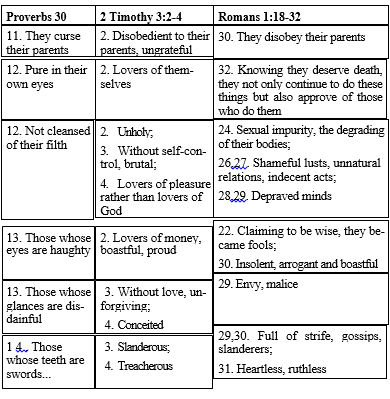
Even then, this answer leaves further questions to be asked: ‘What are the last days to which Paul refers in 2 Timothy? His own day, or our own day, or something broader and/or longer?’ For surely to some degree, these four “generations” have been found in every age. They always have been, and always will be, until Christ’s coming and God’s perfect kingdom.
- There are those who curse their fathers and do not bless their mothers: The Law of Moses warns against just this abuse, or cursing, of parents (Exod 21:17; Lev 20:9; Deut 27:16; cf Prov 20:20); it was in fact a capital offense. The Law also commands, positively, that children bless and honor their parents (Exod 20:12; Lev 19:3, 32; cf Prov 23:22-25). “Curse” is the same “qalal” as in verse 10; it signifies to treat lightly, shamefully or disrespectfully.
Charles Bridges writes, “Many are the forms in which this proud abomination shows itself: resistance of a parent’s authority (2Sam 15:1-10), contempt of his reproof (1Sam 2:25), shamelessly defiling his name (2Sam 16:22), needlessly exposing his sin (Gen 9:22), coveting his substance (Prov 19:26; Jdgs 17:2), and denying one’s obligations to him (Matt 15:4-6).”
In his teaching about the “corban”, or gift, Jesus shows that children may honor their parents in the most practical way by providing for their care and not shirking their responsibility (Matt 15:3-9; Mark 7:6-13). Realizing their parents were the ones who cared for them when they were young and helpless, children should especially heed the command to honor them. Furthermore, Jesus’s words strongly suggest that he who does not honor his father or mother does not honor God either. Failing to bless is equivalent to cursing.
We are commanded to honor our parents because they are God’s instruments of creation. Without them we would not exist. Failing to recognize that we owe our lives to our parents, and that subsequently we owe them honor, means failing to recognize God as our Creator and Father, whom we are especially obliged to honor.
References to father and mother recur in verse 17, after the next tetrad, suggesting a connection between the first two groups of four in this chapter. In fact, the curses (the warnings of judgment) in that verse make a fitting conclusion to verses 11-14 also, since they supply the punishment, in graphic description, that seems to be lacking from the first series:
“The eye that mocks a father, that scorns obedience to a mother, will be pecked out by the ravens of the valley, will be eaten by the vultures.”
- Those who are pure in their own eyes and yet are not cleansed of their filth: The word for “cleansed” (“rakhats”) means “to wash; to wash away; to bathe”. It is used of physical and ceremonial washings, and hence figuratively of removing sin and guilt through confession (e.g., Isa 1:16; Psa 26:6; 73:13; cf Deut 21:6).
Likewise, “filth” (“tsow’ah”: meaning excrement or bodily excretions of every sort) may refer to physical uncleanness (cf Isa 4:4; 28:8; 36:12), but also metaphorically to moral defilement (Zech 3:3,4). When Zechariah describes the removal of the high priest Joshua’s defiled garments (Zech 3:3-5), he is plainly referring to Joshua being cleansed from guilt and then receiving a new standing as the LORD’s representative before the people.
There are those — especially in religious circles, unfortunately — who see themselves as “pure” (“tahowr”: cf the same word in Prov 20:9; 22:11; Psa 51:10; Ezek 36:25). They think they are something when really they are nothing (Gal 6:3). Like the Laodiceans, they say to themselves, ‘We are rich; we have acquired wealth and do not need a thing.’ But they do not realize that they are wretched, pitiful, poor, blind and naked (Rev 3:17).
In effect, such ‘pure ones’ are so depraved that they cannot understand their own depravity, and so perverse that they cannot see their own perversity. So they go about seeking to prove some imagined ‘purity’ by diligently keeping every outward ritual, and developing “a form of godliness” even while denying the power of such godliness to transform their own lives (2Tim 3:5). In this they hope to appear righteous to others (cp Prov 16:2; 20:9).
Are we ever like this? Do we sometimes tell others, implicitly if not explicitly, “Keep away; don’t come near me, for I am too sacred for you!” (Isa 65:5)? Are we ever like the Pharisee who went into the temple courts to pray, whose prayer began with: “God, I thank you that I am not like other men — robbers, evildoers, adulterers — or even like this poor fellow standing here beside me!” (Luke 18:11)?
We should not forget that the Greek word for “hypocrite” (transliterated directly into English) described in the first place a stage actor, playing a part for his audience. The actor on the stage may have no qualities or character traits in common with the character he is portraying. He may be the worst kind of scoundrel who is simply acting the part of a saintly person. Or he may be an exemplary individual portraying a mass murderer.
Are we ever stage actors? Do we ever fall into the trap of pretending to be what we know we are not, for the sake of pleasing or deceiving others? If so, then, in the words of Jesus, we may be like “whitewashed tombs, which look beautiful on the outside but on the inside are full of dead men’s bones and everything unclean” (Matt 23:27). He also said of such men: “You are the ones who justify yourselves in the eyes of men, but God knows your hearts. What is highly valued among men is detestable in God’s sight” (Luke 16:15).
The sad fact is that self-deception can never cleanse. It can only continue to assert what is false; it can do nothing to make that assertion true. It will try to cover its ‘stench’ with a cloud of perfume, all to no avail. But the ones who remain on this self-deceiving course will continue to go wrong until it is too late to go right. The time will come when the one who is “vile” or “filthy” will remain so by a decree infinitely greater than his own conscience, and with no more remedy, even to the end of time (Rev 22:11). The only safe course, when confronted with one’s own moral filth, is — like the tax collector of Jesus’s parable — to beat upon the breast and say, “God, have mercy on me, a sinner” (Luke 18:13).
#3. Those whose eyes are ever so haughty, whose glances are so disdainful: Seeing themselves as “pure”, they must see others as not quite up to the same standard. The proverb emphasizes the eyes because the glance or look is the most immediate evidence of their contempt for others. These men are wise in their own eyes, when in reality they have less hope than fools (Prov 26:12). “Haughty” is the Hebrew “ram”, to be high or lifted up, in pride; the KJV captures the intensity of the phrase with an exclamation: “O how lofty are their eyes!”
“Disdainful” is a different word, “nasa” (to lift up), but with the same effect. This haughtiness leads to a corresponding contempt, or disdain, for those whom they see as ‘beneath’ them (Prov 6:17; 21:4). In English, the same thought is conveyed as having one’s nose in the air, or looking down one’s nose at others (cf Isa 3:16).
We may see this lofty, blind pride, as Bridges points out, in:
- the worldly greatness (and blindness) of Moab (Isa 16:6; Jer 28:29);
- the pride of the prince of Tyre (Ezek 28:2);
- the boasting of Antiochus (Dan 11:36);
- the self-glorifying ostentation of Haman (Esth 5:11);
- the self-satisfied contemplation of Nebuchadnezzar admiring his own works, before the severe chastening of God had taught him the wholesome lesson: “Those who walk in pride he is able to humble” (Dan 4:37);
- the striking apparel and blasphemous posing of Herod (Acts 12:21); and
- the remarkable hubris of the “man of sin”, sitting in God’s temple and proclaiming himself to be God (2Thes 2:4).
The words in this verse drip with irony. Catching this spirit, Matthew Henry writes: “[Agur] speaks of them with amazement at their intolerable pride and insolence: ‘Oh how lofty are their eyes!’ With what disdain do they look upon their neighbors, as not worthy to be set with the dogs of their flock! What a distance do they expect everybody should keep; and, when they look upon themselves, how do they strut and vaunt like the peacock, thinking they make themselves illustrious when really they make themselves ridiculous! There is a generation of such, on whom He who resists the proud will pour contempt.”
#4. Those whose teeth are swords and whose jaws are set with knives to devour the poor from the earth, the needy from among mankind: “Swords” is the plural of “chereb”, a fairly common Hebrew word. In Proverbs it is used of a double-edged sword (Prov 5:4), the piercing of reckless words (Prov 12:18), and the words of a false witness against his neighbor (Prov 25:18).
The word for “jaws” is “metalle’ot”, referring to the jawbone, but with emphasis on biting and thus alluding to the teeth. Whenever the word appears, it is parallel to teeth: in two cases it refers to the jawbone of a lion (Joel 1:6; Psa 58:6, where the NIV translates “fangs”); in Job 29:17 it refers to the “fangs” of wicked men.
The word for “knives” is “ma’akhalot”, creating alliteration with the previous “metalle’ot”. “Ma’akhalot” refers to a large knife for carving meat, a butcher knife. Such a knife could be used for slaughtering an animal and dividing the body pieces, exactly the procedure used by the priests in the offering of sacrifices. Ironically, all four times the noun is used in the Bible (Gen 22:6, 10; Jdgs 19:29; and here) it describes or suggests the killing, dismembering, sacrificing and/or eating of human beings!
Although human, those who have teeth like swords, and butcher knives set in their jaws, have essentially become brute beasts, predators seeking whom they might attack and devour. They accomplish this by hateful words and cruel schemes, by false accusations, and/or by secret gossip and slander, seeking to damage the reputations and destroy the spirits of others. Being predators, they are likely to go after those whom they see as weak, the poor and needy of this world, the ones least able to defend themselves, or having the least standing in society in the first place (Prov 31:8,9). In the words of Jesus, such men “devour widows’ houses” while making a show of lengthy prayers (Matt 23:14) — the actions of a “hypocrite”.
When the righteous Job remembers the times he “broke the fangs of the wicked and snatched the victims from their teeth” (Job 29:17), he is thinking of how he confronted such predatory men. David spoke of such men as “those who devour my people as men eat bread” (Psa 14:4) — i.e., these predators “devour” men as casually as other men eat bread! Micah spoke of those “who tear the skin from my people and the flesh from their bones” (Mic 3:2,3; cp also Jer 5:17; 30:16).
That men and women can become like brute beasts, forgetting or never truly understanding what it means to be created in the image of God, is a great tragedy. Such people wreak havoc, by words and deeds, upon their fellows. This is why such passages as Psalm 49 remind us that the rich and those of high standing may be like the beasts that perish (vv 12, 20). It is also why the great prophecies of Daniel and Revelation picture the Gentile nations as predatory beasts.
By far the greatest tragedy is when, as this proverb implies, brothers and sisters of Christ go so far as to forget their privileged status in God’s family, and then bite and devour their own fellow believers. Alongside them the great beasts of prophetic image pale into insignificance:
“If you keep on biting and devouring each other, watch out or you will be destroyed by each other” (Gal 5:15).
“For I am afraid that when I come I may not find you as I want you to be… I fear that there may be quarreling, jealousy, outbursts of anger, factions, slander, gossip, arrogance and disorder” (2Cor 12:20).
“What causes fights and quarrels among you? Don’t they come from your desires that battle within you?” (James 4:1).
The final irony is that such men will find themselves, at the last, having to face the Son of God, who will truly have a sharp sword coming out of his mouth. That sword will be a sword of Divine power with which he will punish the wicked, smite the nations, and rule over God’s Kingdom (Rev 19:15,16; cp also Rev 1:16; Psa 2:9; 2Thes 2:8).
The sword-bearing Son of God will destroy these wicked, but he will at the same time reward and bless the righteous — those who have shown true heavenly wisdom and demonstrated their purity by being “peace-loving, considerate, submissive, full of mercy and good fruit, impartial and sincere”. Such “peacemakers who sow in peace” will “raise a harvest of righteousness” (James 3:17,18).
 The Origin of the Organic World – Part One