
Agur’s confession of ignorance (vv 2,3) is followed by five questions (v 4) which call attention to the greatness of the LORD.
The “most stupid” of men? (verses 2,3)
“I am the most ignorant of men; I do not have a man’s understanding. I have not learned wisdom, nor have I knowledge of the Holy One.”
Agur confesses that he is ignorant of the ways of God. “Ignorant” (“brutish” in the KJV, “simple” in the LXX) refers to his intellectual dullness; he is like the lower animals. The same word, “ba’ar”, refers to the “senseless” and perishing beasts in Psalm 49:10-12, and again in Psalm 73:21,22, and to the “stupid” man who hates correction in Proverbs 12:1.
Agur’s claim to being “brutish” (v 2) is here clarified in that he is not one of those who has knowledge or understanding of God (v 3). C.H. Toy thinks he is sarcastically referring to others who may have claimed such knowledge. If so, this verse would be akin to Job 32:9, where the young Elihu finally speaks to his elders: “It is not only the old who are wise [but they really aren’t wise either!], not only the aged who understand what is right [but even they don’t understand!].”
In this case, however, Agur would seem to be the elder (or father) addressing younger students (or sons). So Thomas Constable comments: “Behind this ironical section one can perhaps imagine Agur’s sons [or disciples: v 1] claiming to be wiser than their father [or teacher]. Agur confessed his own limited understanding while at the same time making it clear that those he addressed knew no more than he did… Agur humbly regarded his own discernment as limited, but he did not claim to be a fool.”
There is another way of imagining the scene behind the words. Agur might have been concerned that his disciples would think too highly of him, thinking his ways and thoughts were very far above theirs. To counteract this, he turns the matter back on himself. Since he was an eminent man in their estimation, he would confess his own ignorance. Their reactions would necessarily be: ‘If you come to this conclusion about yourself, then where do we stand?’ In a brilliant stroke, he avoids offending them, and yet he compares them, along with himself, to brute beasts in the sight of God, with nothing to commend them at all.
Made wiser by his suffering, Job makes a similar confession in Job 42:5,6: “My ears had heard of you [the LORD] but now my eyes have seen you. Therefore I despise myself and repent in dust and ashes.”
Kidner says there is in verse 2 “an undertone of irony at the expense of the average man’s self-assurance”, and then he points to 1 Corinthians 8:2: “The man who thinks he knows something does not yet know as he ought to know.”
John Schultz writes: “It takes wisdom to recognize one’s limitations… What this man says is that the deeper he penetrates into the mystery of wisdom, the more he realizes how little he knows. There may be a touch of irony in Agur’s words, but that does not diminish the depth of his understanding. It remains true that the closer we get to God the more incomprehensible He becomes. The apostle Paul states that it takes all the saints together ‘to grasp how wide and long and high and deep is the love of Christ, and to know this love that surpasses knowledge’ (Eph 3:18,19).”
In this thought there is yet another echo of the Book of Job, this time Job 28: No matter how tirelessly one searches, true wisdom and understanding of divine things may seem elusive (cf Psa 139:6; Rom 11:33). The search for such wisdom may, and should, encompass a lifetime, but the search itself may be the means of discovery, renewal and rebirth.
Nor have I knowledge of the Holy One: The “Holy One” (“qedoshim”) is in the plural, as in Proverbs 9:10 (the only other place in Proverbs where it occurs). It may refer to the Sovereign LORD and God, with the plural pointing to His majesty, greatness and excellence — that is, He is the ‘Most Holy One of all’. Such a “plural of majesty” (as scholars call it) is often found in the Hebrew titles of the Deity.
Less likely, the plural may refer particularly to the multitudinous Angels of the Holy One Himself. The NRSV, for example, translates “the holy ones [plural]”, and puts “the Holy One [singular]” in the margin. A third possibility is: ‘I have no knowledge of holy things.”
Agur’s questions (verse 4)
Having claimed ignorance (vv 2,3), Agur now asks his listeners five questions that focus on the acts of God. These questions demonstrate that, no matter how wise human beings are (or, often, think they are), they are really so severely limited that they cannot even explain what the LORD does, much less how He does it.
As E.W. Clarkson puts it in The Pulpit Commentary: “We may know many things, but, when it is all told, what an infinitesimal fraction is this when compared with all that is unknown! What vast, inexhaustible treasures of truth and wisdom are hidden, and must remain hidden, in the air, in the earth, in the sea! How little, then, can we understand of Him, the Eternal and Infinite One, who reigns in the heavens! How unfathomable the depth of the riches, both of the wisdom and knowledge of God (Rom 11:33)!”
In this verse, there is an echo of God’s questions in Job 38 (‘Where were you when I did this and that?’), and His other discourses in Job 39-41 (‘Do you know when I did this, or can you do this?’; ‘Who are you to question me?’).
There are also similarities with Proverbs 8:24-29, where the personified Wisdom speaks of her companionship with the Almighty from the beginning of His vast works. Also, the prophet Isaiah asks puny man to account for the workings of Omnipotence:
“Who has measured the waters in the hollow of his hand, or with the breadth of his hand marked off the heavens? Who has held the dust of the earth in a basket, or weighed the mountains on the scales and the hills in a balance? Who has understood the mind [or Spirit] of the LORD, or instructed him as his counselor? Whom did the LORD consult to enlighten him, and who taught him the right way? Who was it that taught him knowledge or showed him the path of understanding?” (Isa 40:12-14).
All these passages imply, with an ironic edge, that no one can compare himself with God.
Question 1: Who has gone up to heaven and come down?: First of all, “to come down” is a fairly common Bible idiom for what is technically called a theophany. This word comes from the Greek, and signifies a manifestation of the Divine presence and power among men. Thus:
“The LORD came down to see the city and the tower Hof Babel] that the men were building” (Gen 11:5).
“Mount Sinai was covered with smoke, because the LORD descended on it in fire. The smoke billowed up from it like smoke from a furnace, the whole mountain trembled violently” (Exod 19:18).
There are numerous examples of this usage (e.g., Gen 17:22; 18:21; Exod 3:7,8; 19:11, 20; 34:5; Psa 18:9,10; 68:18; 144:5,6; Deut 30:12; Isa 7:11; 64:1; Acts 7:34; Acts 10; Acts 11; cp also John 6:33,38,50,51,58,62).
In the same way, the end of a theophany, or the closing of an act of God-manifestation, is spoken of as “going up”:
“When he had finished speaking with Abraham, God went up from him” (Gen 17:22).
“And the glory of the LORD went up from within the city…” (Ezek 11:23). See also Genesis 28:12, 17; 35:13; Judges 13:20; Psalms 47:5; 68:18.
It is a similar situation, and word usage, for men who have been called into the presence of the LORD. To ascend up to heaven is to receive knowledge of the LORD who dwells there, as Moses did when he ascended Sinai, the mount of the LORD. Here we ought to think of “heaven” not so much as a place above the earth, but as the place where God Himself is to be found. Likewise, then, to come down from heaven is to bring that word from God near to men:
“Now what I am commanding you today is not too difficult for you or beyond your reach. It is not up in heaven, so that you have to ask, ‘Who will ascend into heaven to get it and proclaim it to us so we may obey it?’ Nor is it beyond the sea, so that you have to ask, ‘Who will cross the sea to get it and proclaim it to us so we may obey it?’ No, the word is very near you; it is in your mouth and in your heart so you may obey it” (Deut 30:11-14; cf Deut 29:29; Rom 10:6-8).
Moses’ journey up the mountain inaugurates a pattern for prophets. They ascend a high place, or are caught up in a vision, or have a dream, and find themselves in the presence of God (or His Angel). While there they receive revelations, after which they return to the company of other men to communicate what they have seen and heard (1Kgs 22:19-23; Isa 6:3; Dan 7:13,14; 2Cor 12:2-4; etc). Thus God (or His Angel) may “come down” and then “go up”, while men must first “go up” to receive the inspired message and then “come down” to share it with others.
We see, then, that this first question in Proverbs 30:4 applies to God initially. But it may also apply to a man: Christ has gone up to heaven after descending to the grave (John 3:13), and from heaven he will yet come down to the earth again (Acts 1:9-11). We have seen that “to go up” and “to come down” are terms of theophany — respectively, the withdrawal of the LORD’s presence, and the renewal of His revelation to man. The revelation of Jesus the Messiah (God manifest in the flesh) is the preeminent example of Jehovah’s redemptive actions in the world. Likewise, the other questions that follow here have the same dual application: first to the Father, and then to His Son, in a subtle anticipation of the fuller manifestation of the New Testament.
The pages of Scripture provide some notorious examples of humans presumptuously seeking to go up to “heaven” under their own power, and without having been called. They do this in the vain hope of finding God, or perhaps in an even more vain attempt to act as “gods” themselves:
- In the Old Testament, this desire is as old as Eve, who wished that she and Adam might become “like God [or ‘gods’]” (Gen 3:5; cf Phil 2:6).
- Later, men sought to build themselves a city at Babel, with a tower that reached to the heavens (Gen 11). However, their tower was destroyed and they were scattered, and their language was confounded so that they could no longer even communicate with one another, much less with God.
- The proud king of Babylon-Assyria (Sennacherib?) wanted, in occupying Jerusalem, to ascend to “heaven” (the LORD’s throne) and become like God himself, but his plans were ignominiously thwarted (Isa 14:12-20; cp similar language in Ezek 28:11-19, and the more general use in Job 20:6,7 and Amos 9:2).
- In the New Testament, King Herod Agrippa arrayed himself in gorgeous robes and gave a speech to the people. This led to his being acclaimed as “a god” and exulting in the comparison. Then, “immediately, because Herod did not give praise to God, an angel of the Lord struck him down, and he was eaten by worms [‘like a rotten cabbage’, Harry Whittaker put it] and died” (Acts 12:23).
Question 2: Who has gathered up the wind in the hollow of his hands?: The LORD has absolute sovereign control over the forces of nature. He has created the wind (Amos 4:13), and He holds it at bay in His storehouses until He is ready to release it. “He makes clouds rise from the ends of the earth; he sends lightning with the rain and brings out the wind from his storehouses” (Psa 135:7; cf Psa 65:7; 89:9; 93:3,4; 107:28-30).
Jesus, in his rebuke that stilled the winds and the storm on the sea, was asserting his claim, alone among men, of holding the forces of nature under his control:
“A furious squall came up, and the waves broke over the boat, so that it was nearly swamped. Jesus was in the stern, sleeping on a cushion. The disciples woke him and said to him, ‘Teacher, don’t you care if we drown?’ He got up, rebuked the wind and said to the waves, ‘Quiet! Be still!’ Then the wind died down and it was completely calm. He said to his disciples, ‘Why are you so afraid? Do you still have no faith?’ They were terrified and asked each other, ‘Who is this? Even the wind and the waves obey him!’ ” (Mark 4:37-41; cf Matt 8:26,27; 14:32,33).
Question 3: Who has wrapped up the waters in his cloak?: This phrase compares the clouds of the heavens to garments (e.g., Job 26:8). E.H. Perowne writes, “Men bind up water in skins or bottles; God binds up the rain-floods in the thin, gauzy texture of the changing clouds, which yet by His power does not rend under its burden of waters” (NET Notes). Job uses similar imagery in Job 38:8,9 (also v 16):
“Who shut up the sea behind doors when it burst forth from the womb, when I made the clouds its garment and wrapped it in thick darkness?”
The massive weather systems that may encompass sizeable portions of the whole globe at any moment, such as a Category 5 hurricane spanning half an ocean, are pictured here as the cloak which the LORD throws around Himself and His works. The word picture of Job 26:8-14 concludes with these words:
“And these are but the outer fringe of his works; how faint the whisper we hear of him! Who then can understand the thunder of his power?”
The “outer fringe” (simply “parts” in the KJV) is literally “outskirts” (RV, ASV, RSV), as of a vast garment. In figurative language, the man who experiences the awesome power of the greatest storm imaginable is doing no more than touching the least fringe, or edge, of the LORD’s garments.
Question 4: Who has established all the ends of the earth?: The “ends of the earth” signify here the people who live in the distant lands and islands, remote from the Land of Israel. The God of Israel, the only true God, is also the God of all the world and all mankind:
“Ask of me, and I will make the nations your inheritance, the ends of the earth your possession” (Psa 2:8).
“All the ends of the earth will remember and turn to the LORD, and all the families of the nations will bow down before him, for dominion belongs to the LORD and he rules over the nations” (Psa 22:27,28).
“He will rule from sea to sea and from the River to the ends of the earth. All kings will bow down to him and all nations will serve him” (Psa 72:8, 11).
“It is too small a thing for you to be my servant to restore the tribes of Jacob and bring back those of Israel I have kept. I will also make you a light for the Gentiles, that you may bring my salvation to the ends of the earth” (Isa 49:6).
Question 5: What is his name, and the name of his son?: The last of the five questions takes a step beyond the others; it relates not just to characteristics but also to identity, for in Bible usage the “Name” holds great significance.
It is not necessary that we spell the covenant Name of the LORD (“Yahweh”, “Jehovah”, and other variants) precisely, nor that we pronounce it uniformly. Ironically, verse 5 adopts a different name for Him than the expected Yahweh, or Jehovah. It uses “Eloah”, a characteristic Name for the LORD in the Book of Job.
What is necessary is that we recognize what that Name means, in all its forms, as it alludes to the LORD’s character revealed through His word and His actions. This means also that we recognize His Son, the Lord Jesus Christ, as the fullest demonstration of His purpose (cp Heb 1:1,2). This means in turn that we devote our lives to understanding that character and that purpose, and to living more and more in the likeness of the Father and the Son. The Name of the LORD is the Name of His Son. By our belief in the Father through that Son, their Names become our name also.
Thus it follows, from this and the previous verses, that, when such a special Son (the only begotten) of such a Father is finally conceived and born, we will do well to learn all that we can about him. But at the same time, we will also do well to recognize that the Son’s “Name” (his character and purpose) will likewise elude our absolute comprehension. Such a Son of God “has a name written on him that no one knows but he himself” (Rev 19:11,12). In fact, it may be spoken: it is “the Word of God” (v 13); but its depths and heights can scarcely be comprehended by us, since we are constituted, for now, in this weak flesh. “In him are hidden all the treasures of wisdom and knowledge” (Col 2:3).
This thought might warn us that, even as we search for him, we must guard against presumptuous speculation about the genetic make-up, proneness to sin, tempt-ability, and such like of this most unique of all human beings. Things that have been revealed we gratefully receive, as best we are able, meanwhile recognizing that other, “secret things” belong to the LORD alone (Deut 29:29).
Tell me if you know!: This last little phrase — ‘Tell me if you know!’, or ‘If you know!’ — may well apply to all the previous questions. It is similar to the “Tell me, if you understand” of Job 38:4, and the “Tell me, if you know all this” of Job 38:18. But it applies especially well to the final question, for it was to the very nature of the coming Messiah, and the extent to which he might truly claim to be the Son of the Almighty, that the eyes of so many Jews were closed, despite numerous hints in their own Scriptures.
As believers in Christ, are our eyes as open as they should be to “knowing” God? Should Agur’s words of exhortation and warning be addressed to us also? “Tell me, if you know!” Of course, we must exert ourselves, with the utmost effort and sincerity, to “know… the only true God, and Jesus Christ” (John 17:3). But in our pursuit of greater knowledge, we must also be on guard not to fray the ties that bind us to one another, as we are, hopefully, bound to our God and our Savior.
When our Lord Jesus Christ faced his last and greatest trial, in the last hours of his mortal life, he knew that he had little time left to advise his followers. So he spoke to them of continuing to “know” God, presumably more fully and more perfectly. But he also spoke — and at greater length — of the importance of them continuing to be “one” with each other (vv 11,21-23). His words in John 17 are an exhortation — as well as a warning — to us.
A parallel with John 3
Following a suggestion from Harry Whittaker, let us consider some of the parallels between:
- these previous few verses in Proverbs 30 (especially vv 1-4, with a thought from v 5 as well), and
- Nicodemus’s interview with Jesus (John 3:1-21):
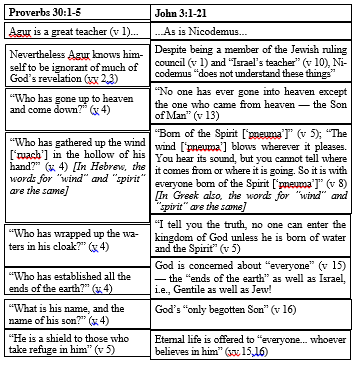
Surely, if and when Nicodemus remembered the passage from Proverbs 30, he would have reflected on its parallels in what he had heard. He would come to realize more fully that, in speaking to the rabbi Jesus, he was dealing with One who had an extraordinary relationship with the Lord of the entire Universe, and thus One who could truly claim to be the Messiah.
 The Origin of the Organic World – Part One