
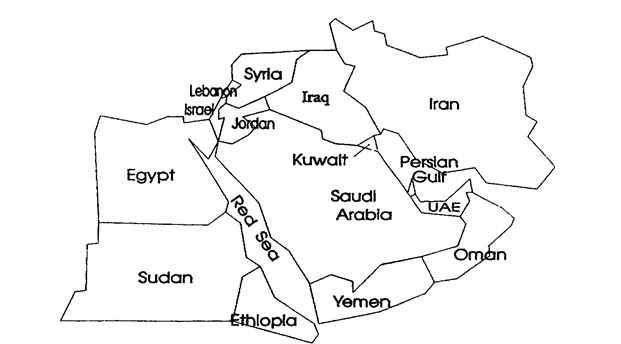
Once again, the iconoclastic leader of Iraq has been playing a cat and mouse game with the coalition forces. Tensions have been raised over ground to-air missiles placed in the no-fly zone south of the 32nd parallel in Iraq. While these maneuvers have captured the attention of the world’s press, Iraq’s eastern neighbor, Iran, has been quietly and systematically developing a powerful military machine. Iran’s moves could prove far more unsettling to the area than anything Iraq can do.
Russian equipment
It should come as no surprise that the new military might amassed by Iran has been purchased from the cash-starved Russian government. Sitting on proven oil reserves that are over 40 billion barrels, Iran can easily afford purchases of vast quantities of military equipment.
The New York Times, January 10, 1993, reports that recent Iranian purchases include ICBMs, fighter planes, nuclear technology and scud missiles as well as shipment loads of light weapons and ammunition. Perhaps most threatening, however, has been the major new purchase during 1992 — a new submarine fleet.
Submarines
The Wall Street Journal, November 16, 1992 reports, “The first of an unspecified number of ‘Kilo’ class submarines being purchased by Iran was delivered this month. The submarines will be based on the Straight of Hormuz, the crucial bottleneck through which 12 million barrels of oil pass daily. That oil accounts for roughly a third of the industrial world’s needs.”
The article continued, “The Kilo is a diesel-electric sub that is very quiet and relatively easy to maintain. It is the sum of many hard lessons learned by the former Soviet navy as it struggled through four accident-plagued decades to master the difficult, costly art of running the world’s largest submarine fleet.”
Iranian leaders have said the Kilos will be based 250 miles east of the strait, at Chah Bahar. From there, they will prowl the deeper waters of the Gulf of Oman and the Arabian Sea. This represents a major shift in Iranian strategy. In the early 1980’s, Iran used mines and small gun ships in a vain bid to block the flow of oil tankers navigating the strait. A former Royal navy frigate commander was quoted as saying, “A submarine like that can’t be swept away as easily as a gun ship or mines. It changes the equation very significantly. If a similar conflict arose in the near future, the Kilos would raise the ante.”
Submarines are detected by pulses of sound, called sonar, or by passively listening for the sub’s own noise. But the Kilos are quieter than nuclear subs and sound waves can be deflected by thermal layers where currents of cold and warm water meet. “If you take the Mediterranean and make it more difficult to hunt in, you have the Gulf of Oman,” said James McCoy, Royal Navy frigate commander.
Iran and Sudan
In the Tidings for March, 1992, we reported a developing alliance between Sudan and Iran. At the time, benefits from the alliance seemed one-sided. Sudan is annually provided with 3.4 million barrels of oil and $23 million (US) in light weapons, ammunition and military uniforms. The only apparent benefit to Iran was permission to implement the full Islamic law nationwide for the first time in Africa. Upon further review, however, the agreement is seen to be far more extensive than initially reported.
The Toronto Globe and Mail reports that members of Iran’s elite Revolutionary Guards are training approximately 85,000 members of Sudan’s Popular Defense Force. Aspects of the training include land, air and naval combat. In addition to the presence of its military personnel, Iran is now allowed to patrol the skies and territorial waters of Sudan.
This alliance puts Iran in a very enviable position for its new naval forces. Once trained and at full strength, Iran and Sudan could virtually control two very important naval highways — the Persian Gulf and the Red Sea. Every day, one half of the world’s oil supply flows along these two waterways. There is in this situation a staggering potential for disrupting the economies of Japan and the West.
Bible prophecy
Ezekiel 38:5 indicates that ancient Persia, Ethiopia and Libya will be working together toward a common goal of destroying Israel. Modern Iran encompasses ancient Persia and today’s Sudan occupies the area of ancient Ethiopia (Tidings, March, 1992).
An interesting scenario is before us. If Iran continues to increase its military strength south of Israel, it would entrap the Jewish nation in the event of an invasion from the north. If an attack from the north were to occur today, Israel, like any nation, would defend herself at all costs. When all seemed lost, she would flee to the south. If Iran controls areas south of Israel, that option will be cut off. Israel will then be left with no alternative but to turn to the one force which can truly deliver her from all trouble — the God of Israel.
The pieces of the puzzle are being put into place by the hand of God Almighty. We pray and watch for that great day of his Son’s appearing when His ancient purpose will reach its final consummation.
 The Origin of the Organic World – Part One