
[From numerous conversations and letters, it is evident the following opinion has gained considerable credibility in the brotherhood. We have decided to print the best available summary of arguments in favor of this idea. A refutation of this view will appear next month, God willing.]
Will a final Arab-Israeli war result in a devastating defeat for Israel? And will such a defeat (Ezekiel 38-39 notwithstanding) be the last defeat for Israel before the return of Christ? I believe that both of these questions can be answered in the affirmative as the following will show.
First of all, there are numerous prophecies that speak of an Arab-Israeli conflict in the last days. The attached table concentrates on seven such passages:
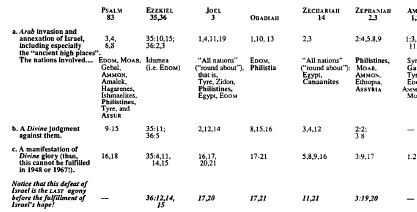
What is significant about these seven (and several others could be added) is the remarkable similarity amongst them:
- Each pictures an Arab attack upon Israel. While it is true that Psalm 83 does not actually say that this attack will succeed, all of the other six do say so (consider Ezk. 35:5,15; 36:2-5; Joel 3:2,3,5-7; Obad. 10-14; Zech. 14:1,2; Zeph. 1:2,3 and Amos 1:3,6,9,11,13). And thus they supplement Psalm 83’s lack on this one point.
- There is an amazing conformity as to the nations named in each of the seven prophecies: Psa. 83 lists the most nations (ten in all: cp. Gen. 15:18-21 and perhaps Dan. 7:7 and Rev. 12:3; 13:1; etc..). But four of those ten (Edom, Moab, Ammon and the Philistines) figure in almost every other of the seven passages. These names closely correspond to Jordan and the Palestine Liberation Organization who have, at least according to their view, been dispossessed of their territory by an expansionist Israel.
- In two of the prophecies (Joel 3 and Zechariah 14), the phrase “all nations” occurs. This has led some to suppose (mistakenly, I believe) that these passages are parallel to Ezk. 38-39 and describe a mammoth Russian-led coalition from Europe and Asia and indeed (through perhaps the United Nations) from virtually all nations on the face of the earth. This misconception arises, I think, from two causes:
(a) failure to appreciate the reasonable limitations, in the Bible, of such all-inclusive language (run your finger down the usages of “all” in the concordance!); and
(b) failure to consider the context: whereas Joel 3:2 and Zech. 14:2 both use “all nations,” Joel 3:11 and Zech. 14:14 modify that phrase to mean “all nations round about.” Furthermore, as the chart shows, Joel 3 and Zechariah 14 actually name only Arab nations in the Middle Eastern area. - Considering some of the nations involved (see #2 above), it is evident that the Arab nations will fight Israel once again in order to reclaim their land, which they believe to have been stolen from them. But, even more precisely, Psa. 83 and Ezk. 36 state their objective to be the reclamation of the ancient high, or holy, places (36:2) – or the “houses of God” (83:12). Most likely, this means especially the ancient Temple mount, where now stands the Moslem Dome of the Rock. It is interesting that, though they are but a small minority in Israel, certain fanatically religious Jews are bent on the destruction of the Moslem “abomination” and the subsequent erection of a new Jewish temple on its former site. Will some such act be the spark that sets off the final Arab-Israeli conflagration?
- Each of these seven passages predicts a manifestation of Divine glory to defeat Israel’s conquerors and to reveal the true God of Israel to all men. True, it may be argued that – in a fairly vague way – such prophecies have already been fulfilled (in some cases, in Old Testament times; in other cases, perhaps in 1948 or 1967). (And it is agreed that many Bible prophecies, of course, have more than one fulfillment.) But surely such language as the following is intended also to describe, in the final and most perfect fulfillment, the arrival in glory of the Lord Jesus Christ and the establishment of his Father’s glorious millennial kingdom:
“That men may know that thou, whose name alone is Jehovah, art the most high over all the earth” (Psa. 83:18).
“The LORD also shall roar out of Zion, and utter his voice from Jerusalem; and the heavens and the earth shall shake…So shall ye know that I am the LORD your God dwelling in Zion, my holy mountain” (Joel 3:16,17).
“But upon Mount Zion shall be deliverance…and the kingdom shall be the LORD’S” (Obad. 17,21).
Such verses as these prove that we are dealing here with last-days prophecies. - Whereas most of the nations enumerated are the immediate neighbors of Israel (Syria, Lebanon and Egypt being added to Jordan and the PLO), Psa. 83:8 also mentions Assur (or Assyria: cf. Zeph. 2:13) in a very important role:
“Assur also is joined to them; they have helped the children of Lot [i.e. Moab and Ammon].”
Coming at the end of the list, Assyria might seem no more than an afterthought. But might it not be rather that Assyria is by far the most important of the military powers arrayed against Israel? The verse may even imply that what had been threatened before, but never achieved, is finally made possible through the invaluable assistance of Assyria. Thus, what Moab and Ammon (Jordan) have been unable to accomplish – when helped merely by Syrians and Egyptians and Palestinians – they at last accomplish with the intervention and help of the greater power from the northeast.
And this is in keeping with the facts of history also. The early history of the nation of Israel contains several incidents in which David and Jehoshaphat, among other kings, defeated their immediate Arab neighbors and even expanded into their territory (II Sam. 5:8; 10; 12; I Chron. 11; 18; 19; 20; II Chron. 20). But, later, when first Assyria and afterward Babylon came from further to the east, and joined themselves to these same Arab nations, then at first most and at last all of Israel and Judah (including Jerusalem) fell.
It may be suggested that we are in the midst of another fulfillment of this same sequence. It is true that in 1948 and 1956 and 1967 and 1973 Israel has defeated her closest Arab neighbors and has extended her dominion into their lands. And this Israeli supremacy has become so much a part of Christadelphian “legend” and “lore” that many now find it unthinkable that the “clever” Israelis could ever lose to the “bumbling” Arabs. But events may prove this hope to be as vain as Hananiah’s (Jer. 28), that Jerusalem would never fall to Nebuchadnezzar. History -divine history tells us that what Jordan and Egypt could not do on their own, Assyria and Babylon could help them to accomplish!
It is surely most extraordinary that the modern nation occupying the ancient land of both these Old Testament “superpowers” should have by far the largest and best-trained military in the Middle East, and a leader bent on expansion, headship of all Arabs and absolute elimination of all Jews. I am referring, of course to Iraq and Saddam Hussein. It remains to be seen, at this writing, how his confrontation with America will play itself out. But experts state that, even if Saddam Hussein is deposed or assassinated, his potential successors would make him look like a “Boy Scout”! So anything less than the total liquidation of Iraq and its war machine would leave in place, especially from Israel’s perspective, the frightful specter of an enormous Arab confederacy led against their country by the latter-day successor of Babylon and Assyria.
Will Saddam Hussein survive his current crisis to fight, another day, against Israel? If he does, then it must be noted that the passion of his life is to see himself as the spiritual successor (one might almost say “reincarnation”!) of king Nebuchadnezzar of Babylon, who forged a huge empire spanning the Middle East, and whose crowning achievement was the destruction of Jerusalem. So much has this vision consumed Saddam that he has begun a massive archaeological reconstruction of ancient Babylon, and that he has had pictures taken of himself standing in one of Nebuchadnezzar’s war-chariots. Is it amusing, or spine-chilling, that in modern Iraq the artists’ portrayals of Nebuchadnezzar look eerily like Saddam himself?
7) Notice that this defeat of Israel by Moslem/Arab nations is plainly marked out (in five of the seven selected passages) as the very last defeat of Israel before an extraordinary fulfillment of Israel’s hope:
“Neither will I cause men to hear in thee [i.e. the mountains of Israel] the shame of the heathen any more, neither shalt thou bear the reproach of the people any more” (Ezk. 36:15).
“Then shall Jerusalem be holy, and there shall no stranger pass through her any more” (Joel 3:17).
“There shall be no more utter destruction” (Zech. 14:11).
In contrast with these seven prophecies, Ezk. 38-39 has an almost totally different cast of characters. These are by and large an outer ring of Moslem nations encircling the inner ring listed in Psa. 83, etc. Does this not suggest that the fulfillment of Ezekiel’s vision should be relegated to the time immediately after Christ’s kingdom is established? (Note the relevance of “dwelling safely” in Ezk. 38:8,11,14 – compared with Ezk. 28:25,26; 34:25,28; Zech. 14: 11; Jer. 23:5,6.) And does it not therefore drastically limit the effect of Gog-Magog’s attack upon Israel?
8) It was stated at the outset that numerous other passages fit into this same framework: i.e. of a final Arab-Israeli war resulting in defeat for Israel, and that such a defeat will be the very last suffered by Israel before her deliverance by Christ at his return. Some of these are Psalm 60; Isa. 13 – 23; Isa. 34; Jer. 25; Jer. 44-51. While some contain prophecies which have received a first fulfillment, the pattern of history suggests a repeat of what has gone before.
Such details are fascinating, in light of recent events; they should compel us to keep our minds open, in the days ahead, to what are for many of us exciting new possibilities. We should “watch Israel,” and we should “watch Israel’s neighbors” too! (Did not Jesus counsel us to “behold the fig tree, and all the [other] trees” too?)
And we should cultivate minds which (no matter what we think we already know) remain willing to be taught further by the Bible and by unfolding events. Surely none of us has all the answers yet!
Finally, we all need to be alertly watching and constantly praying (particularly for the peace of Jerusalem). And especially should we “lift up our heads” in faith and hope and eagerness, “for” – as surely as day follows night, and that rapidly – “our redemption draweth nigh”!
 The Origin of the Organic World – Part One