
“Enoch walked with God” (Genesis 5:24) . A faithful lifetime in a few words. The first article in this series concluded with reference to “walking with God”. That is, close personal daily relationship with Him in Christ, “this is life eternal” (John 17:3) ; utter dependence on Him to “give us this day our daily bread”, rather than the trust in materials that the world’s increase in knowledge has placed in our hands.
It is possible to accept the truth of the Gospel in the same way as we might accept, for instance, the theory of relativity. This technological age may have conditioned us to acceptance of this nature. If that is so then one will have knowledge, but may not have “the love of Christ which passeth knowledge” (gnosis) Eph. 3:19. Warm affection for the Father, with whom we have received adoption in Christ, may not, in reality, be felt. The mercy of God to a miserable sinner may not be appreciated.
The Publican (Luke 18:10-14) went down to his house justified, but the Pharisee did not. Why was this? The Pharisee had learnt the Law by the soul-less repetitive method of memorising words, which had entered ear and eye but had, in a manner of speaking, been kept standing before the unopened door of his heart. “The law entered that the offence might abouna” (Rom. 5:20), or in other words, “That sin by the commandment might become exceeding sinful” (Rom. 7:13) . The haughty attitude of the Pharisee was proof positive that he did not fully know the law. Conversely, the “Lord merciful to me a sinner” of the publican was clear evidence that he had full knowledge of his state.
“The letter killeth but the spirit giveth life” wrote Paul to Corinth (2 Cor. 3:6) . The Pharisee had only learnt the letter of the Law, but in spirit was still in darkness. Awareness of personal guilt is a prerequisite to justification. This ability to see ourselves as we really are, will not come through merely learning words or acquiring knowledge, rather conversely is the effect. “Knowledge (gnosis) puffeth up” (1 Cor. 8:1) . The words must be inwardly digested, meditated upon, prayed about and applied to the practicality of living.
There are those who have taken an extreme view in relation to knowledge. They have said in effect that having been baptised there is no further need to delve into the intricacies of the Bible. Some, however, may have been put off by the arrogance of some of those who claim to know. Realisation is only possible if we apply ourselves diligently, and so those who elevate knowledge for its own sake, and those who avoid learning more about our Father and His work in Christ Jesus, will both, we suggest, risk adopting the Pharisee’s attitude.
We have heard the word ‘study’ in 2 Tim. 2:15 taken as reference to the act of learning; this is quite wrong. The R.V. has it “give diligence”, the R.S.V. “do your best”, and the N.E.B. “try hard”: In other words “do your best to please God”. It exhorts to action after the preparation of the mind by the word. One can only find favour with God through saying and doing. Filling our minds with His Law without subsequent repentant action will merely increase our responsibility to judgment. To one sinner Jesus said: “Go and sin no more” (John 8:11) . Morality then, is a development arising out of true repentance and humility before God. The immorality of this age, can be traced to man’s rejection of God. The theory of evolution has excluded the possibility of a great judge in the heavens. As a body we are not unaffected by this. An outburst like “Lord be merciful to me a sinner” is an unlikely cry for many today. It is possibly due to the blame that we attribute to our ‘filthy flesh’ rather than to our own infidelity.
Are we resigned in our mind that the flesh, or whatever we mean by this word, is so depraved that it cannot manifest divine attributes like love, joy or peace? Surely we are exhorted to yield our fleshly potential as “instruments of righteousness” (Rom. 6:13) . Surely the personality chastised by the “Word” will blossom beautifully. Isn’t this what is meant by being “transformed by the renewing of your mind”? (Rom. 12:2); that we might conform to Jesus the “altogether lovely” (Song. 5:16). If we fall “we have an advocate with the Father, Jesus Christ the righteous” (1 John 2:1) . The resignation of the mind to the innate sinfulness of man’s nature, will have considerable bearing on our attitude and conduct. “Sin is the transgression of the Law” (1 John 3:4).
Can we talk about a sinful left finger or a sin contaminated right ear? How then can we use the word “sinful” as an adjective for our natural constitution? But maybe some will object to this definition of what they mean — if this is so, let them reflect that confusing and cloudy use of language on their part may be causing misunderstanding.
During the first century a school of thought developed in the ecclesias that, we believe, unwittingly promoted immorality. It was known as Gnoticism taken from the Greek word “Gnosis”, which is represented by our English word “knowledge”. They promulgated the view that the creation was evil, being the work of Demiurge (Creator God) who had fallen from grace with Divine Being (Supreme God) . The logical extension of this theory was that evil practice by the human race was inevitable. In effect this idea insisted that humanity is “unclean of itself” contrary to Romans 14:14 and the spirit of Acts 10:14-15.
The Present Emergency
There is in the body today an atmosphere of thought that has tendencies not dissimilar to those of ancient Gnosticism. While the modern philosophy does not state that the creation was bad, it does insist that the sons and daughters of Adam are born with a physically defiled constitution and are the subjects of God’s wrath on this account, before they sin. The implication of this theory, where the sacrifice of Christ is concerned, who bore our nature (Heb. 2:14) is clear; he was wounded and bruised for physical, sinful nature, his and ours, rather than OUR PERSONAL TRANSGRESSION AND INIQUITY contrary to Isaiah 53:5.
The wrath of God falls upon those who disobey Him and whose sins are not covered (Eph. 5:6) . Christ “suffered for sins, the righteous for the unrighteous” (I Pet. 3:18 RV) . The Gnostics were largely responsible also for the apostacy that resulted in the collapse of the first century ecclesial structure. We are certain that if unchecked the error of today will result in a like tragedy.
One of the principle reasons for the publication of “The Believer” is to try, in the mercy of God, to hold the parts together, today. In this activity we may appear partisan, taking sides that is. However, this is farthest from the writer’s thought.
We compare below some of the characteristics of first century Gnoticism and what appears to be its 20th century counterpart.
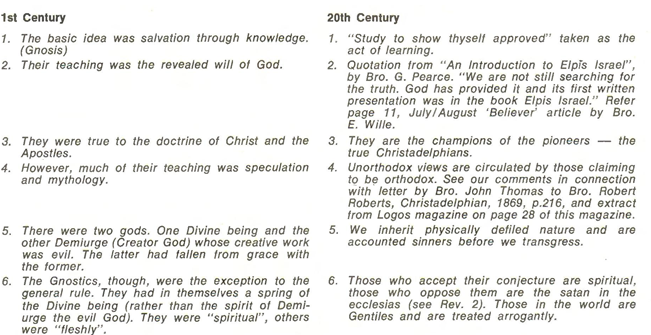
It is the writer’s view, shared by not a few, that the attitudes in the body today that seem to identify with the ancient Gnostics and which finds support in the pages of the Logos magazine, is a principal cause of disunity. Many of our assemblies once warm are now cold and un-neighbourly and visitors come and go unnoticed. We know some who have left the truth and others who have seriously considered it. (See Editorial page 1, July/Aug. Believer.)
As the day of our Master’s return draws near, what must He be thinking as he looks upon our irreligious disharmony? Surely we have not so learned Christ. The Father looks upon us as individual members of the body of His Son. This personal aspect of God’s relation with man cannot be overstated, and personal devotion is a growing need in our body. The parables of the prodigal son and the lost lamb can be multiplied.
Worldly trends have not helped us. Mass media, group tuition, more recently by closed circuit television, have tended to impersonalise us. We have to some extent become numbers. This generation has seen the growth in the body of Bible Schools where the very term “School” implies that there are teachers and those taught. Where the personality of the teachers is built into an authoritative image, there is a perfect setting for the uncritical group acceptance of what may be only personal opinion. We do not say that all who attend Bible Schools are so affected, but the dangers are there where personal vigilance is absent. Blind acceptance of powerful personalities and their words is sponsored by some (refer quotation Logos 1971 and reference to Elpis Israel page 170 on page 8 of this issue) .
Individually we need to “hold a straight course in the word of truth” (2 Tim. 2:15 A.V. margin) , like the helmsman of a ship. This is our personal duty. Unless we follow this procedure we might become like the proverbial junk shop that takes anything in. It is very easy to leave our personal investigation to those who labour in the word giving them “double honour” (1 Tim. 5:17) . But we cannot place the responsibility of our tuition on the shoulders of others. The apostasy arose our of such mental laziness. It behoves us to hold fast that which we have “that no man take (our) crown” (Rev. 3:11).
Unity is a necessity so that others may be invited to share our glorious hope. Jesus prayed for us “that they all may be one; even as thou, Father, art in me and I in thee, that they also may be one in us: that the world may believe that thou hast sent me” (John 17:21) . Unity can only be developed through individuals who have a personal appreciation of the “Love of Christ that passeth knowledge” (Gnosis) (Eph. 3:19) . By adding to our knowledge “Temperance – patience – Godliness – brotherly kindness and charity”, we shall “neither be barren nor unfruitful in the knowledge of our Lord Jesus Christ” (2 Pet. 1:6-8) .
We appeal to all to pray for our Father’s blessing on every endeavour to produce that maturity through unity, spoken of by Paul to our Ephesian Brethren and Sisters, “till we all attain unto the unity of the faith, and of the knowledge of the Son of God, unto a full grown man unto the measure of the stature of the fullness of Christ” (Eph. 4:13 R.V.) .
Yes, knowledge has been increased. We return in conclusion to the context from which this theme was chosen in Daniel 12. We are referred to the return of Michael the great prince, of the deliverance of everyone found written in the Book, of the resurrection and judgment. Wisdom is equated with the saving of others. “And they that be wise shall shine as the brightness of the firmament; and they that turn many to righteousness as the stars for ever and ever”.
 The Origin of the Organic World – Part One